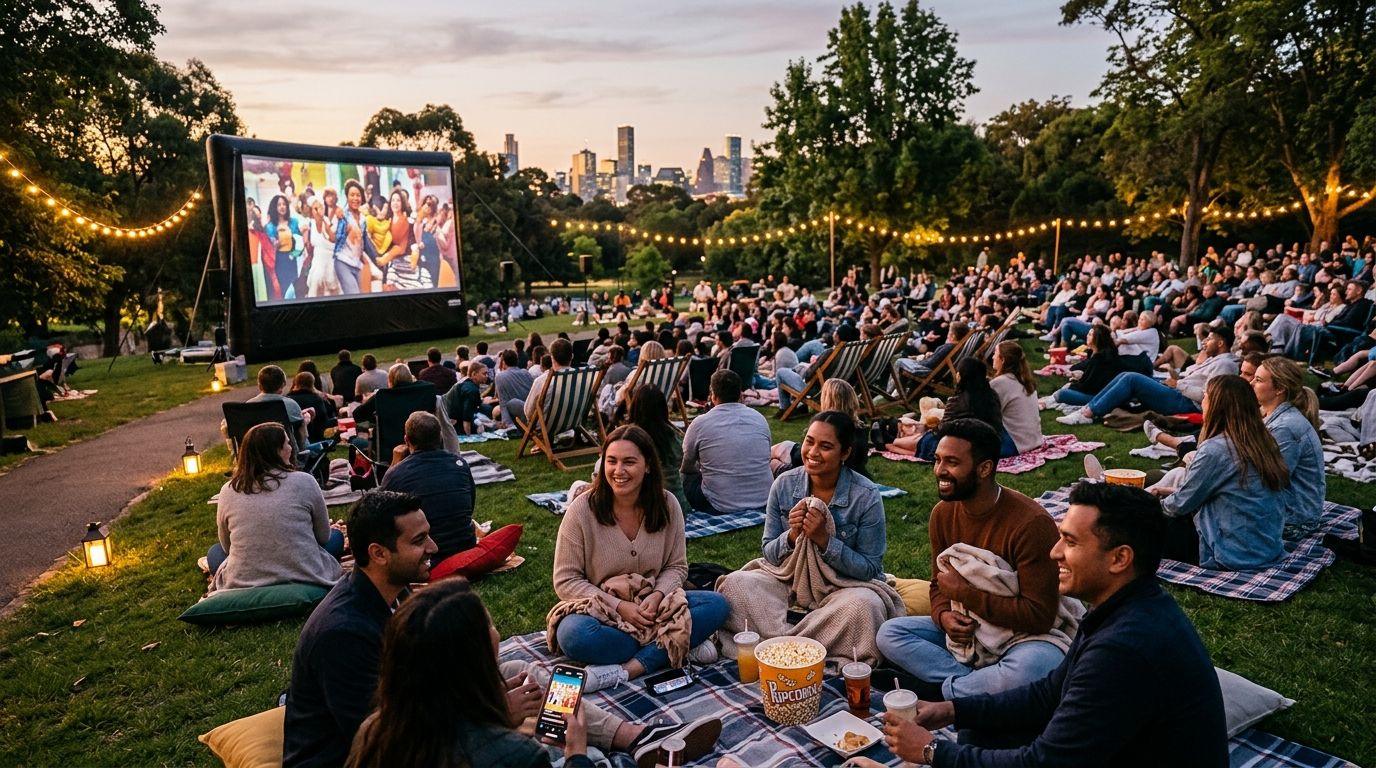
Pop-up and outdoor cinema events run on a compressed sales window — often 3-6 weeks from location reveal to last screening — so paid media has to build demand fast, not build a brand over months. Unlike a venue with year-round footfall, an outdoor cinema season lives or dies on hitting occupancy before the final showing, with weather risk and one-off site costs sitting behind every unsold ticket.
- Paid media for outdoor cinema events works best when spend is phased around the location reveal, not spread evenly across the season.
- Retargeting warm audiences converts pop-up browsers into bookers faster than cold prospecting on a 3-6 week sales window.
- Google Search Ads capture high-intent, location-specific searches that Meta and TikTok miss entirely.
- Waitlist and SMS campaigns recover sold-out demand without extra ad spend in 2026.
Why paid media matters for pop-up and outdoor cinema events
A fixed venue can rely on repeat visits and organic search to fill quiet weeks. A pop-up cinema has no history at that location and often no permanent listing — every ticket has to be won inside a short window, usually one summer season or a single festive run.
That changes the media mix. Brand-building channels that pay off over a year are the wrong bet when the last screening is six weeks away. The paid media that wins for outdoor cinema events is built around urgency, location proof, and fast retargeting loops, not slow-burn awareness.
Three structural facts drive the strategy:
- Weather-dependent demand means bookers often decide within 48-72 hours of a forecast, not weeks in advance.
- A pop-up has no search history at that site, so paid search and paid social carry the full weight of discovery.
- Occupancy targets are fixed per screening — a half-empty outdoor cinema costs the same to run as a sold-out one.
FullyBooked works with experience operators facing exactly this shape of problem: short runs, fixed capacity, no second chance at the date.
Update your campaign timeline around the location reveal
Most operators launch paid media too early, spending against a date with no confirmed line-up or venue photography. Sequence spend instead:
- Teaser phase (1-2 weeks pre-reveal): low-spend awareness ads to build a retargeting pool.
- Reveal phase (launch week): heaviest spend, location and film schedule confirmed, urgency messaging live.
- Sell-through phase (weeks 2-5): retargeting plus Google Search Ads on branded and location terms.
- Last-chance phase (final week per screening): scarcity messaging, countdown creative, waitlist activation.
The pop-up experience marketing approach applies directly here — pop-up cinema is a subset of the same limited-run problem every seasonal experience operator faces in 2026.
Build a paid social funnel that sells the location, not just the film
Outdoor cinema tickets sell on setting as much as programming. A rooftop screening in Manchester and a country estate screening in Kent are different products even with the same film on the bill.
- Lead with location photography and site atmosphere in top-of-funnel creative, not poster art.
- Run separate ad sets per site if you operate more than one location — audience intent differs by postcode.
- Use video over static; outdoor cinema is an atmosphere sell and static images undersell the setting.
- Test picnic-and-blanket lifestyle creative against film-poster creative for first-time bookers.
- Cap awareness spend once a screening passes roughly two-thirds capacity and shift budget to the next date.
Use retargeting to convert browsers into bookers
A visitor who viewed your ticket page and didn't buy is your highest-value audience for the rest of the season. Cold prospecting on a 3-6 week runway burns budget that retargeting recovers at a lower cost per ticket.
- Build a 14-day website retargeting audience segmented by screening date viewed.
- Serve countdown creative ("3 days left for Friday's screening") rather than repeating the launch ad.
- Layer in a checkout-abandonment sequence for anyone who started booking and stopped.
- Exclude everyone who already booked so you stop paying to reach converted bookers.
The mechanics sit in more detail in retargeting ads for event ticket sales — the same logic applies whether the event is indoors or on a lawn under a screen.
Add Google Ads for high-intent, location-specific searches
Someone searching "outdoor cinema near me" or "outdoor cinema 2026" plus a town name is closer to booking than anyone scrolling social. Pop-ups skip this channel more than any other segment, because there is no permanent listing to anchor a campaign around.
- Bid on branded terms plus location-plus-category variants for every site you run.
- Use location and sitelink extensions pointing at individual screening dates.
- Run Performance Max only once you have enough site photography and ticket-page assets to feed it.
- Pause search spend the moment a screening sells out so you stop paying for clicks with nothing to sell.
Get a paid media plan for your season
Talk to FullyBooked before your next location reveal goes live.
Fix your no-show rate before you scale spend
Weather-dependent outdoor events lose seats to no-shows that indoor venues keep. Every no-show is paid media spend that produced a ticket but not an attendee, and scaling budget on top of a leaky no-show rate inflates cost per attendee rather than cost per ticket.
- Send reminders 48 hours and 4 hours before each screening.
- Offer a reschedule option on marginal-weather dates instead of losing the booking outright.
- Track no-show rate by screening and by acquisition channel — some paid channels bring lower-intent bookers.
- Feed no-show data back into bidding so you optimise toward attendees, not just checkouts.
The retention side of this is covered in how to reduce no-shows for ticketed events.
Build a waitlist for sold-out screenings
Good-weather dates sell out fast, and every sold-out screening generates demand you can recycle with no extra ad spend.
- Capture email and mobile via a waitlist form the moment a screening hits capacity.
- Push new or added dates to the waitlist first, before any paid announcement.
- Use waitlist volume as proof-of-demand creative for the next site or the next season.
See waitlist marketing for a sold-out event for the full sequence.
Measure cost per ticket, not cost per click
Paid media for outdoor cinema events gets judged on seats filled per screening. The only number that matters at season close is cost per ticket against average ticket value.
- Track cost per ticket by campaign and by screening date, not just by platform.
- Set a hard cost-per-ticket ceiling before launch.
- Cut spend on any date that breaches the ceiling two screenings running and move the budget forward.
Comparison: paid media options for pop-up and outdoor cinema events
| Option | Best for | Key limitation |
|---|---|---|
| Meta and Instagram ads | Location-led awareness and retargeting through the reveal phase | Weak on last-minute, high-intent search demand |
| Google Search Ads | Capturing bookers already searching a town plus outdoor cinema | Needs real landing page content per date to perform |
| TikTok paid and organic | Younger audiences and shareable atmosphere content | Slower to convert directly into ticket sales |
| Influencer seeding | Proof-of-atmosphere content ahead of a location reveal | Hard to attribute to individual ticket sales |
| Email and SMS to past bookers | Fast fills on newly added dates from a warm list | Only works once a database exists from a prior season |
“Every screening date is its own micro-campaign. Treat the season as one flat push and you will overspend on the dates that were always going to sell.”
Common mistakes pop-up and outdoor cinema operators make
- Launching paid media before the location is confirmed. Ads with no address and no site photography convert far worse than reveal-phase creative.
- Spreading spend evenly across the season instead of concentrating it on each reveal and each last-chance window.
- Skipping Google Search Ads because the event has no permanent listing, handing high-intent searches to competitors running all summer.
- Building the retargeting pool too late, so the cheapest audience of the entire campaign never gets used.
- Treating no-shows as purely a weather problem, when reminder sequences and reschedule offers recover a meaningful share of those seats.
FAQ
What is the best paid media channel for outdoor cinema events?
Google Search Ads on location-specific terms combined with Meta retargeting perform best for outdoor cinema events in 2026. Together they capture both high-intent searchers and warm browsers inside a short sales window.
How far ahead should paid media start for a pop-up cinema launch?
Start a low-spend teaser phase 1-2 weeks before the location reveal, then move to heaviest spend the week the reveal goes live. Waiting until close to the first screening wastes the retargeting window.
Is TikTok worth the spend for outdoor cinema marketing?
TikTok works well for atmosphere-led content and younger audience reach, but converts more slowly to direct ticket sales than search or retargeting. Use it to build the retargeting pool rather than as the primary conversion channel.
How do you handle weather cancellations in paid media?
Build reschedule messaging into ad and email sequences before the season starts so a cancelled screening becomes a rebooking rather than a refund. Reminders 48 and 4 hours out also cut no-shows on marginal-weather dates.
What is a good cost per ticket for a pop-up cinema campaign?
There is no universal figure because it depends on ticket price and site costs. Set a hard cost-per-ticket ceiling before launch and track performance by screening date, not just by platform.
Should every screening date get its own ad set?
Yes. Segmenting by date lets you cut spend on underperforming screenings and push last-chance creative on dates approaching capacity, instead of running one flat campaign across the season.
Does influencer seeding help sell outdoor cinema tickets?
Influencer content works best pre-reveal to build proof of atmosphere, but direct attribution is difficult. Pair it with retargeting so the awareness it creates gets converted rather than just viewed.
How do you recover demand once a screening sells out?
Capture waitlist signups the moment capacity is reached, then offer added dates to that list first. Sold-out proof also makes strong creative for the next location or next season.
One last thing
The operators who fill outdoor cinema seasons fastest reallocate budget within 48 hours, not at the end of the week. Moving spend off an underperforming Tuesday screening onto a Friday date approaching capacity does more for cost per ticket in 2026 than any creative refresh, and it costs nothing to do.