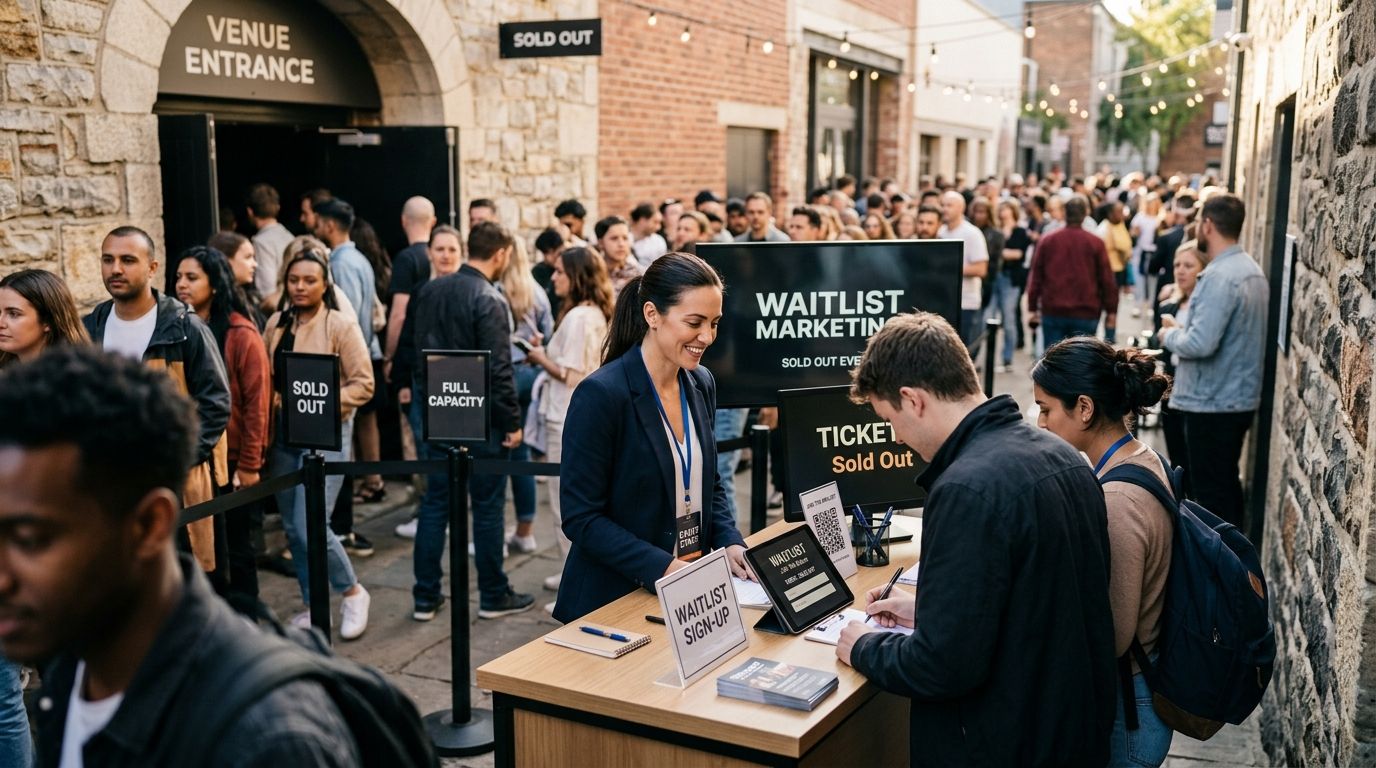
A waitlist marketing campaign for a sold-out event turns turned-away demand into a second wave of ticket sales: capture the people who missed out, keep them warm with targeted messages, then release freed-up inventory to them first when cancellations or extra capacity appear. The part most operators skip is the release mechanism — without a clear trigger for when and how waitlist names convert to bookings, the list just sits there as a vanity metric.
- A waitlist marketing campaign for a sold-out event needs three parts: capture, nurture, and a fast release trigger.
- SMS converts waitlist releases faster than email because sold-out fans check texts in minutes, not hours.
- FullyBooked treats a waitlist as a live retention channel, not a static form on a dead product page.
- Close waitlist recruitment 24 to 48 hours before doors and switch fully into release mode.
- A waitlist with no deadline becomes a wishlist — nobody acts on it.
Why this matters
A sold-out event is a demand signal, not a finished sales cycle. Every name on a waitlist is someone who already tried to pay you and got turned away — warmer than any cold audience a paid media campaign will reach in 2026.
Most venues and attractions treat "sold out" as the end of the marketing job. It's the start of a second, cheaper conversion cycle: no ad spend needed to convince someone who already wanted in, just a system to catch cancellations, upgrades or extra releases and put them in front of the right person within minutes.
How to run a waitlist marketing campaign for a sold-out event
Six steps, in this order:
- Capture at the point of failure. The moment someone hits "sold out" on your ticketing page, prompt them to join a waitlist with one field — email or phone, not both.
- Segment by urgency signal. Someone who tried three times to book is hotter than someone who joined from a social post. Tag them if your CRM or ticketing platform allows it.
- Nurture on a short cadence. One confirmation message immediately, then a check-in 48 hours before the event confirming the list is live and explaining what triggers a release.
- Set a hard release trigger. Decide in advance whether a cancellation releases automatically to the top of the list or whether your team approves batches manually. Automatic converts faster.
- Give a tight claim window. When a spot opens, give the contact a short window — commonly a few hours — before it passes to the next name or returns to general sale.
- Close the loop with non-converters. Anyone still on the list after the event becomes your warmest audience for the next date. Feed them into retention marketing rather than letting the list go cold.
FullyBooked runs this exact structure across the venues and events it manages, because a waitlist is one of the few channels where the audience has already self-selected as high-intent.
SMS vs email vs WhatsApp for the release trigger
Both nurture and release matter, but they don't want the same channel.
| Channel | Role in the campaign | Response speed | Best for |
|---|---|---|---|
| SMS | Release trigger | Minutes | Sold-out events with fast-moving cancellations |
| Nurture and pre-release warm-up | Hours to a day | Building anticipation before any spot opens | |
| WhatsApp broadcast | Two-way confirmation and urgency | Minutes | Venues with an existing opted-in list |
Verdict: run email for the nurture sequence and SMS or WhatsApp for the release itself. Email is too slow for a two-hour claim window. A text lands on a phone the booker is already checking because they're anxious about missing out twice.
If you don't already have phone capture in place, building a WhatsApp broadcast list needs to happen before the sold-out moment, not during it.
“A waitlist without a release deadline is just a wishlist.”
Why waitlist conversion varies
The gap between a list that converts and one that sits dead comes down to a handful of factors:
- Capture friction — a two-field sign-up form loses more people than a single tap-to-join button.
- Release speed — the longer the delay after a spot opens, the more likely the person has booked something else.
- Channel choice — email-only waitlists convert slower than lists with SMS or WhatsApp opt-in.
- Cadence between capture and event date — a list that goes silent for weeks loses recall.
- Clarity of the trigger — bookers need to know exactly what happens when a spot frees up, not just that they're "on a list".
- List size relative to inventory — 500 names for 10 freed spots needs tighter segmentation than 40 names at a small venue.
Should you charge a deposit to join a waitlist?
A deposit filters out low-intent sign-ups but shrinks total list size, so the call depends on whether you need volume or quality. High-demand one-off formats — a themed pop-up, a limited-run experience — benefit most, because a deposit-holder converts the moment a spot opens instead of leaving your team chasing non-responders through the final 24 hours.
Lower-demand recurring events are better off with a free, frictionless list. You want the volume, and you can afford the drop-off.
How long should a waitlist stay open before a sold-out event?
Close active recruitment 24 to 48 hours before the event and switch fully into release mode. Past that point, new sign-ups have almost no realistic chance of a seat, and a live form adds noise to a list your team is already managing under time pressure.
Keep the list itself alive after the event. Recruitment closes; the audience doesn't expire.
What's the difference between a waitlist and a retention list?
A waitlist is event-specific and time-bound; a retention list is ongoing and spans every event you run. Anyone who doesn't convert off the waitlist should roll into the broader list rather than being discarded — they've shown demand for your venue, just not for that specific date. That handover is where most operators leak the value they just built.
Which events justify a full waitlist campaign?
Not every sell-out needs the full six-step build. It's worth the setup when at least one of these is true:
- The event sells out more than 72 hours before doors, leaving time for a release cycle.
- Cancellations are common in your format, so inventory genuinely frees up.
- The event recurs, meaning the list carries forward instead of being rebuilt.
- Ticket value is high enough that a handful of recovered seats covers the admin time.
One-off events that sell out an hour before doors don't need a nurture sequence. They need a single SMS blast to whoever's already opted in.
Turn your next sell-out into a system
FullyBooked builds the capture, nurture and release flow for venues and events.
FAQ
What's the best channel for a waitlist marketing campaign for a sold-out event?
SMS or WhatsApp wins for the release trigger because response speed decides whether the seat gets filled. Email works better for the earlier nurture sequence, before any spots have opened.
How do you capture waitlist sign-ups when an event sells out?
Put a single-field sign-up prompt directly on the sold-out ticket page rather than sending people to a separate form. Fewer fields means a higher capture rate at the moment of highest intent.
Should a waitlist release tickets automatically or manually?
Automatic release converts faster because it removes the delay of a team member approving each name. Manual release only suits small venues handling a handful of names where personal follow-up adds value.
Is a waitlist better than running more paid ads to a sold-out event?
A waitlist is cheaper and converts faster because the audience already tried to book once. Paid ads pointed at a sold-out listing waste spend driving people to a page that can't take their money.
How long should the claim window be when a waitlist spot opens?
A short window, commonly a few hours, forces a decision and moves the offer to the next name if nobody responds. Longer windows let hot leads cool off or book something else.
What happens to people left on the waitlist after the event?
They move into your retention marketing flow rather than being dropped, because they've already shown demand for your venue. That group is usually the strongest converting audience for your next date.
Does a waitlist work for recurring events, not just one-off sell-outs?
Yes, and recurring formats like comedy nights or supper clubs are where it performs best, because the same demand pattern repeats. The list carries between dates instead of being rebuilt each time.
How much does a waitlist campaign cost to run?
The cost sits in messaging fees and setup time rather than media spend, since the audience is already captured. Compared with acquiring new bookers through paid media, it's the cheapest conversion path a venue has.
One last thing
Operators who get the most out of a waitlist marketing campaign for a sold-out event treat the list as reusable infrastructure, not a one-off patch for a single date. A well-run waitlist from an October sell-out becomes the seed audience for a December launch, and FullyBooked has built that loop across the 50+ operators it manages heading into 2026.
If the goal is filling every freed seat before it goes back to general sale, the fix usually isn't more ad spend. It's cutting the capture-to-release time on the system already sitting on your ticketing page.


