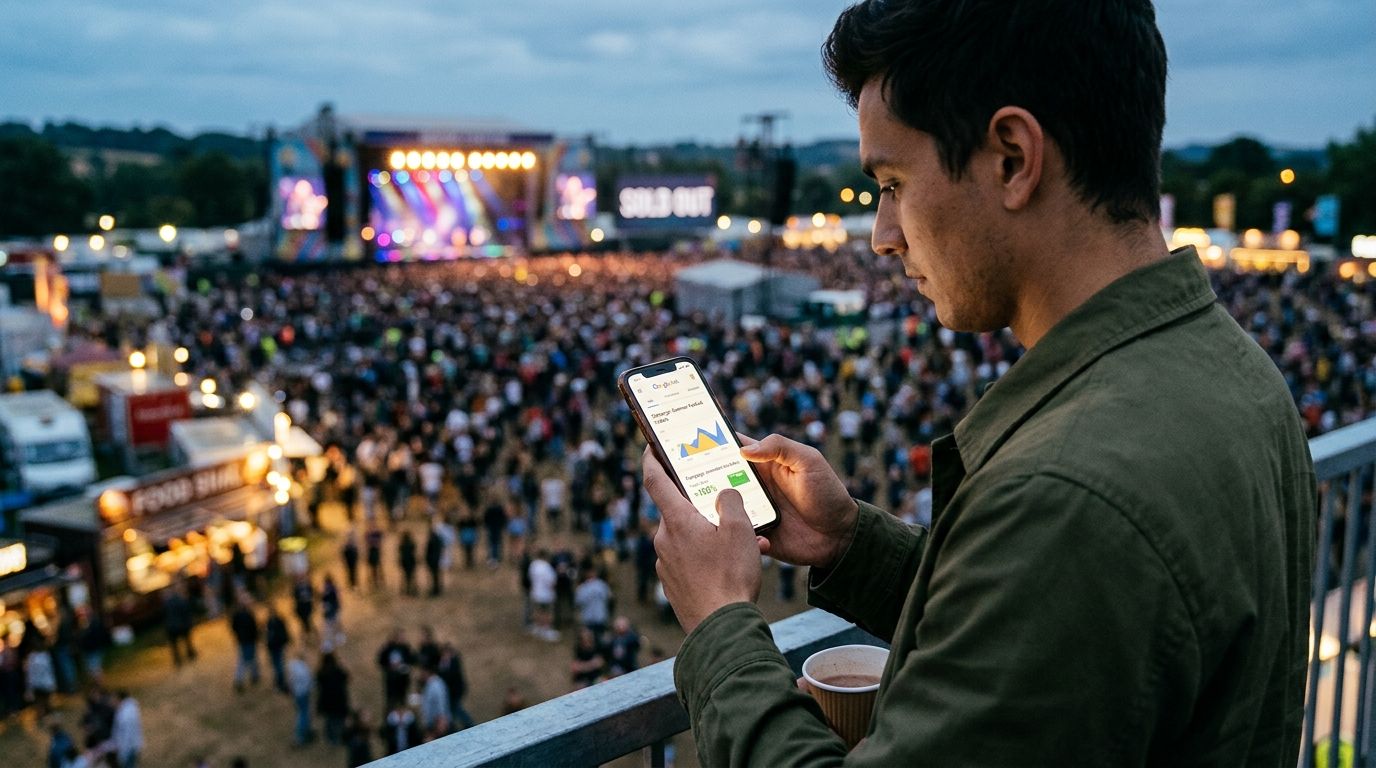
Google Ads sells event tickets when you split budget across intent-based Search campaigns, automated Performance Max campaigns and retargeting — not when you run one generic campaign and hope it converts. Venues that treat Google Ads as a single channel usually waste spend on broad keywords with no ticket-page landing experience behind them.
- Search campaigns catch people already typing your event or venue name — the highest-intent traffic you can buy.
- Performance Max spreads one campaign across Search, Display, YouTube and Gmail to fill unsold inventory.
- Retargeting ads recover visitors who viewed tickets but didn't buy — usually the cheapest conversions in the account.
- A dedicated ticket landing page, not the homepage, is what makes google ads sell event tickets at scale in 2026.
- FullyBooked structures paid media funnels for venues and events, not generic lead-gen accounts.
Why this matters
Most venues that try Google Ads on their own build one Search campaign, target a handful of broad keywords, and send every click to the homepage. That setup burns budget on people who were never close to buying and gives Google's algorithm nothing useful to optimise against.
The operators who consistently sell more tickets in 2026 run a layered account: Search for people actively searching, Performance Max to extend reach automatically, and retargeting to bring back the drop-offs. Each layer does a different job, and none of them work in isolation.
How do you use Google Ads to sell more event tickets?
- Build a dedicated ticket landing page — not the homepage. It needs the date, price tier, and a single buy button above the fold.
- Start with a Search campaign on branded and event-specific terms — your event name, venue name, and "[event type] near me" phrases convert fastest because intent is already there.
- Layer in Performance Max once Search is stable — it pulls the same landing page across Display, YouTube, Gmail and Discover without you building separate creative for each.
- Install conversion tracking on the ticket purchase event, not just page views — Google's bidding algorithm needs the actual sale signal to optimise spend correctly.
- Turn on retargeting for anyone who reached the ticket page without buying — this audience converts at a lower cost than any cold traffic you'll ever buy.
- Review search terms weekly in the first month — venues waste the most budget in week one before negative keywords get added.
Search campaigns: the fastest way to catch someone already looking
Search is where you catch someone who has already decided they want a night out and is comparing options. Keep match types tight around your event name, venue name, and category terms — a comedy club should bid on "[venue] tickets" and "comedy night [city]", not generic terms like "fun things to do".
Budget here should be small relative to the account but protected — this traffic converts at the highest rate because the buyer already has intent, they just need a fast path to checkout.
Performance Max: automate placement across every Google surface
Performance Max takes one set of assets — images, headlines, your ticket landing page URL — and places them across Search, Display, YouTube, Gmail and Discover automatically. For events with a fixed date, this is what fills unsold inventory in the two to three weeks before the event without building five separate campaigns.
The trade-off: less control over exactly where ads show. Feed it strong creative and a clear conversion goal, and let it run for at least two weeks before judging performance — Google's algorithm needs a learning period.
Retargeting: recover the tickets you almost sold
Anyone who lands on your ticket page and doesn't buy is your warmest audience. A retargeting campaign for event ticket sales built specifically around that drop-off audience usually outperforms cold Search traffic on cost per booking, because you're not paying to re-earn attention — you're paying to close a decision that's already half made.
Run retargeting continuously, not as an afterthought bolted on at the end of the month. It's the cheapest lever in a Google Ads account built to sell event tickets.
Want your Google Ads account audited?
FullyBooked builds paid media accounts for venues and events selling tickets in 2026.
Why results from Google Ads vary between venues
- Ticket price point — higher-priced experiences need longer nurture through retargeting; low-cost tickets convert faster off Search alone.
- Lead time to the event date — a one-off event with a fixed date needs a compressed, front-loaded spend curve; a year-round venue can run steady-state campaigns.
- Landing page conversion rate — the same ad spend produces wildly different results depending on whether the page loads fast and shows the buy button immediately.
- Seasonality — categories tied to holidays or weather see demand spikes Google Ads should be scaled around, not spread evenly across the year.
- Audience size in the local market — a venue in a dense city has more Search volume to capture than one in a small town, which shifts more budget toward Performance Max and Display.
- Whether conversion tracking is set up correctly — an account optimising toward the wrong goal (page views instead of purchases) will never perform, regardless of budget.
Is Google Ads or Facebook Ads better for selling event tickets?
Google Ads wins for capturing existing intent — people already searching for your event or venue — while Facebook and Instagram win for building awareness among people who haven't heard of you yet. Most venues running paid media in 2026 use both: Google Ads for the bottom of the funnel, social for the top.
How much of my marketing budget should go to Google Ads?
There's no fixed percentage that fits every venue — it depends on category, ticket price and how much of your audience is already searching by name versus discovering you cold. A marketing budget split built for attraction operators accounts for those differences rather than applying one ratio across every business type.
Do I need Performance Max if I already run Search?
Yes, if you have unsold inventory close to an event date — Performance Max extends reach across Display, YouTube and Gmail automatically, which Search alone can't do. Running Search only caps you to people already typing a query, and most of your potential audience never searches at all.
FAQ
Can Google Ads sell event tickets for a one-off event?
Yes — a compressed campaign structure with Search for intent and Performance Max for reach works well for single-date events, especially in the final two to three weeks before the date.
What's the best Google Ads campaign type for selling tickets?
Search campaigns convert best for people already searching your event or venue name, while Performance Max extends that same offer across Display, YouTube and Gmail to reach people who haven't searched yet.
Do I need a separate landing page for Google Ads traffic?
Yes — a dedicated ticket page with the date, price tier and buy button above the fold converts far better than sending Google Ads traffic to a general homepage.
How long before an event should I start running Google Ads?
Start Search campaigns as soon as tickets go on sale to build conversion data early, then scale Performance Max and retargeting in the final weeks before the event date.
Is retargeting worth running for event ticket sales?
Retargeting is one of the strongest levers in a ticket-selling Google Ads account because it targets people who already viewed the ticket page but didn't buy.
Should I run Google Ads and Facebook Ads at the same time?
Most venues in 2026 run both — Google Ads to capture existing search intent and Facebook or Instagram to build awareness among people who haven't heard of the event yet.
What's the biggest mistake venues make with Google Ads?
Sending traffic to the homepage instead of a dedicated ticket page, and tracking page views instead of the actual purchase event, which stops Google's bidding algorithm from optimising correctly.
One last thing
The single biggest lever most venues ignore isn't the campaign type — it's what happens after the click. An account with perfect Search and Performance Max structure still underperforms if the ticket page takes too long to load or buries the buy button below a hero video. Fix the landing page before you touch the bidding strategy.


