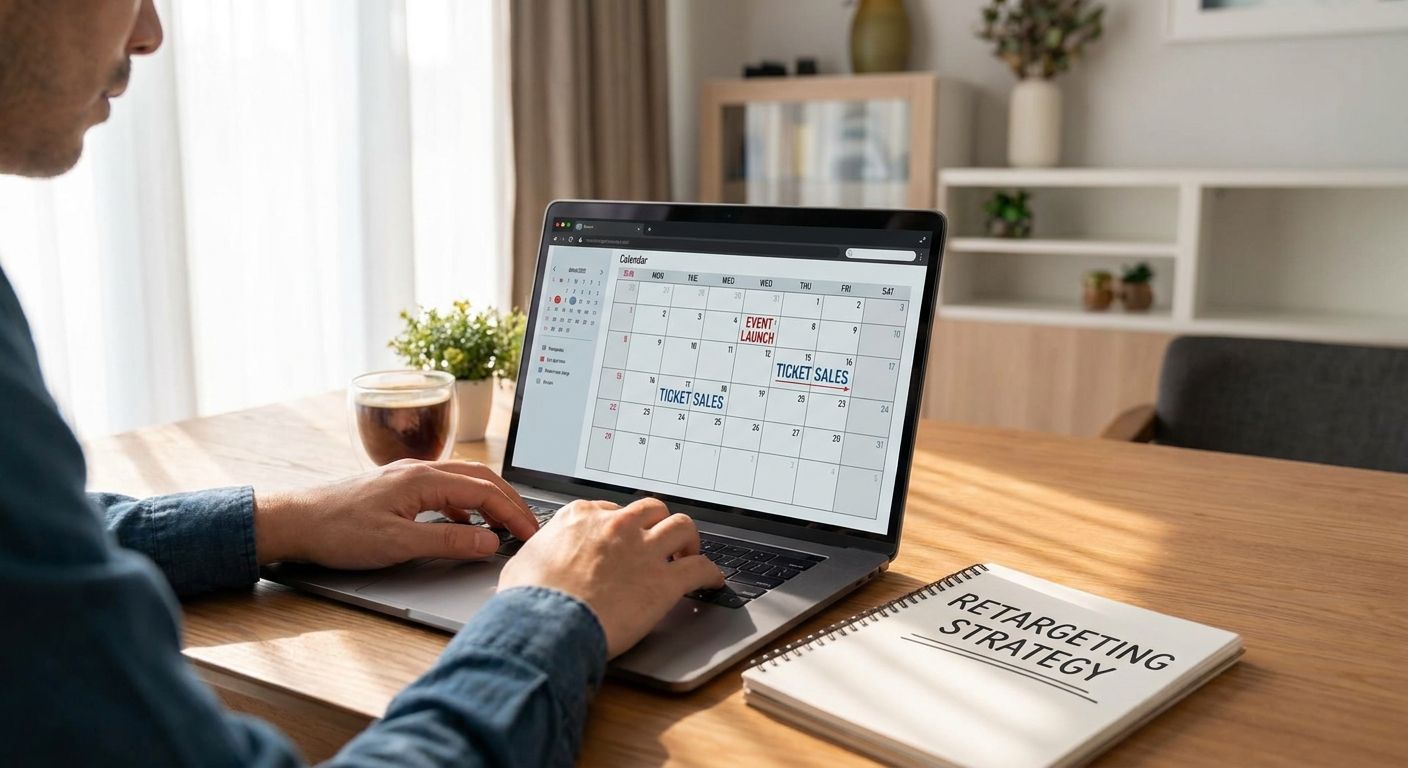
Retargeting ads sell event tickets by re-engaging people who already showed intent -- page viewers, checkout abandoners, past attendees -- with creative matched to how far they got before dropping off. The fix most operators skip: checkout abandoners are the highest-intent segment and the one usually left on the same flat bid as everyone else, instead of getting priority budget. Retargeting only works on the volume already sitting in your pixel or email list, so a venue with thin traffic needs prospecting fixed first, not more retargeting spend.
- Retargeting ads for event ticket sales work best segmented into page viewers, checkout abandoners and past buyers.
- Meta holds website visitors in a custom audience for up to 180 days; Google Display remarketing lists last up to 540 days.
- Checkout abandoners convert fastest in 2026 -- prioritise their budget over general website retargeting.
- FullyBooked runs retargeting-led paid media for venues and events, part of £85M+ in ticket revenue generated to date.
- Exclude confirmed ticket buyers from every campaign -- unexcluded audiences waste spend and annoy customers.
Why this matters
A cold Meta or Google campaign has to convince a stranger to buy a ticket in one sitting. A retargeting campaign only has to remind someone who already looked at the event page, started checkout, or attended last time -- a much shorter path to a sale. That gap in conversion difficulty is why retargeting budgets should never be an afterthought bolted onto a prospecting campaign.
Most venues running retargeting in 2026 still treat it as one audience with one ad. That flattens the highest-intent people -- checkout abandoners -- into the same bucket as someone who bounced off the homepage in three seconds. Fixing the segmentation is the single highest-leverage change available before touching creative or budget at all.
Selling more tickets for your venue or event depends on getting this retargeting layer right before scaling prospecting spend further.
How to use retargeting ads for event ticket sales
Build three parallel audiences and match creative to each one instead of running a single generic ad:
| Audience segment | Platform | Audience window | Best for |
|---|---|---|---|
| Page viewers, no purchase | Meta / Google Display | Up to 180 days (Meta), up to 540 days (Google) | Broad awareness nudge |
| Checkout abandoners | Meta + email | Up to 180 days (Meta) | Fastest recovery, highest intent |
| Past attendees | Meta lookalike + CRM export | First-party list, no expiry | Repeat bookings, new event launches |
| Email non-openers | Meta Custom Audience from email list | Up to 180 days (Meta) | Re-engaging lapsed subscribers |
Set up purchase-confirmation exclusion first, on every audience, before anything else goes live. Skip this step and confirmed buyers keep seeing ads for tickets they already own, which wastes spend and looks sloppy to the customer.
Website visitor retargeting: 180-day window on Meta
Meta's custom audience tool holds anyone who lands on your ticket page for up to 180 days, which is long enough to cover most event lead times. This is the lowest-intent segment of the three -- someone who looked and left -- so it should carry a lower priority bid than checkout abandoners, not an equal one. Creative here should reintroduce the event: date, venue, headline draw, nothing more complicated than that.
Checkout abandoner retargeting: the highest-intent segment
This is the segment that should get first claim on budget. These people entered payment details or got close enough to see a price, then stopped -- the drop-off is usually friction (a card error, a distraction, a hesitation on price) rather than disinterest. Dynamic creative that shows the exact event, date and remaining availability outperforms generic venue branding here, because the person already knows what they were buying.
Past attendee retargeting: lookalikes and repeat bookings
A CRM export of past ticket buyers is a first-party list with no platform expiry, which makes it the most durable audience of the three. Use it two ways: as a direct retargeting list for new events at the same venue, and as a seed audience for Meta lookalikes to find new prospects who resemble people who already bought. Venues launching a second event or a new run should build this list before the on-sale date, not after.
Get a retargeting funnel built for your venue
FullyBooked has generated £85M+ in ticket revenue across 50+ operators.
Why retargeting results vary
- Ticket price point -- higher-priced events have longer decision windows, so retargeting needs to run longer before the sale closes
- Event lead time -- a same-week event compresses the whole retargeting window into days, not weeks
- Audience size -- a small venue's pixel pool is thin, which caps how much a retargeting audience can scale before frequency gets excessive
- Creative fatigue -- the same static ad shown repeatedly to the same small audience stops converting faster than a rotated set would
- Platform overlap -- running Meta and Google to the same list at once burns through frequency faster and inflates cost per result
- Ticket inventory scarcity -- a near-sellout changes the right message from "come see this" to "almost gone," and retargeting creative should follow that shift
Reducing no-shows for ticketed events is the natural next step once retargeting has recovered the sale -- the two problems sit on either side of the same funnel.
How long should retargeting ads run before an event?
Retargeting should run continuously from the moment tickets go on sale until the event date or sellout, whichever comes first, with checkout abandoner campaigns running longest since that audience refreshes daily. Page-viewer campaigns can taper off in the final stretch before the event, since urgency messaging converts better on warmer audiences already further down the funnel.
Is retargeting better than prospecting for ticket sales?
Retargeting is not a replacement for prospecting -- it only recovers people already in your pixel or email list, so a venue still needs cold prospecting to bring new visitors into that pool in the first place. The two work in sequence: prospecting fills the top, retargeting closes the bottom.
What ad creative works best for event ticket retargeting?
Dynamic creative naming the specific event, date, and remaining ticket availability outperforms static venue-branding ads for retargeting specifically, because the audience already knows the venue and needs the missing detail, not an introduction.
FAQ
What's the best retargeting audience for event ticket sales?
Checkout abandoners are the best retargeting audience for event ticket sales because they already progressed furthest through the funnel before dropping off. Website visitors and past attendees are useful secondary segments but convert more slowly.
How much budget should a venue set aside for retargeting?
Retargeting should take a minority share of total paid media spend, with the majority reserved for prospecting new audiences into the funnel. The right split depends on how much traffic the venue already generates and how close the event date is.
How long does Meta keep website visitors in a custom audience?
Meta holds website visitors in a custom audience for up to 180 days. Google Display remarketing lists can hold members for up to 540 days, which suits events with a longer lead time.
Is retargeting effective for last-minute ticket sales?
Yes, retargeting is well suited to last-minute ticket sales because checkout abandoner audiences already contain people who almost bought. Urgency-led creative naming remaining availability works especially well here.
Should retargeting ads target past attendees for a new event?
Yes, past attendee lists make strong retargeting audiences for new events and strong seed lists for Meta lookalike audiences. They convert faster than cold prospecting because the relationship already exists.
What's the difference between retargeting and remarketing for events?
Retargeting and remarketing are used interchangeably in event marketing -- both mean serving ads to people who already visited your site or interacted with your event page. Platform terminology varies but the mechanics are the same.
Does retargeting work for one-off or pop-up events?
Retargeting works less well for pop-up events with no prior traffic, since the pixel has nothing to build an audience from. Prospecting needs to run first to generate the visitor pool that retargeting then recovers.
How do you stop retargeting ads to people who already bought a ticket?
Exclude confirmed buyers using a purchase-confirmation pixel event on every retargeting campaign. This is standard practice and prevents wasted spend on people who no longer need convincing.
One last thing
Most venues running retargeting in 2026 never set up the purchase exclusion audience, which means confirmed buyers keep seeing ads for tickets they already own. It costs nothing to fix and it stops wasted spend on the one segment that never needed convincing. Set it up before touching budget splits or creative -- it's the single cheapest fix on this whole list.


