Event marketing for beer festivals runs on session-based ticketing, weather-dependent demand, and a sales window that closes hard once gates open — get the segmentation and paid media sequence right and a multi-session festival can sell out its VIP tasting slots two to three weeks before doors open.
- Event marketing for beer festivals needs session-level ticketing and pricing, not one blanket campaign for the whole weekend.
- Paid social fills early sessions fastest when audience segments are split by ale enthusiast, corporate group and local day-tripper.
- Retargeting and SMS in the final two weeks close the gap that awareness ads alone leave open.
- FullyBooked has generated £85M+ in booking revenue and sold 3M+ tickets across 50+ experience operators.
- No-show and wet-weather planning matters more at beer festivals than at most ticketed events.
Why beer festival marketing is different
A beer festival isn't one product with one price. It's a run of separate sessions — Friday evening, Saturday afternoon, Sunday closer — each with its own capacity ceiling and its own buyer.
A food festival faces a similar structure, and the food festival marketing playbook covers the parallel logic of stall partnerships and session pricing if you're running both formats. But beer festivals carry two extra pressures: weather sensitivity that can gut a single session overnight, and a buyer split between committed craft-beer enthusiasts and casual day-trippers who book on price alone.
Marketing that treats the whole weekend as one campaign burns budget on sessions that were always going to sell and starves the ones that need the push. The fix in 2026 is session-level targeting, not festival-level targeting.
The step-by-step marketing sequence for a beer festival
1. Build session ticketing before you build a single ad
Get the ticket structure right first — every campaign after this depends on it.
- Cap each session to a real number, not "unlimited" — scarcity drives early conversion
- Price session tiers by demand (Friday evening usually outsells Sunday afternoon)
- Set an early bird window that closes on a fixed date, not "while stocks last"
- Bundle a tasting flight or brewery masterclass into the mid-tier ticket
- Hold back 10-15% of capacity for a release two weeks out to reward warm retargeting traffic
2. Segment your audience before spending a pound on ads
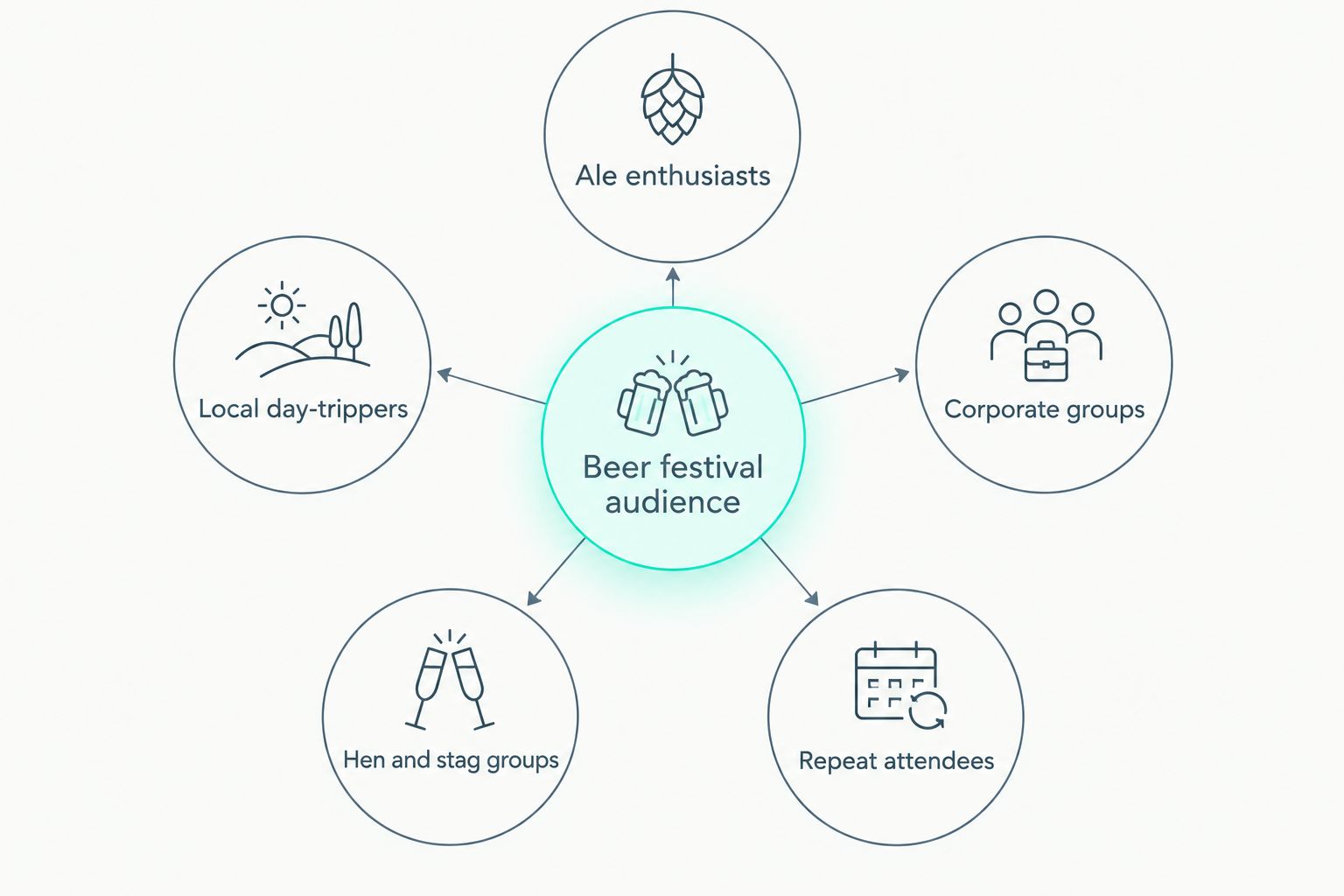
A beer festival has at least five distinct buyer types, and they don't respond to the same creative.
- Ale and craft beer enthusiasts who follow specific breweries — reach them through brewery partner lists
- Local day-trippers who decide on price and proximity, not brand loyalty
- Corporate and work-social groups booking blocks of 8-20 tickets
- Hen, stag and birthday groups after a themed session
- Repeat attendees from last year's festival, pulled from your ticketing or CRM export
3. Run paid social to fill early sessions first
Boosting a Facebook event page and hoping is the free version of this. The version that actually fills sessions three weeks out builds separate ad sets around the session structure, not the festival as a whole — the same discipline covered in paid media for brewery tap rooms.
- Build separate ad sets per session, never one campaign for the whole weekend
- Use lookalike audiences built from last year's ticket buyer list
- Test video creative showing the pour, the queue, the crowd — static flyers underperform
- Cap frequency so the same session ad doesn't fatigue a warm audience
- Shift daily budget toward the lowest-selling session, not an even split
4. Get local press and beer influencers seeding the event
- Pitch local food and drink writers a "first taste" preview two weeks before doors open
- Send sample vouchers to micro-influencers in the craft beer niche
- Partner with participating breweries to cross-post into their own lists — their audience already drinks beer
- Time influencer posts to land the same week early bird pricing closes
5. Retarget everyone who looked and didn't book
Awareness ads get the click. Retargeting ads for event ticket sales get the checkout, and this is where most beer festival budgets fall short.
- Retarget visitors who viewed a specific session page with an ad for that exact session
- Exclude anyone who has already purchased to stop wasting spend
- Run countdown creative in the final 10 days before the festival
- Pair retargeting with an abandoned-checkout email for anyone who started but didn't finish
6. Layer email and SMS as the date closes
- Send a "sessions nearly full" email seven days out using genuine remaining capacity
- SMS reminder 48 hours before with parking and travel info — this doubles as a no-show reducer
- Give past attendees separate early access messaging
- Cap festival emails at 3-4 sends across the whole campaign to avoid list fatigue heading into 2026's busier festival calendar
7. Plan for weather and no-show risk on the day
- Have a wet-weather contingency message ready to send same-day
- Keep a live waitlist so cancelled sessions get resold same-day, not left empty
- Track no-show rate by ticket type — corporate blocks no-show more than solo enthusiast tickets
- Reserve a small local paid social budget for last-minute walk-up pushes
Fill your beer festival sessions
Paid media and retention built around your session structure, not a blanket campaign.
Comparison: marketing options for a beer festival
| Option | Best for | Key limitation |
|---|---|---|
| In-house social boosting | Small single-day festivals under 2,000 capacity | No session-level targeting; budget spent evenly regardless of demand |
| PR and influencer seeding alone | Building pre-launch buzz and local press coverage | Doesn't convert browsers into checkouts on its own |
| Local radio and print | Reaching older, local day-trip audiences | Hard to track return on spend, long lead times |
| Specialist paid media and retention agency (FullyBooked) | Multi-session festivals needing sold-out sessions and repeat-year growth | Needs a real ticketing or CRM feed to segment properly |
Verdict: for a single small session, in-house social boosting is fine. For a multi-day, multi-session beer festival, event marketing built around session-level paid media and retargeting outsells a blanket campaign every time.
Common mistakes beer festival organisers make
- Treating the whole festival as one product instead of pricing and marketing each session separately
- Spending paid social budget evenly across all sessions instead of pushing the slow ones
- Ignoring weather risk in the comms plan until the week of the event
- Skipping brewery partner cross-promotion — breweries carry warmer audiences than a generic festival page
- Running no waitlist system, so cancelled tickets in the final 48 hours go unsold
FAQ
What's the best way to market a beer festival with multiple sessions?
Build session-level ticketing first, then run separate paid social ad sets per session rather than one campaign for the whole weekend. This lets budget shift toward whichever session is under-selling.
How much should a beer festival spend on paid social?
There's no fixed figure — spend proportional to which sessions are still under-sold two weeks out, not an even split across the whole run. Shifting budget daily toward the slowest session outperforms a flat weekly allocation.
Is influencer marketing worth it for a beer festival?
Yes, when it's targeted at craft beer micro-influencers and timed to land the week early bird pricing closes. Generic lifestyle influencers with no beer audience rarely move ticket sales.
How early should beer festival tickets go on sale?
Open sales with an early bird tier that closes on a fixed date, ideally 6-8 weeks before the festival, then hold back 10-15% of capacity for a release two weeks out. This gives retargeting traffic something genuinely scarce to buy.
How do you reduce no-shows at a beer festival?
Send an SMS reminder 48 hours before the session with parking and travel details, and track no-show rate separately by ticket type. Corporate blocks and group bookings typically no-show at a higher rate than solo enthusiast tickets.
Should beer festivals use SMS marketing?
Yes, for time-sensitive reminders in the final 48 hours — SMS open rates beat email in that window and it doubles as a no-show reducer.
What makes beer festival marketing different from general event marketing?
Beer festivals run multiple sessions with different demand curves and carry higher weather cancellation risk than most ticketed events, so the marketing plan needs session-level targeting and a wet-weather contingency built in.
When should a beer festival hire a marketing agency instead of running ads in-house?
Once the festival runs more than two or three sessions or spans multiple days, in-house social boosting stops scaling because it can't segment or shift budget fast enough between sessions.
One last thing
Most beer festival organisers skip the held-back capacity release. Selling every ticket up front feels efficient, but keeping 10-15% back for a release two weeks before doors open gives retargeting traffic genuine scarcity to react to — a "sessions nearly full" message with real numbers behind it, not a stock banner that's been up since launch. That single tactic, paired with session-level ad sets, is the difference between a festival that limps to capacity on the final day and one that's sold out by the week before in 2026.


