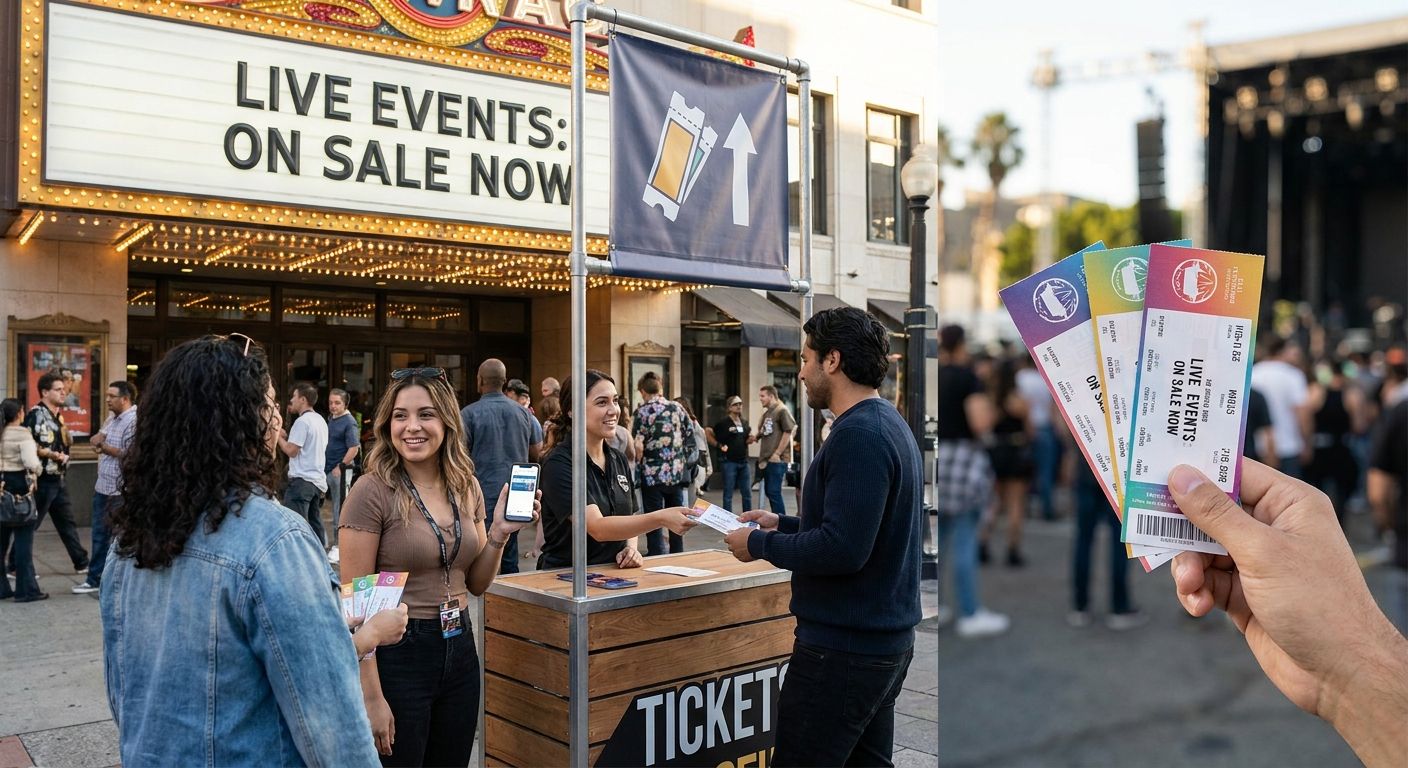
Selling out a venue in 2026 takes more than a Facebook boost and a hope. The strategies below are ranked by how fast they move ticket sales and how well they hold up once the initial hype fades.
- Influencer seeding and paid media urgency campaigns are the fastest movers for best ticket sales strategies for live events in 2026 — both verdict: Buy.
- Retention and lifecycle marketing turn one-time bookers into repeat revenue; skipping it caps lifetime value. Verdict: Buy.
- Waitlist backfill and early-bird tiering protect cash flow before the event date. Verdict: Hold.
- Generic social boosting with no retargeting layer wastes spend on cold audiences. Verdict: Skip.
Why this matters
Most venues and event organisers still run marketing the way they did in 2019: one paid social push, a few emails, and a countdown clock. That approach fills the front row and leaves the back half empty.
The operators moving the most tickets in 2026 stack channels — paid media for reach, influencer marketing for trust, retention for repeat spend — instead of betting everything on one tactic. If you want the fastest route to more bookings, start with how to sell more tickets for your venue or event before picking a single channel in isolation.
How this ranking works
This list is ordered by speed to measurable ticket sales, based on aggregated campaign patterns across 50+ managed operators spanning live music, escape rooms, adventure parks, comedy clubs and immersive experiences. Strategies that move tickets within days rank above strategies that build value over months, even when the long-term tactic matters more.
Each entry names what it does, when it works, and when it doesn't. Skip the ones that don't match your event type — a haunted house and a wine tasting experience do not sell tickets the same way, even in the same city.
The ranked strategies
1. Urgency-driven paid media — the fastest mover
Countdown-based paid social and search campaigns compress decision time by putting a deadline in front of the buyer at the exact moment they're scrolling. Ad sets built around "last chance" messaging, limited release dates, or capacity thresholds consistently outperform evergreen "buy tickets" creative because they force a decision instead of inviting a browse. This works hardest in the final two to three weeks before an event date, when procrastinating bookers finally convert. Verdict: Buy.
2. Influencer seeding before doors open — the trust multiplier
Sending a small group of relevant creators through an experience before public sale, or during a soft-launch window, builds third-party proof that paid ads can't fake. A single credible creator post showing real footage of an axe throwing venue, an escape room, or a trampoline park does more for conversion than five polished brand ads. For channel selection and vetting, the best influencer marketing platforms for hospitality brands is worth reviewing before you commit budget. This strategy works best 4-8 weeks ahead of an event, giving content time to circulate. Verdict: Buy.
3. Lifecycle retention marketing — the repeat-booker engine
One-time bookers cost the most to acquire and generate the least lifetime value. Email and SMS sequences triggered by past attendance — a follow-up 48 hours after a visit, a re-engagement message 60 days later, a loyalty nudge before a new season launches — turn single transactions into repeat revenue without new ad spend. Operators running structured retention alongside acquisition consistently protect margin better than those relying on paid media alone. Full sequencing detail sits in retention marketing tactics for experience businesses. Verdict: Buy.
4. Multi-channel stacking — the channel mix
Running paid social, search, and organic content together outperforms any single channel run in isolation, because different buyers convert on different platforms depending on how far ahead they book. A comedy club filling a Friday night needs a different mix than a food festival selling day passes three months out. Channel prioritisation by venue type is broken down at best marketing channels for escape rooms, and the logic transfers to most experience formats. Verdict: Buy.
5. Waitlist and standby ticketing — the backfill
A waitlist captures demand you'd otherwise lose when an event shows sold out, then automatically fills cancellations without manual follow-up. It also gives you a warm list to notify the moment a second date or extra capacity opens. This strategy protects revenue rather than generating new demand, so it ranks below acquisition tactics — but skipping it means every cancellation is a lost sale with no recovery path. Verdict: Hold.
6. Early-bird tiered pricing — the cash-flow front-loader
Releasing a limited allocation at a lower price early, then stepping price up in tiers as the date approaches, rewards early commitment and front-loads cash flow for production and marketing spend. It works well for planned, date-fixed events — festivals, one-off shows — and less well for walk-in experiences like axe throwing or bowling where booking windows are short. Verdict: Hold.
7. No-show reduction via SMS reminders — the quiet profit saver
A reminder sequence sent 24 hours and 2 hours before an experience reduces no-shows on free or low-commitment bookings, which matters more for attractions with fixed staffing and time-slot capacity than for one-off ticketed concerts. It won't sell a single new ticket, but it recovers slots that would otherwise sit empty. Verdict: Hold.
8. Untargeted social boosting — the wasted spend
Boosting a post to "people interested in events" with no retargeting layer, no lookalike audience, and no urgency mechanic burns budget on cold traffic that rarely converts. It's the strategy most operators default to because it's the easiest to set up, not because it works. Verdict: Skip.
“A single credible creator post beats five polished brand ads for ticket conversion.”
Comparison at a glance
| Strategy | Speed to results | Best for | Verdict |
|---|---|---|---|
| Urgency-driven paid media | Days | Any event nearing capacity deadline | Buy |
| Influencer seeding | 4-8 weeks | New venues, immersive experiences | Buy |
| Lifecycle retention marketing | Ongoing | Repeat-visit formats (gyms, escape rooms) | Buy |
| Multi-channel stacking | 2-6 weeks | Most venue and event types | Buy |
| Waitlist and standby ticketing | Ongoing | Sold-out or capacity-limited events | Hold |
| Early-bird tiered pricing | Months out | Fixed-date festivals and shows | Hold |
| SMS no-show reminders | Ongoing | Time-slot attractions | Hold |
| Untargeted social boosting | N/A | Nobody, in 2026 | Skip |
Where to start
- Match the strategy to your booking window. A haunted house selling same-week tickets needs urgency-driven paid media before it needs a retention sequence; a festival selling six months out needs tiered pricing first.
- Don't run retention before you have volume. Lifecycle marketing needs a base of past attendees to trigger from — build acquisition first, then layer retention once you have repeat-visit data.
- Vet any agency or platform on outcomes, not promises. Ask for ticket volume and revenue figures tied to specific campaigns, not vague "engagement" metrics.
Get a ticket sales plan built for your venue
Paid media, influencer marketing and retention strategy in one plan.
FAQ
What's the best ticket sales strategy for live events in 2026?
Urgency-driven paid media combined with influencer seeding moves tickets fastest in 2026, especially in the final two to three weeks before an event date. Retention marketing then protects repeat revenue once you have a base of past attendees.
Is influencer marketing better than paid ads for selling tickets?
Neither replaces the other — influencer content builds trust that paid ads can't fake, but paid media reaches cold audiences at scale. The strongest campaigns run both together rather than choosing one.
How far ahead should I start marketing a live event?
Start influencer seeding and content 4-8 weeks ahead, then shift budget to urgency-driven paid media in the final two to three weeks. Fixed-date festivals should layer in tiered early-bird pricing months out.
Does retention marketing work for one-off events?
Retention marketing works best for repeat-visit formats like climbing gyms, escape rooms and museums, less so for genuine one-off concerts. One-off events should focus budget on acquisition and urgency tactics instead.
How much should I spend on paid media for ticket sales?
Spend scales with venue capacity and ticket price, so there's no fixed figure — the more useful benchmark is shifting budget toward urgency-driven creative as the event date approaches rather than spreading it evenly.
What's the biggest mistake operators make selling tickets?
Boosting a post to a broad, untargeted audience with no retargeting layer wastes the most budget for the least return. Every dollar should hit a retargeting list, a lookalike audience, or an urgency mechanic.
Should I use a waitlist if my event isn't sold out?
Yes — a waitlist costs nothing to run and captures demand you'd otherwise lose to cancellations closer to the date. It's a backfill tool, not a primary sales driver, but skipping it leaves recoverable revenue on the table.
One last thing
Operators who combine paid media with retention marketing outperform operators running either channel alone — that pattern holds across the 50+ venues and events managed under this approach, covering 3M+ tickets sold and £85M+ in generated revenue. The single-channel operators plateau; the stacked ones keep compounding into 2026 and beyond.


