Food festivals sell most of their tickets in a compressed window — often the final three to four weeks before gates open — then the event disappears for a year until the next edition. Event marketing for food festivals has to do a full season's growth work inside that sprint, across paid media, creator content and a retention list that has to survive twelve months of silence.
- Event marketing for food festivals works best when paid media, creator content and retention run as one system, not three separate campaigns.
- Food festivals behave like pop-up experiences: single site, single weekend, hard deadline — treat the campaign structure the same way.
- Geo-targeted paid media outperforms broad brand-awareness spend for single-location, date-bound events.
- Creator-led food content converts faster than static ads because taste and atmosphere don't translate to a banner.
- Skip one-off influencer gifting with no negotiated deliverables — it rarely moves ticket sales for a single-weekend event.
Why this matters
A food festival doesn't get a slow build. There's no membership renewal cycle, no subscription drip, no year-round footfall to fall back on — the campaign either fills the field in a few weeks or it doesn't. FullyBooked has run this exact pattern across 50+ experience operators, generating £85M+ in ticket revenue and selling 3M+ tickets, and the pattern that shows up again and again with date-bound, single-location events is the same: paid media, influencer content and retention have to be planned as one campaign, not three departments.
Get the sequencing wrong and you end up with a festival that's fully staffed, fully catered, fully licensed — and half-booked three weeks out.
Who this is for
This guide is for organisers running a ticketed food festival: street food markets, drinks-and-food pairing weekends, multi-vendor culinary festivals, or council-backed food events that need to hit a revenue target inside a single date range. If you're already asking how to sell more tickets for your venue or event with a fixed deadline bearing down, this is the exact problem event marketing for food festivals is built to solve.
It's not for year-round venues with rolling availability — that's a different campaign shape entirely, built on evergreen search and retargeting rather than a countdown.
What to look for in event marketing for food festivals
A campaign built around the booking curve, not the calendar month
Food festival ticket sales don't follow a calendar — they follow a curve that spikes hard in the final weeks. A marketing partner who treats week one and week eleven the same way is optimising for the wrong shape entirely.
Support for multi-vendor, multi-pass ticketing
Most food festivals sell more than one ticket type — day passes, weekend passes, VIP tasting passes, early entry. Campaigns need separate creative and separate targeting per pass, because the buyer for a £15 day ticket and a £60 VIP tasting pass isn't the same person.
Geo-targeted paid media, not broad reach
A food festival happens in one place on one weekend. Broad brand-awareness spend across a wide radius wastes budget on people who were never going to make the drive — radius-based, location-first targeting is the only version that makes sense here.
Creator content that shows food, not just announces it
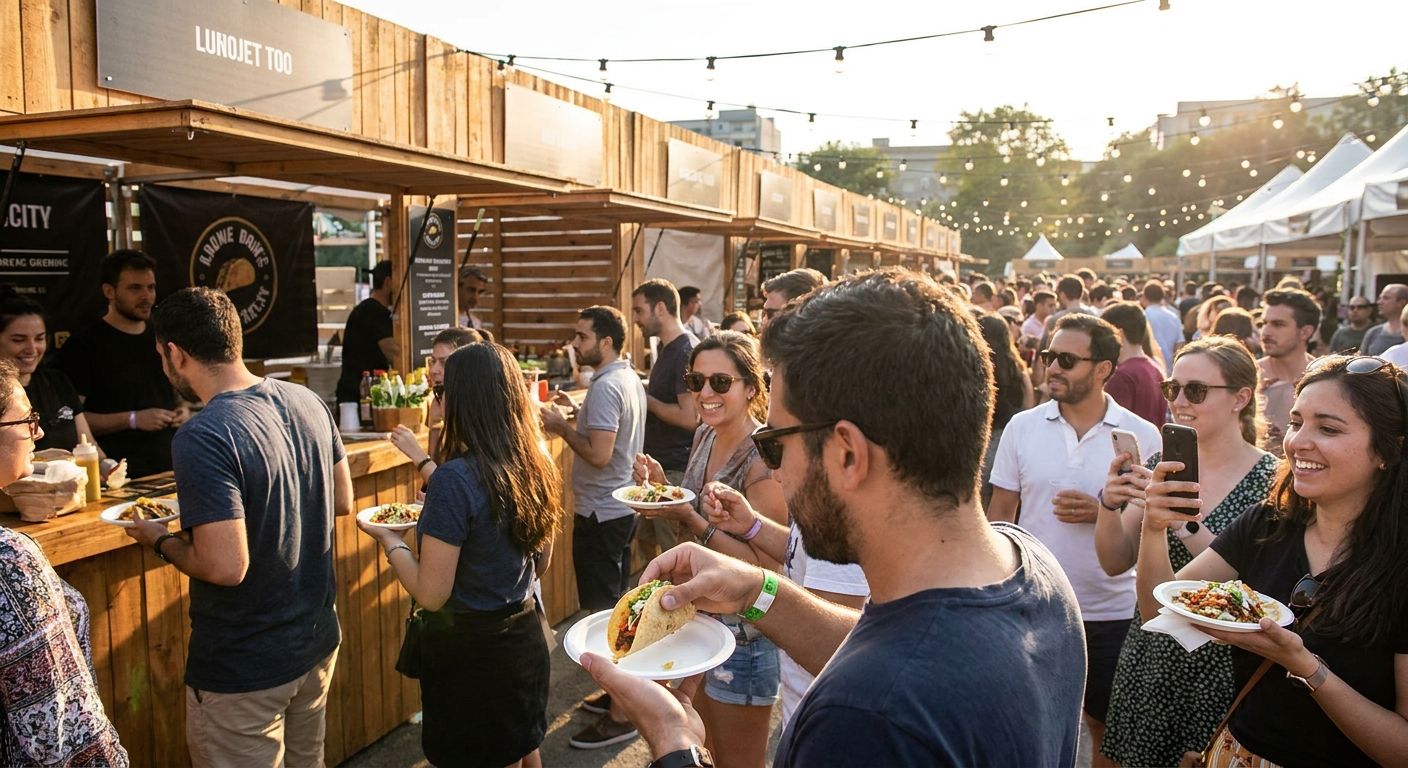
Food is a visual, sensory sell. Static ad copy telling people there's "amazing street food" does none of the work that a fifteen-second clip of a vendor plating a dish does — influencer and creator content consistently outperforms static creative for this category.
A retention plan that survives the gap between editions
Most food festivals run once a year. Without a retention system — email, SMS, an early-access list — every edition starts from zero instead of from last year's attendee base.
Top picks: the plays that actually move tickets
The pop-up parallel — treat it like one
Food festivals are structurally identical to pop-up experiences: one site, one date range, one shot to convert demand before it evaporates. The campaign discipline that works for pop-up experience marketing — front-loaded awareness, hard-deadline urgency creative, no slow-burn brand play — maps directly onto a food festival's timeline.
Verdict: Run it.
Geo-targeted paid media for the final push
The last two to three weeks before a food festival are where most of the volume sits, and that's where paid spend has to concentrate. The approach used for paid media on immersive experiences — tight radius targeting, urgency-led creative, deadline messaging — applies almost unchanged to a food festival's closing weeks.
Verdict: Run it.
Creator-led discovery over static ads
A static image of a food stall tells people the festival exists. A creator walking the site, tasting dishes on camera, tells people why it's worth the trip. The influencer marketing model built for adventure parks — day-out, family-decision-driven content — sits closer to how food festival buyers actually decide than a generic influencer gifting campaign does.
Verdict: Test it.
A lifecycle retention system for next year's edition
An annual food festival that doesn't capture attendee data at the door is rebuilding its audience from scratch every twelve months. A structured retention campaign — early-access lists, post-event follow-up while the event is still fresh — is the difference between a festival that grows year on year and one that resets to zero each time.
Verdict: Consider it, especially if this isn't the festival's first year.
Fill your next food festival
Get a tailored plan for paid media, influencer content and retention.
What to avoid
- Broad brand-awareness display campaigns. They look premium in a pitch deck and do almost nothing for a single-weekend, single-location event where the buyer pool is geographically limited.
- One-off influencer gifting with no negotiated content deliverables. A free ticket in exchange for "maybe a story" rarely produces content that sells tickets — it produces content that gets posted after the festival is already sold out or already over.
- Generic email newsletters instead of a real retention sequence. A once-a-year "see you next time" blast is not the same as a structured lifecycle campaign that reopens sales the moment next year's dates are confirmed.
Verdict comparison
| Play | Best for | Timing | Verdict |
|---|---|---|---|
| Pop-up campaign structure | First-time or annual single-site festivals | Full campaign window | Run it |
| Geo-targeted paid media | Driving last-mile ticket volume | Final 2-3 weeks | Run it |
| Creator-led food content | Building pre-launch awareness and trust | Weeks 1-6 of campaign | Test it |
| Retention lifecycle system | Multi-year, repeat-edition festivals | Post-event, ongoing | Consider it |
FAQ
What is event marketing for food festivals?
Event marketing for food festivals is the paid media, influencer content and retention work built around a single date-bound, single-location ticketed event. It's structured around a compressed booking curve rather than a year-round campaign, because most tickets sell in the weeks right before the festival opens.
When do most food festival tickets sell?
Most food festival tickets sell in the final weeks before the event rather than months out. Campaigns that front-load awareness early and concentrate paid spend closer to the date tend to match how buyers actually decide.
Is influencer marketing worth it for food festivals?
Yes, when it's structured with negotiated deliverables rather than free-ticket gifting. Food is a visual, sensory sell, and creator content showing the actual experience consistently outperforms static ad copy for this category in 2026.
Should food festivals run paid social or search ads?
Both, but weighted toward paid social with geo-targeting for a single-location event. Search picks up people already looking for the festival by name; social does the work of reaching people who haven't heard of it yet.
How do food festivals get repeat attendees year after year?
Through a retention system that captures attendee data at the door and follows up within days of the event ending, not months later. Festivals without this rebuild their audience from zero every edition.
What's the difference between paid media and influencer marketing for a food festival?
Paid media buys placement and targets people by location and intent; influencer marketing borrows trust and shows the actual experience through a creator's lens. The two work best run together, not as alternatives.
Does FullyBooked work with food festivals specifically?
FullyBooked works with experience-based businesses generally — venues, events, attractions and entertainment spaces — and a ticketed, date-bound food festival fits that same category. The agency has generated £85M+ in revenue and sold 3M+ tickets across 50+ operators.
How much should a food festival spend on paid media?
Budget should scale with the campaign window and concentrate in the final weeks before the event rather than spreading evenly across months. There's no fixed figure that fits every festival — venue capacity and ticket pricing tiers both change the math.
One last thing
The single biggest lever for a food festival's return ticket sales isn't anything that happens during the event — it's the follow-up campaign sent within 48 hours of gates closing, while the food and the atmosphere are still fresh in people's minds. Wait three weeks and that same audience has moved on to the next thing on their calendar.