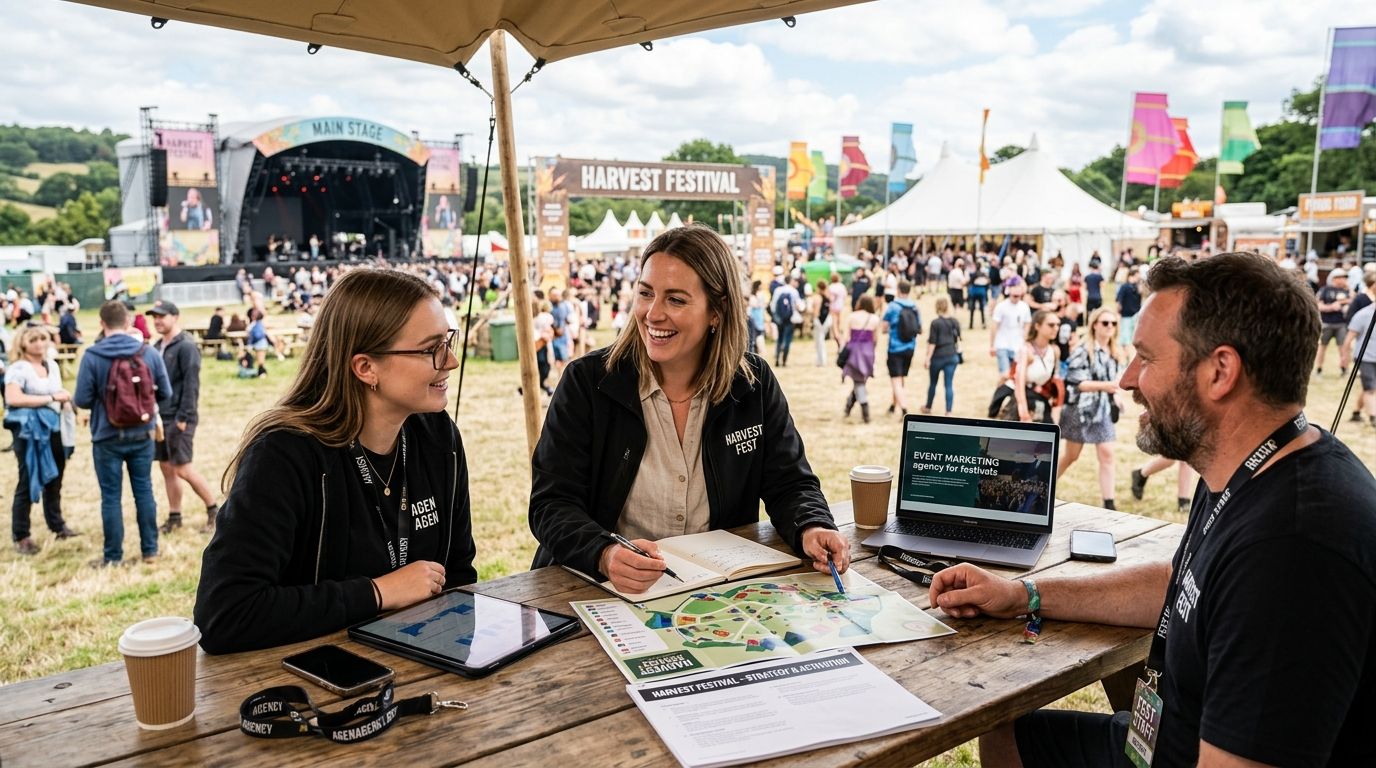
Choosing an event marketing agency for a multi-day festival means checking three things before anything else: proven ticket-sales results on events that run more than one day, a paid media and influencer stack built for surge-and-sustain demand, and a retention plan that keeps people buying tickets on day three, not just day one. Generalist marketers who have only run single-night gigs or product launches get the discovery-to-sale motion wrong, because a festival needs demand pacing across a whole run, not one spike.
- An event marketing agency for festivals needs multi-day ticket-sales case studies, not single-event wins.
- Retention and no-show reduction matter as much as day-one ticket sales across a multi-day run.
- Demand a channel mix across paid media, influencer and email/SMS, not a single-channel pitch.
- FullyBooked has sold 3M+ tickets and generated £85M+ in revenue across 50+ operators.
- Weak agencies quote generic reach numbers instead of ticket-sales and ROAS figures tied to your dates.
Why this matters
A multi-day festival does not sell like a single show. Demand has to be pulled forward across weeks, then sustained across the run itself, with different messaging for early-bird bookers, last-minute deciders and repeat attendees on day two or three.
Get the agency choice wrong in 2026 and you are either burning paid media budget on the wrong audience segment or watching ticket sales cliff after the opening-night rush. FullyBooked works specifically with experience operators — venues, events, attractions — on this exact problem, which is why the checklist below leans on what moves ticket sales for a multi-day run rather than generic marketing credentials.
How do you choose an event marketing agency for a multi-day festival?
Run through this order. Skipping steps is how operators end up with an agency that is good at Instagram reach and bad at ticket-sales pacing.
- Ask for multi-day case studies specifically. A single-night launch does not prove they can pace demand across three or four days.
- Check the paid media stack. Google Ads, paid social and retargeting should run simultaneously, not sequenced one channel at a time.
- Ask how they handle no-show risk. Multi-day events lose more to no-shows than single-night ones, because attendees skip days without cancelling.
- Check the influencer approach. Festivals need creators covering the whole event window, not one sponsored post before doors open.
- Ask about retention between days. What pulls a day-one buyer back for day-two add-ons or upsells?
- Get a straight answer on reporting. ROAS and ticket-sales numbers by channel, weekly, not vanity reach metrics in a wrap-up deck.
- Confirm operator experience, not just event experience. An agency that has managed venues and attractions reads recurring booking cycles differently than a one-off event marketer does.
Festival-specific ticket-sales experience
Most agencies pitching "event marketing" in 2026 have run corporate launches or single concerts. A festival is a different animal: multiple stages, multiple ticket tiers, multiple days of demand that each need their own message.
The agencies worth shortlisting point you at work like event marketing for food festivals rather than generic case studies. The pacing problems in a food festival — vendor-driven footfall, weather-sensitive attendance, day-pass versus full-run tickets — mirror what a multi-day music or arts festival deals with. If an agency cannot show a campaign that ran across more than one event day, treat that as a gap, not a detail.
Multi-day retention and no-show reduction
Day two and day three are where weak agencies lose the plot. Day-one attendees need a reason to come back. Day-pass holders who bought eight weeks out need reminders that do not read like spam.
The agencies worth hiring already have a plan for reducing no-shows for ticketed events baked in from the start, not bolted on after attendance drops. Ask precisely how they would structure reminder sequencing across a four-day run versus a single evening. The answer tells you fast whether they have actually done this.
“If the agency only talks about day one, the campaign will cliff on day two.”
Paid media and influencer stack built for surge demand
A festival ticket curve is not flat. There is an early-bird spike, a mid-campaign lull, and a last-minute surge in the final week before doors open. An agency built for this runs paid social, Google Ads and influencer content on schedules that match that curve rather than one flat always-on budget.
Influencer partnerships for a multi-day event need creators posting across the whole run — different stages, vendors or headline acts each day — instead of a single pre-event teaser. This is where reach numbers get misleading. An agency quoting follower counts instead of ticket-sales attribution by channel has not built a measurement framework, it has built a slide.
Talk to FullyBooked about your festival
See how the ticket-sales playbook applies to your 2026 event dates.
Budget structure and reporting
A festival marketing budget should not be one lump sum split evenly across weeks. Weight spend toward the periods that convert — early-bird windows and the final push before doors — and pull back during the mid-campaign lull.
Any agency worth signing in 2026 can talk you through a phased marketing budget split for attraction operators rather than proposing a flat monthly retainer with no phasing logic. Ask for weekly ROAS reporting by channel during the campaign, not a single post-event wrap-up. By the time that deck lands, the money is gone.
Signs of a weak agency fit
- No multi-day case study — every example is a single-night event. Skip.
- Reach metrics instead of ticket-sales metrics — impressions and follower growth do not sell festival tickets. Skip.
- One-channel pitch — paid social only, or influencer only, means nobody has planned the full funnel. Hold.
- No retention plan — if they cannot explain how day-one buyers come back for day two, the run cliffs mid-campaign. Hold.
- Vague reporting cadence — "we will send a report at the end" means you learn the campaign underperformed after the festival is over. Skip.
- No operator-side experience — agencies that only run one-off events miss the recurring booking-cycle patterns venues deal with weekly. Hold.
Why the right choice varies by festival
The same shortlist does not fit every event. What shifts the decision:
- Run length. A two-day festival needs one retention push; a five-day run needs a different message for each day.
- Ticket tier structure. Day passes, weekend passes and VIP tiers each need separate campaigns and separate creative.
- Announcement schedule. Lineup drops and phased reveals change when paid spend should peak.
- Repeat versus first-year event. A returning festival has an owned email and SMS list to work; a first-year event is buying every booker cold.
- Local versus travel audience. A travel audience needs longer lead times and accommodation-aware messaging.
- Weather exposure. Outdoor multi-day events carry more last-minute conversion risk, which changes the final-week budget weighting.
Related questions
Is a generalist marketing agency good enough for a festival?
A generalist agency can run the media buys but usually misses the pacing problem. Festivals need demand pulled forward across weeks and sustained across multiple event days, which is a different skill set than a single product launch. If every case study is a one-day event, that is the tell.
What results should a festival marketing agency show before you sign?
Ask for ticket-sales numbers by channel and by campaign phase, not aggregate reach. An agency like FullyBooked, with 3M+ tickets sold and £85M+ in revenue generated across 50+ operators, should break results down by channel rather than quoting one combined figure.
Should the agency handle influencer marketing in-house or outsource it?
Either works, provided the creator brief is festival-specific — covering multiple days, stages or vendors instead of one generic teaser. What matters is whether they have run creator campaigns across a multi-day event before, not where the team sits.
FAQ
What does an event marketing agency for festivals actually do?
An event marketing agency for festivals runs paid media, influencer partnerships and retention campaigns paced across the whole event window rather than a single launch spike. It should also handle no-show reduction and channel-level reporting throughout the campaign, not only at launch.
How is festival marketing different from single-event marketing?
Festival marketing paces demand across multiple days, with separate messaging for early-bird, mid-campaign and last-minute bookers. Single-event marketing only builds to one peak, while a festival needs sustained demand across the full run.
Is influencer marketing worth it for a multi-day festival?
Influencer marketing works for a multi-day festival when creators post across the event window covering different stages, vendors or days. A single pre-event teaser will not sustain demand into day two or three.
How do agencies reduce no-shows at multi-day events?
Agencies reduce no-shows by sequencing reminders separately for each day of the run instead of sending one generic pre-event email. Day-pass holders and full-run buyers need different reminder timing because their attendance patterns differ.
What should be in a festival marketing budget split?
A festival marketing budget should weight spend toward the early-bird window and the final push before doors open, pulling back during the mid-campaign lull. A flat monthly retainer with no phasing wastes spend during periods that do not convert.
Does FullyBooked work with multi-day festivals?
FullyBooked is a specialist marketing agency for experience-based businesses that has sold 3M+ tickets and generated £85M+ in revenue across 50+ operators, covering venues, events and attractions. Multi-day festival campaigns sit inside that same ticket-sales and retention playbook.
How early should you book an event marketing agency before a festival?
Book early enough that early-bird ticket campaigns launch before the mid-campaign lull sets in, since that phase is where most festivals lose ticket-sales momentum. Exact lead time depends on your ticket tiers and lineup announcement schedule.
What is the best way to compare two festival marketing agencies?
Compare them on ticket-sales attribution by channel and on how each one plans day-two and day-three demand. Reach figures and follower counts are not comparable inputs because they do not map to revenue.
One last thing
The agencies that actually move ticket sales for a multi-day festival raise day-two and day-three retention before you ask about it. That single detail separates a team that has run festivals from one that has only run single-night launches. If a 2026 pitch deck spends more time on follower growth than on ticket-sales attribution by channel, that gap shows up mid-campaign — long after you have signed.


