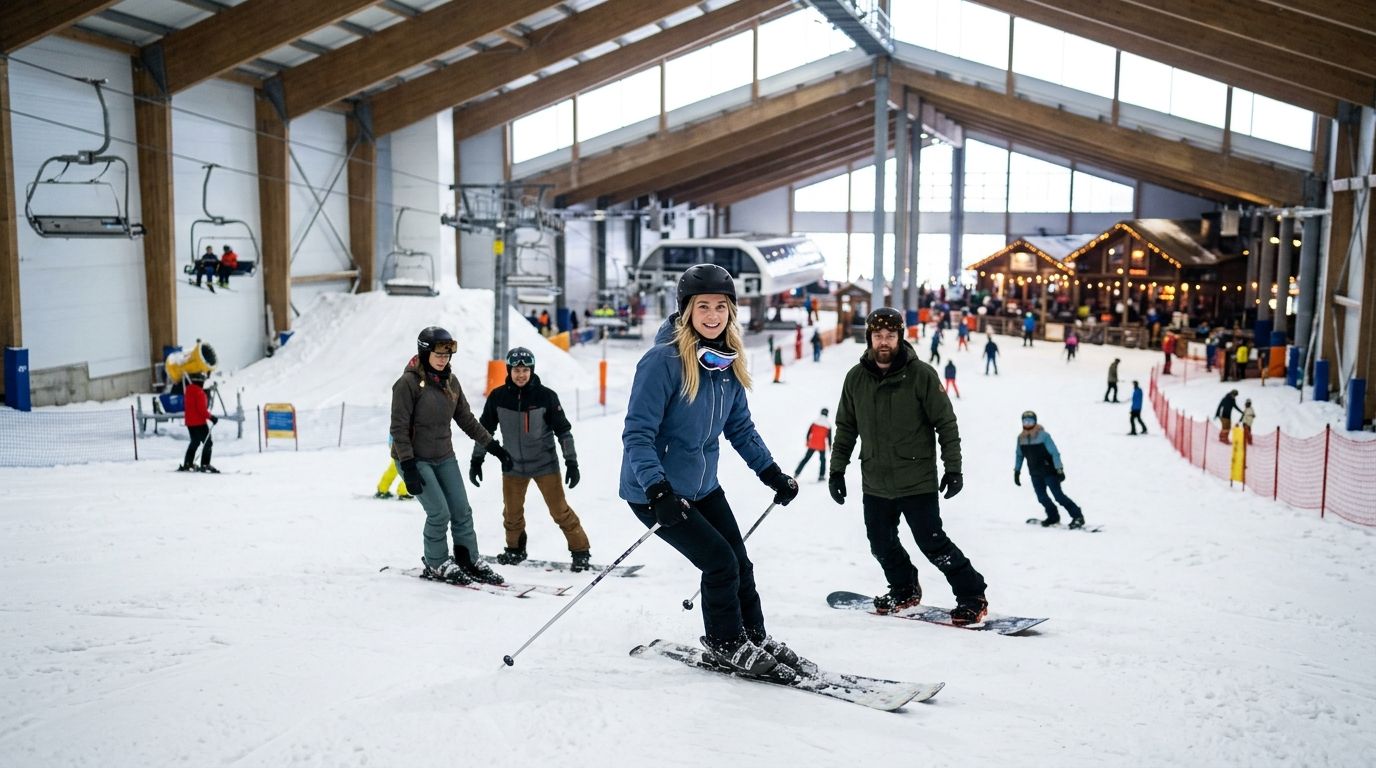
Paid media for indoor snow and ski centres has to sell a 60-minute lesson slot or a two-hour family session, not a generic "visit us" click. The verdict: Google Search Ads for lesson and session-type keywords, paired with Meta retargeting on abandoned bookings, wins for indoor snow and ski centres because search intent here is narrow and the booking window is short.
FULLYBOOKED® runs paid media for experience operators across the UK, and indoor snow centres behave differently from trampoline parks or escape rooms: bookers search by activity type ("beginner ski lesson", "snowboard taster session"), by slot time, and often by school holiday week. A campaign structured around one blended "attraction" ad group misses all three signals. FullyBooked treats each session type as its own funnel, which is the structural difference this guide covers.
- Paid media for indoor snow centres wins when Google Ads is split by session type (lesson, freeride, sledging) rather than one blended attraction campaign.
- Meta retargeting on abandoned session bookings recovers bookers who searched a specific time slot and left without paying.
- Weekday off-peak sessions need separate bid strategies from weekend and school holiday slots — blending them wastes spend on already-full slots.
- FullyBooked structures campaigns by session type for experience operators; a blended account is the most common mistake indoor snow centres make in 2026.
Why this matters for indoor snow and ski centres
Indoor snow centres sell a fixed number of slots per session, per slope, per day. Unlike a soft play centre with rolling capacity, a ski lesson has a hard cap — once the 10am beginner slot is full, no amount of ad spend recovers that hour. That makes paid media for indoor snow centres a scheduling problem as much as a demand problem.
School holiday weeks (October half term, Christmas, February half term, Easter, summer) create predictable demand spikes that generic attraction marketing doesn't account for. Weekday mornings outside those weeks are the opposite: low natural search volume and a real need to manufacture demand through paid media rather than wait for it. Any campaign plan for this segment has to separate these two demand states rather than run one blended budget across the year.
Update your Google Ads structure around session type
Generic "ski lessons near me" campaigns waste spend when a beginner searcher and an intermediate freerider both land on the same ad and the same landing experience.
- Split ad groups by session type: beginner lesson, intermediate/advanced session, snowboard taster, sledging, freeride pass
- Bid up on high-intent terms with a time qualifier ("ski lesson this weekend", "snowboard taster today")
- Use call-out extensions for equipment hire and instructor-led sessions rather than burying that detail in ad copy
- Exclude broad "skiing holiday" and "ski resort" traffic with negative keywords — that searcher wants a mountain, not a dome
- Route each ad group to the matching booking page, not the homepage
Measure demand by session slot, not by day
A Tuesday 9am beginner lesson and a Saturday 2pm family sledging slot have completely different fill rates and completely different cost-per-booking tolerances.
- Pull booking data by slot, not by daily total, before setting bid adjustments
- Flag slots that consistently sell out organically and lower paid spend against them
- Flag slots that consistently under-fill and raise bids or add promotional messaging
- Compare weekday-morning fill rate against weekend fill rate monthly, not annually
Build a retargeting funnel for abandoned bookings
Most bookers who reach a session selector and don't complete are price-comparing lesson lengths or checking a friend's availability — they haven't lost interest, they've paused.
- Set a retargeting window of 3-7 days on anyone who reaches the booking calendar without completing
- Serve dynamic creative showing the exact session type they viewed, not a generic ad
- Cap frequency so the same booker isn't shown the ad more than once a day
- Layer a second retargeting audience for previous visitors approaching a school holiday week
This is the same mechanic that works for retargeting ads for event ticket sales — the principle transfers directly because both sell a time-bound, capacity-limited slot.
Run creative built on real snow footage, not stock imagery
Parents booking a first ski lesson for a child want to see what the slope actually looks like indoors — stock mountain photography undersells the format and creates a mismatch at arrival.
- Film short vertical clips of actual lesson groups on the slope, not empty facility shots
- Show a first-timer's reaction in at least one ad variant — nervousness followed by a smile converts better than polished instructor footage alone
- Test one creative angle per audience: beginners see reassurance messaging, repeat visitors see progression messaging ("ready for the black run?")
- Rotate creative every 3-4 weeks to avoid fatigue on a small local audience pool
Fill off-peak weekday slots with targeted local media
Weekday mornings outside school holidays are the hardest slots to fill and the ones paid media has the most influence over, because there's almost no organic search demand to compete with.
- Target parents of home-schooled or nursery-age children with weekday daytime scheduling
- Target corporate groups and team-building bookers with LinkedIn or Meta ads timed to Monday-Wednesday send windows
- Offer a lower-commitment taster format in ad copy for weekday slots specifically
- Push local radius targeting tighter on weekdays (10-15 miles) than on weekends (25-30 miles), since weekday bookers are less willing to travel far before work or school
Optimise your local presence alongside paid spend
Paid clicks convert better when the Google Business Profile and local listings back up the ad promise — a searcher who clicks an ad and then reads three-star reviews about long queues will bounce before booking.
- Keep session times and capacity accurate in Google Business Profile so paid landing pages don't contradict organic search results
- Respond to reviews mentioning wait times or instructor quality within a few days, not weeks
- Build location pages for each session type so paid and organic traffic can share a landing experience
A fuller local SEO strategy for experience venues covers profile optimisation in more depth, but the paid media impact alone is enough reason to keep it current.
Get a paid media plan built for your slopes
Session-level campaign structure for indoor snow and ski centres.
Channel comparison for indoor snow and ski centres
| Channel | Best for | Key limitation |
|---|---|---|
| Google Search Ads | High-intent bookers searching by session type | Limited volume outside school holiday weeks |
| Meta/Instagram Ads | Family audiences, retargeting abandoned bookings | Needs fresh video creative every few weeks to avoid fatigue |
| TikTok Ads | First-timer and teen/young-adult audiences | Weaker for corporate and group booking intent |
| Local display/programmatic | Filling weekday off-peak slots in a tight radius | Lower click-through than search, harder to attribute directly |
| Agency-run multi-channel (FullyBooked) | Operators managing session-level budgets across peak and off-peak | Requires clean booking-system data to segment by slot |
Verdict: Google Search Ads is the foundation channel — build it first, then layer Meta retargeting once the booking funnel has enough traffic to remarket against.
Common mistakes indoor snow and ski centres make
- Running one blended campaign for all session types. A beginner lesson searcher and a competitive freerider have nothing in common except the building they're both walking into.
- Ignoring slot-level fill data. Spending equally across a slot that's 90% full and one that's 20% full burns budget where it isn't needed.
- Treating school holiday weeks as a single block. Half term in October and half term in February have different weather-driven demand — assuming they behave the same wastes bid strategy.
- Using resort or mountain imagery instead of dome footage. It sets the wrong expectation and increases no-shows when reality doesn't match the ad.
- Skipping retargeting entirely. A booker who reaches the calendar and leaves is warmer than any cold search click — not remarketing to them is the single most common waste of budget seen in 2026 accounts.
FAQ
What's the best paid media channel for indoor snow centres?
Google Search Ads wins for indoor snow centres because bookers search by specific session type and time. Meta retargeting should sit alongside it to recover abandoned bookings.
Is Meta or Google better for filling weekday off-peak ski slots?
Google covers active searchers, but weekday off-peak slots rarely have search volume to bid against. Local Meta and programmatic display targeting a tight radius fills those slots more reliably.
How much should an indoor snow centre spend on paid media?
Budget should flex by season — heavier around school holiday weeks and lighter, but not zero, in quiet weekday periods where paid media is the only lever generating demand.
Do indoor ski centres need separate campaigns for lessons and freeride sessions?
Yes. Beginner lesson searchers and intermediate freeride searchers convert on different messaging and different landing pages, so blending them into one ad group lowers conversion rate for both.
How does retargeting work for ski and snowboard bookings?
Retargeting targets anyone who reaches the session booking calendar without completing, typically within a 3-7 day window, showing the exact session type they viewed rather than a generic ad.
What creative works best for indoor snow centre ads?
Real footage of lesson groups on the actual dome slope outperforms stock mountain imagery, because it sets an accurate expectation and reduces no-shows.
Should indoor snow centres target corporate groups with paid media?
Yes, particularly for weekday slots. LinkedIn and Meta ads timed to early-week send windows reach team-building bookers who fill capacity that weekend-only marketing misses.
Who runs paid media for indoor snow and ski centres?
FullyBooked structures paid media campaigns for experience operators including indoor snow and ski centres, building session-level campaign architecture rather than one blended attraction account.
One last thing
The fastest fix most indoor snow centres skip in 2026 isn't a new channel — it's splitting one Google Ads account into five, one per session type, before spending another pound on Meta. Structure beats budget in a capacity-capped business.


