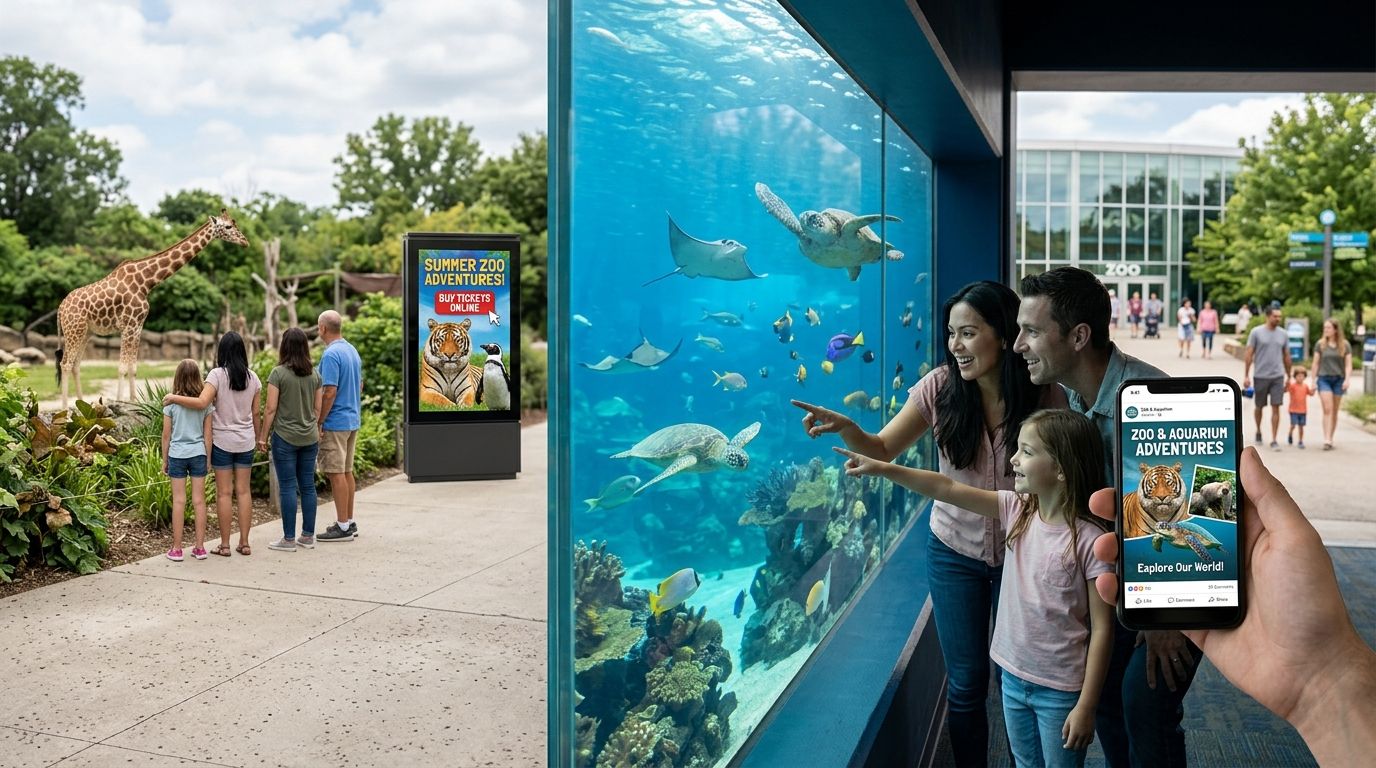
Paid media for zoos and aquariums is the use of targeted Google Ads, Meta, and TikTok campaigns to convert browsing families into ticket bookings and membership sign-ups, aimed at filling weekday slots and lifting revenue per visit. Zoos and aquariums sell an experience that's weather-exposed, school-holiday-driven, and heavily reliant on repeat family visits through memberships — which means a generic "days out near me" campaign wastes budget fast. The winning approach in 2026 treats search, social, and retargeting as three separate jobs, not one campaign duplicated three times.
- Paid media for zoos and aquariums works best when search campaigns target family intent and social carries the visual proof.
- Membership and annual pass ads need separate budgets from single-ticket campaigns — different buyer, different funnel.
- Retargeting lapsed members and cart-abandoners typically outperforms cold prospecting on cost per booking.
- FullyBooked treats school holidays, half term, and weather patterns as pacing triggers, not afterthoughts.
Why paid media matters for zoos and aquariums
A zoo or aquarium doesn't get one shot at a booking — it gets three: the first-time visitor, the returning family, and the member who renews once a year. Each of those needs a different ad, a different landing page, and a different bid strategy, which is exactly where most in-house campaigns for attractions fall down.
Families researching a day out compare zoos, aquariums, theme parks, and soft play in the same search session, often within a 48-hour window before booking. Paid media for zoos and aquariums has to win that comparison on search intent and visual proof — video of the shark tunnel or the meerkat enclosure does more work than any headline. FullyBooked builds these campaigns specifically for experience operators rather than adapting retail templates that were never built for ticketed, date-based attendance.
The paid media playbook for zoos and aquariums
This is the manual build order. Run it in sequence, and bring in paid support once you've validated which channels convert.
Map your booking calendar before you spend a pound
Zoos and aquariums have predictable demand curves: half term, Easter, summer holidays, and a slow January-to-March stretch. Building your media plan around this calendar prevents you from overspending on weeks that were always going to sell out anyway.
- Pull last year's daily ticket sales and flag the five slowest weeks
- Mark school holiday dates for your primary catchment area
- Note weather-sensitive days if your zoo has significant outdoor exhibits
- Set higher budgets for the two weeks before each half term
- Flag membership renewal anniversaries as a recurring monthly trigger
Build search campaigns around family search intent
Google Ads for zoos and aquariums should split into at least three ad groups: brand terms, generic "days out" terms, and location-modified terms. Bidding the same way across all three wastes spend on searchers who were already going to click your brand anyway.
- Separate brand, generic, and local ad groups with distinct budgets
- Use responsive search ads with animal-specific and exhibit-specific headlines
- Add school holiday dates directly into ad copy during peak windows
- Exclude "free" and "jobs" search terms from generic campaigns
- Bid up on mobile for last-minute weekend searches
Run visual-first social ads
Meta and TikTok reward zoos and aquariums that lead with footage, not offers. A ten-second clip of a penguin feed outperforms a static banner because it answers the real question: is this worth the drive? The full channel breakdown for this segment sits in FullyBooked's social media strategy for aquariums and zoos.
- Lead creative with keeper talks, feeding times, or behind-the-scenes footage
- Run separate creative for weekday off-peak vs weekend slots
- Use carousel ads to show multiple exhibits in one unit
- Test UGC-style video from real family visits over polished brand film
- Layer in seasonal creative for Halloween, Christmas, and summer holidays
Retarget lapsed and browsing visitors
Anyone who viewed your ticket page but didn't book is your cheapest conversion opportunity. Anyone whose membership lapsed in the last 12 months is your second cheapest. Both groups need their own retargeting pools, not a single generic come-back ad.
- Build a 7-day website visitor pool for cart abandoners
- Build a separate 30-90 day pool for lapsed members
- Exclude anyone who already booked in the last 14 days
- Use dynamic creative showing the exhibit they viewed where tracking allows
- Cap frequency at 3-4 impressions per week to avoid fatigue
Layer in membership and annual pass campaigns
Membership buyers behave differently to single-ticket buyers: longer consideration window, more sensitive at renewal, more likely to convert from email than cold ads. Treat annual pass campaigns as a separate funnel with their own landing page and budget line.
- Run membership campaigns as always-on, not seasonal bursts
- Target parents of children in the 2-10 age range as the core audience
- Test value framing against savings framing in ad copy
- Push renewal reminders as paid social 60 days before expiry
- Build a lookalike audience from your current member list
Optimise your Google Business Profile and local presence
Before any national campaign, get your free listing right — it captures the "aquarium near me" searches your paid ads are competing against anyway. Full setup steps sit in FullyBooked's guide to optimising a Google Business Profile for a venue.
- Add fresh photos of exhibits monthly, not just at launch
- Respond to every review within 48 hours
- Keep opening hours and seasonal closures updated in real time
- Use Google Posts to promote limited-run events like Halloween or Christmas grottos
- Add booking links directly to the profile rather than a generic homepage link
Measure cost per booking, not cost per click
A campaign with a low CPC and no bookings is a bad campaign. Set up conversion tracking tied directly to completed ticket purchases and membership sign-ups, split by channel and by ticket type.
- Track cost per booking separately for single tickets vs memberships
- Set a maximum acceptable cost per booking before scaling any campaign
- Review channel performance weekly during peak season, monthly off-peak
- Attribute multi-touch journeys where family bookings span several sessions
- Kill underperforming ad sets within 7 days of launch, not 30
Paid media channels for zoos and aquariums compared
| Channel | Best for | Key limitation |
|---|---|---|
| Google Search Ads | Capturing high-intent days-out and local searches | Competitive CPCs during school holiday peaks |
| Meta Ads | Visual storytelling and membership prospecting | Needs fresh creative every 2-3 weeks to avoid fatigue |
| TikTok Ads | Reaching younger parents and driving awareness | Weaker direct-response tracking than Meta or Google |
| Retargeting and display | Recovering cart abandoners and lapsed members | Needs enough site traffic to build usable audiences |
| In-house management | Small operators with time to run their own accounts | Limited bandwidth to test seasonal creative fast enough |
| Specialist agency (FullyBooked) | Operators wanting media built around booking calendars | Requires handing over campaign control and reporting access |
The verdict: zoos and aquariums that split search, social, and retargeting into distinct funnels consistently see lower cost per booking than those running one blended campaign across all three.
“If your ad account only optimises for the cheapest click, it fills your slowest Tuesday with people who were never going to buy a membership.”
Common mistakes zoos and aquariums make with paid media
- Treating every visitor as a first-timer. Membership renewal and lapsed-member retargeting get ignored in favour of constant cold prospecting.
- Running one campaign all year. Half term, summer holidays, and the January lull need different budgets and creative, not the same ad set on repeat.
- Ignoring weather as a pacing signal. Outdoor-heavy zoos see booking spikes on good forecasts, and flat daily budgets miss that demand.
- Skipping conversion tracking on membership sign-ups. Many operators track ticket sales but not memberships, which hides the real cost per booking by channel.
- Using static discount creative instead of exhibit footage. Families respond to seeing the animals, not to a percentage-off banner.
Fill more zoo and aquarium bookings
FullyBooked builds paid media around your booking calendar, not a template.
FAQ
What is the best paid media channel for zoos and aquariums in 2026?
Google Search Ads capture high-intent local and days-out searches, while Meta and TikTok drive awareness through exhibit footage. Most zoos and aquariums need both, split into separate campaigns rather than blended into one.
Is paid media better than organic social for zoos and aquariums?
Organic social builds ongoing engagement, but paid media converts browsing families into bookings during peak windows like half term. The two work together rather than replacing each other.
How much should a zoo or aquarium spend on paid media?
Budget should scale with your booking calendar: heavier spend in the two weeks before school holidays, lighter spend across the January-to-March lull. Check current market rates with a specialist rather than applying a flat percentage.
Should zoos and aquariums run separate campaigns for memberships and single tickets?
Yes. Membership buyers have a longer consideration window and respond to different messaging than single-ticket buyers, so blending both into one campaign dilutes performance for each.
Does retargeting work for zoos and aquariums?
Retargeting cart-abandoners and lapsed members is typically the cheapest conversion path available, because both groups have already shown intent. Separate pools for each group perform better than one generic audience.
How does weather affect paid media for zoos and aquariums?
Outdoor-heavy zoos see booking surges around good weather forecasts, so budgets that flex with forecast data outperform flat daily spend. Aquariums are largely indoor and can run steadier pacing.
What creative works best for zoo and aquarium ads?
Short video of feeding times, keeper talks, or behind-the-scenes footage consistently outperforms static banners. Families are deciding whether the visit is worth the trip, not comparing prices.
How do I track cost per booking for a zoo or aquarium?
Set up conversion tracking tied to completed ticket purchases and membership sign-ups, split by channel and ticket type, then review it weekly during peak season. Cost per click alone hides whether a campaign converts.
One last thing
The operators getting the lowest cost per booking in 2026 aren't the ones with the biggest budgets. They're the ones who stopped running the same ad set from January through December. Splitting membership, single-ticket, and retargeting campaigns apart, even on a modest budget, beats one blended campaign on a bigger one.


