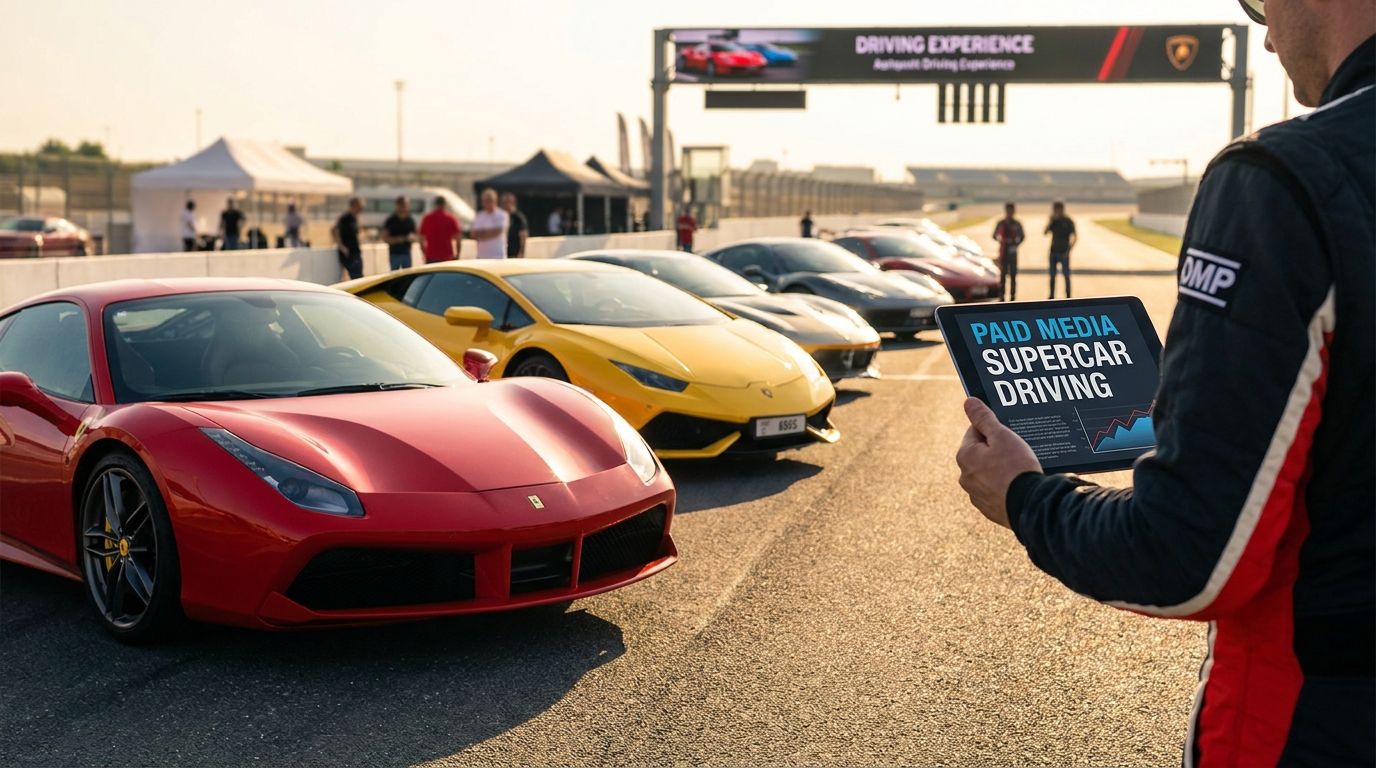
Paid media for supercar driving experience days is advertising built around a small pool of high-intent buyers spending £150 to £500+ on a single booking, not broad reach campaigns chasing car enthusiasts in general. This segment splits into two very different buyers — the person booking a driving slot for themselves and the person buying a gift voucher for someone else — and a campaign that treats them the same wastes budget on both.
- Paid media supercar driving experience campaigns split gift buyers from same-day drivers into separate funnels — merging them cuts conversion rate.
- Meta lookalikes built from past booker lists outperform broad car-enthusiast interest targeting for this audience.
- Google Search should own branded terms plus 'driving experience near me' intent; Meta owns discovery and gifting.
- Retargeting recovers checkout drop-off on a £150-£500 average order value, where hesitation before purchase is normal.
- Christmas and Father's Day gifting windows in 2026 need separate creative and budget pacing from year-round bookings.
Why paid media matters for supercar driving experience operators
A supercar driving day sells an experience, not a product, and the buyer decision cycle looks nothing like ecommerce. Someone researching a track day compares venues, checks reviews, and often waits for a birthday or Father's Day before committing — which means a single-touch ad strategy misses most of the value.
The gift-voucher half of this market runs on entirely different triggers: December and June/Father's Day spikes, browsing on mobile in the evening, buying for someone else without knowing exact car preferences. The same-day booker half runs on intent signals — searching specific track names, comparing lap counts, checking availability calendars. Paid media for supercar driving experience days has to run two funnels in parallel, because the buyer psychology, the creative that converts, and the seasonality don't overlap.
Segment your audience by purchase intent
Before any ad spends a pound, split traffic sources by what stage of intent they represent. Treating a cold Instagram scroller the same as someone who searched "supercar driving experience gift voucher" collapses your funnel into one underperforming average.
- Build a gift-buyer segment around occasion-based interest signals (birthdays, anniversaries, Father's Day, Christmas)
- Build a self-booker segment around location and track-specific search terms
- Tag past customers separately from prospects in your ad platform's custom audiences
- Exclude existing bookers from cold prospecting campaigns to stop wasting spend
- Layer age and income proxies only as a secondary filter, never the primary targeting signal
Build lookalike and retargeting audiences from past bookers
The manual, free-first move is exporting your customer list and uploading it as a seed audience — most experience operators already sit on this data and never use it. A lookalike built from people who've actually paid for a supercar experience beats interest-based targeting on "luxury cars" or "motorsport" every time, because it mirrors real buyers instead of guessed ones.
- Upload your past 12 months of bookers as a seed list for Meta and Google Customer Match
- Build a 1% lookalike first, widen only if volume plateaus
- Separate gift-voucher buyers from self-bookers into two seed lists, not one
- Refresh the seed list monthly so new bookers feed the lookalike pool
- Once the manual process is running, an agency managing this at scale — FullyBooked — automates the seed-list refresh and cross-platform sync so the lookalike never goes stale
Structure Google Search campaigns around high-intent terms
Google Search is where people who've already decided they want a driving experience go looking for a venue — this is bottom-funnel, not discovery. Branded search defends against competitors bidding on your name; non-branded intent terms capture people who haven't picked a venue yet.
- Bid on your own brand terms to stop competitor conquesting
- Build a campaign around "[location] driving experience" and "supercar experience day near me" variants
- Use call extensions and location extensions for last-minute, high-value bookings
- Add negative keywords for "free", "cheap", and unrelated car-buying terms early
- Route search traffic to a landing page matching the exact query, not a generic homepage
Use video creative that sells the drive, not the spec sheet
The biggest creative mistake in this vertical is treating the ad like a car brochure — horsepower numbers and 0-60 times don't convert nearly as well as footage of a real driver's reaction mid-lap. Buyers are purchasing an adrenaline memory, not a vehicle.
- Lead with in-car footage and genuine driver reactions over static car shots
- Show the full experience arc: briefing, track walk, the drive itself, celebration afterward
- Cut a gift-specific version with a voucher/unboxing moment for the December and Father's Day push
- Test a 6-second cutdown for Meta placements alongside a longer 30-second story version
- Avoid generic stock supercar imagery — real venue footage outperforms it on click-through
Layer in retargeting for abandoned high-ticket checkouts
A £150-£500 purchase gets abandoned at checkout more than a £15 one, simply because the buyer wants to think it over. Retargeting exists to catch that hesitation window before it turns into a lost sale.
- Set up a dynamic retargeting sequence triggered at checkout abandonment
- Use a different message at 24 hours (reminder) than at 7 days (urgency or availability)
- Retarget gift-voucher browsers with occasion-specific messaging tied to the actual date approaching
- Cap frequency so retargeting doesn't feel like harassment on a considered purchase
- Pull abandoned-checkout retargeting logic straight from the playbook covered in how paid media funnels get built for high-ticket experience bookings
Set a budget split that matches order value
A high average order value changes how budget should move across the funnel compared to a low-ticket attraction. Front-loading spend into broad prospecting when the purchase cycle runs weeks, not minutes, burns budget before intent has time to build.
- Weight spend toward Search and retargeting once a baseline audience exists, not just cold prospecting
- Hold back a dedicated pot for the two seasonal gifting spikes each year
- Track cost per booking against actual order value, not against a blended average across ticket types
- Reassess channel split monthly rather than locking a fixed allocation for the year
Track ROAS against a longer purchase cycle
Attribution windows built for impulse purchases undercount supercar experience conversions, because the gap between first ad view and booking can stretch to weeks. Judging performance on a 1-day click window hides most of the real return.
- Extend attribution windows to 28 days where the ad platform allows it
- Track assisted conversions, not just last-click, especially for gift-voucher campaigns
- Match ROAS reporting periods to the actual sales cycle, not a fixed weekly report
- Cross-reference ad platform data against actual bookings in your reservation system
Comparison: paid channels for supercar driving experience days
| Option | Best for | Key limitation |
|---|---|---|
| Meta prospecting + lookalikes | Reaching new buyers who resemble past bookers | Needs a seeded customer list to work well; cold interest targeting underperforms |
| Google Search (branded + intent) | Capturing buyers who've already decided to book | Limited reach for pure discovery; won't build new demand alone |
| YouTube/video pre-roll | Building awareness before a gifting season peak | Harder to measure direct attribution to bookings |
| Retargeting (abandoned checkout) | Recovering hesitant high-ticket buyers | Small audience size limits volume without strong top-of-funnel first |
| TikTok organic-boosted paid | Younger gift-buyer demographic, shareable footage | Less predictable ROAS than Search or retargeting |
Verdict: Meta lookalikes seeded from past bookers plus Google Search intent capture form the core of paid media for supercar driving experience days in 2026 — retargeting and video sit around that core, not in place of it.
Common mistakes supercar driving experience operators make
- Running one campaign for both gift buyers and self-bookers — the creative, offer, and landing page all need to differ
- Judging ROAS on a 1-day attribution window — a purchase cycle that runs weeks needs a longer measurement window or the numbers look worse than reality
- Leading creative with spec-sheet detail — horsepower stats don't sell an emotional experience the way in-car footage does
- Ignoring the seasonal gifting spikes — Christmas and Father's Day traffic needs separate budget pacing and creative from the rest of the year
- Skipping retargeting on a high-ticket purchase — checkout abandonment is normal at this price point and needs a dedicated sequence, not a hope that people come back
Fill more track slots in 2026
Talk through your gift-buyer and self-booker funnels with an operator who's run this playbook before.
FAQ
What is paid media for supercar driving experience days?
It's digital advertising — mainly Meta, Google Search, and retargeting — built around the two-part buyer journey of gift-voucher purchases and same-day booking intent for supercar track experiences. It differs from general car marketing because the buyer is purchasing an experience, not a vehicle.
Is Google Search or Meta better for supercar driving experience ads?
Google Search wins for bottom-funnel intent from people who've already decided to book, while Meta wins for discovery and gifting-season reach through lookalike audiences. Most operators need both running in parallel, not one instead of the other.
How long does it take to see results from paid media in this niche?
Because the purchase cycle for a £150-£500 experience can run several weeks, a fair read on performance needs an extended attribution window rather than a snap judgment after a few days.
Should gift-voucher buyers and self-bookers see the same ads?
No — they respond to different creative, different seasonal timing, and different landing pages, so running one blended campaign for both underperforms two separated funnels.
What creative works best for supercar driving experience ads?
In-car footage of real driver reactions consistently outperforms static car shots or spec-sheet messaging, because buyers are purchasing an adrenaline memory rather than comparing vehicle specifications.
Does retargeting matter for a high-ticket experience purchase?
Yes — checkout abandonment is more common at £150-£500 price points than at low-ticket purchases, and a dedicated retargeting sequence recovers a meaningful share of that hesitation.
When should supercar driving experience operators increase ad spend?
Around the two major gifting spikes — Christmas and Father's Day — when gift-voucher search volume and Meta engagement both rise ahead of the date.
One last thing
Most supercar driving experience operators sit on a customer list they've never uploaded as a seed audience — that single free step, done before any spend increase, usually moves the lookalike quality further than a bigger daily budget would in 2026. Fix the seed list first, then scale.


