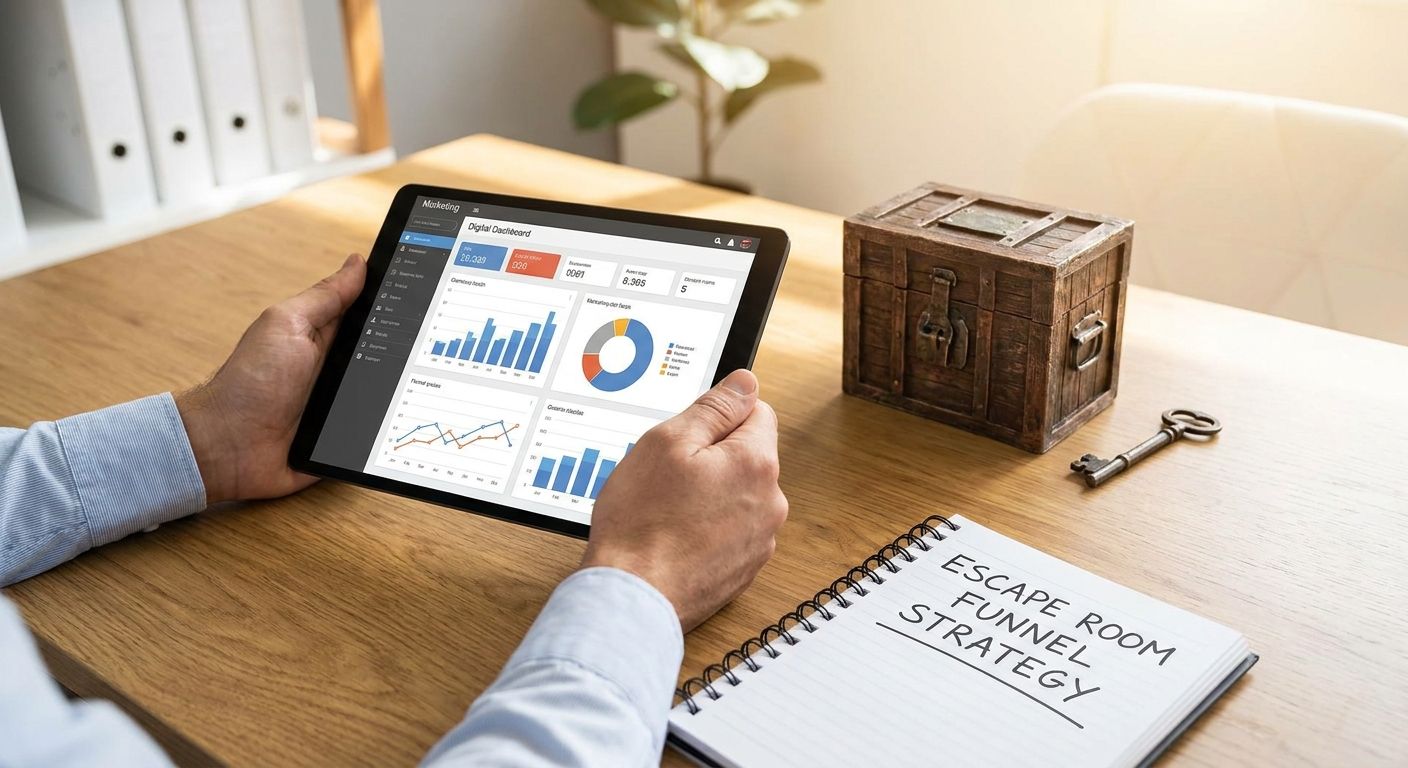
Escape room operators lose bookings every week because their paid media stops at the click instead of the calendar. A funnel that starts with the right audience and ends with a completed booking session is the difference between a full slot sheet and empty rooms on a Tuesday night.
- A working paid media funnel for an escape room needs three stages: cold reach, retargeting, and booking-completion recovery.
- Meta and TikTok drive the cheapest cold traffic for escape rooms in 2026; Google Search converts the highest-intent bookers.
- Cart abandonment on booking platforms runs high for time-slot products — a retargeting sequence within 48 hours recovers a meaningful share.
- Budget split matters more than creative polish: too much spend at the top of funnel starves the retargeting pool that actually books rooms.
- FullyBooked treats group bookings and corporate slots as a separate funnel branch, not an afterthought.
Why this matters
Most escape room operators run Meta ads the same way a retail brand would: broad targeting, a single ad set, and a hope that the algorithm finds bookers. Escape rooms aren't impulse purchases. A booker sees the ad, checks availability for their group size, checks the difficulty rating, and often leaves the site before finishing checkout. Without a funnel built around that hesitation, paid spend gets wasted on clicks that never convert to a confirmed slot.
FullyBooked has run paid media for escape room operators as part of managing 50+ experience operators and generating £85M+ in tracked booking revenue. The funnel structure below is the one that consistently turns cold traffic into filled time slots rather than one-off clicks.
What you'll need
- A booking platform with pixel or conversion API access (FareHarbor, Bookeo, Xola, or similar)
- Meta Ads Manager and a verified Business Manager account
- A Google Ads account with conversion tracking linked to your booking confirmation page
- GA4 set up with a "booking completed" event, not just "page view"
- 3-5 short video clips of the room (reveal moments, group reactions, countdown clock) shot on a phone — no production budio needed
- A minimum test budget of £30-£50/day across channels for the first two weeks
- A list of your existing customer emails/phones for a seed audience and exclusion list
The steps
1. Map your funnel stages before you touch the ad platforms
Define three stages up front: cold reach (people who've never heard of your room), warm retargeting (people who visited the booking page but didn't confirm), and post-booking retention (people who've already played). Each stage gets a different objective, budget, and creative — running one campaign to do all three is the single biggest reason escape room ad accounts underperform.
Set a target cost-per-booking based on your average ticket value. If a group booking averages £120 and you want a 4:1 return, your target cost-per-acquisition sits at £30. Write that number down before you launch anything in 2026 — it's the number you'll optimize every campaign against.
Common mistake: operators set a target ROAS copied from a retail benchmark. Escape rooms have longer consideration windows than a £25 t-shirt purchase, so early-stage ROAS numbers will look worse before they recover.
2. Build cold-traffic reach on Meta and TikTok
Start with broad interest and lookalike targeting on Meta — lookalikes built from your last 180 days of bookers usually outperform manual interest stacking. Layer TikTok in alongside Meta rather than instead of it; short vertical video of a group's reaction at the reveal moment consistently outperforms static images for cold audiences in this category.
Run at least two creative angles: one built around difficulty/challenge ("only 12% of teams escape") and one built around the social occasion (birthday groups, date night, work outings). Split budget 60/40 in favor of whichever angle has the stronger click-through rate after the first 500 impressions per ad.
Expected outcome: a cold-traffic cost-per-click in the £0.40-£0.90 range on Meta, depending on city and season. If you're paying more than that consistently, your creative is the problem, not your bid strategy.
3. Retarget every warm visitor within 48 hours
Anyone who lands on a room or booking page without completing checkout goes into a retargeting audience that fires within 48 hours — booking intent decays fast once someone closes the tab. Use a direct-response ad here: show the exact room, the price, and remaining slots for the week, not a generic brand video.
Add urgency honestly — real slot scarcity, not fabricated countdown timers. If Saturday 7pm has three spots left, say so. This is also where you introduce a group-booking or corporate angle for visitors who spent time on pages that suggest larger party sizes; group booking tactics built for venues apply directly here.
Common mistake: retargeting with the same cold-traffic ad. A warm visitor already knows what your room is — showing them a brand-awareness video instead of a booking-page nudge wastes the impression.
4. Layer in Google Search and Performance Max for high-intent capture
Someone searching "escape room [your city] this weekend" is closer to booking than anyone you'll reach on social. Run exact and phrase match on location plus category terms, and route all clicks to the specific room's booking page, never the homepage. Performance Max can run alongside Search once you have at least 30 conversions logged in the account — feeding it too early with thin data produces expensive, unpredictable results.
Paid media built for immersive experiences follows the same logic: intent-based search spend should never fall below 20% of total paid budget, even when social is delivering cheaper clicks.
5. Recover abandoned bookings with email and SMS
Booking platforms lose a meaningful share of sessions between "select time slot" and "confirm payment." Set up an automated email and SMS sequence that fires within an hour of an abandoned session, then again 24 hours later with a reminder of remaining availability. This single sequence often recovers bookings that paid media would otherwise have to pay to win back through retargeting.
An email marketing strategy built for ticketed events works the same way for escape rooms — the trigger is the abandoned session, not a generic weekly newsletter.
6. Set your budget split and hold it for at least 4 weeks
A reasonable starting split for an escape room in 2026 runs 45% cold reach, 35% retargeting, 20% search. Adjust based on which stage is producing your lowest cost-per-booking after four full weeks of data — not after three days. Escape room booking cycles run longer than most impulse categories, so early optimization on incomplete data produces the wrong conclusions.
Get your funnel audited
See where your escape room paid media budget is leaking bookings.
7. Build a separate branch for group and corporate bookings
Group bookings (6+ people) and corporate team-building slots have a different decision-maker, longer lead time, and higher average value than a standard couple or friend group. Run a dedicated ad set with LinkedIn or Meta targeting office managers and event planners, pointing to a group-specific landing page with capacity and pricing tiers visible upfront.
8. Review weekly, not daily
Check cost-per-booking, not cost-per-click, every week. Daily checks on an escape room account produce false signals because weekday and weekend booking patterns swing wildly — a Tuesday CPA spike is normal, not a crisis.
Troubleshooting
- Cost-per-click looks fine but bookings aren't coming in: your booking page has friction — check load speed on mobile and whether the calendar shows real-time availability or a stale cache.
- Retargeting audience is too small to spend against: widen the window from 7 days to 30 days of site visitors, or add a video-view custom audience from your Meta or TikTok creative.
- Weekday slots stay empty despite ad spend: shift budget toward a midweek-specific offer angle rather than running the same weekend-focused creative every day of the week.
- Group bookings aren't converting from ads: the landing page is the problem more often than the targeting — corporate bookers need visible pricing and capacity, not a "contact us" form.
- No-shows are eating into your paid media ROI: a confirmed booking that doesn't show up still cost you acquisition spend; a no-show reduction strategy closes that leak before it hits your ROAS numbers.
- CPA rising month over month with no seasonal explanation: creative fatigue is the usual cause — refresh video assets every 3-4 weeks, not every quarter.
Tools and resources
- Meta Ads Manager and TikTok Ads Manager for cold and warm-audience delivery
- Google Ads with conversion tracking tied to the booking confirmation page, not the homepage
- GA4 with a custom "booking completed" event
- Your booking platform's abandoned-cart export or webhook for retargeting audience building
- Paid media built specifically for escape rooms if you want the full audit and setup handled rather than built in-house
- Retention marketing for escape rooms for the post-booking loop once the funnel above is filling rooms
What to do next
Once the funnel above is running and stable for a full month, the next lever is channel mix rather than funnel structure — the best marketing channels for escape rooms breaks down where to shift spend as your account matures past the initial 4-week test window.
FAQ
How much should an escape room spend on paid media in 2026?
Most single-location escape rooms start testing with £30-£50 a day split across Meta, TikTok and Google Search in 2026. Budget should scale once cost-per-booking is confirmed stable over a 4-week window, not before.
What's the best paid media channel for escape room bookings?
Meta and TikTok deliver the cheapest cold-traffic reach, while Google Search converts the highest-intent bookers who already know they want to play this week. A funnel needs both — neither channel alone covers the full booking journey.
How long does it take to see results from an escape room ad funnel?
Expect 3-4 weeks before cost-per-booking data is reliable enough to optimize against. Escape room booking cycles run longer than impulse retail purchases, so early-week numbers are usually misleading.
Is retargeting more important than cold traffic for escape rooms?
Retargeting typically produces the lowest cost-per-booking because it targets people who already showed intent by visiting the booking page. Cold traffic still matters — without it, the retargeting pool runs dry within a few weeks.
How do I stop abandoned bookings on my escape room website?
An automated email and SMS sequence firing within an hour of an abandoned booking session recovers a meaningful share of lost checkouts. Combine it with a 24-hour follow-up message showing remaining slot availability.
Should escape rooms run Google Ads or just social media?
Both. Google Search captures people actively searching for a room this weekend, which social media rarely reaches at that exact moment of intent. A 20% minimum search budget alongside social spend is a reasonable starting split.
What creative works best for escape room ads?
Short vertical video showing the reveal moment or a group's reaction outperforms static images for cold audiences. Direct-response ads showing real slot availability work better than brand-style videos for retargeting.
How do group and corporate bookings fit into the funnel?
Group and corporate bookings need a separate ad set and landing page with visible pricing and capacity, aimed at office managers and event planners rather than casual bookers. Treating them as an afterthought inside the main funnel usually produces a low conversion rate.
One last thing
The operators who see the fastest turnaround aren't the ones with the biggest budgets — they're the ones who fix the abandoned-booking recovery sequence first, because that single fix recovers revenue from spend they've already paid for. Fix that before scaling cold-traffic budget in 2026; scaling a leaky funnel just multiplies the leak.


