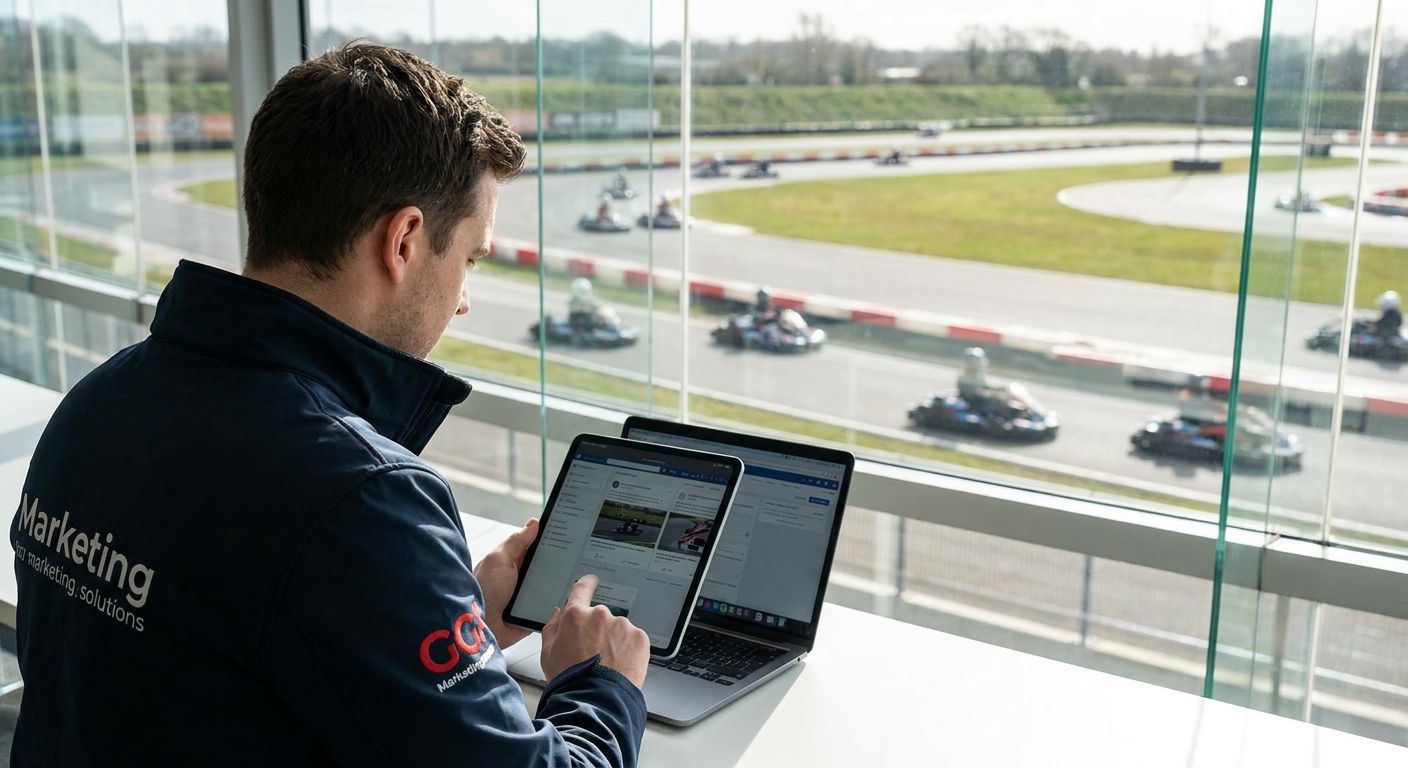
Paid media for karting tracks only works when it matches how people actually book: last-minute, mobile, and driven by a specific date (a birthday, a stag do, a school holiday). Get the channel mix wrong and you're burning spend on impressions nobody converts.
- Paid media for karting tracks performs best when Google Search near-me campaigns run alongside Meta retargeting, not instead of it. Buy both.
- Standalone boosted Facebook posts are the weakest spend for karting tracks in 2026 — treat social as retargeting, not discovery.
- Retention campaigns to past bookers recover repeat visits cheaper than new-customer acquisition; run this from month one.
- FullyBooked has generated £85M+ in ticketing revenue and sold 3M+ tickets across experience operators using this exact funnel logic.
Why this matters
Karting tracks live and die on grid utilisation. An empty 10am slot on a Tuesday is dead revenue the moment the clock hits 10:01 — there's no way to sell it back. That makes paid media a different game than most retail categories: you're not selling a product that sits on a shelf, you're selling a perishable time slot that needs to be filled before it expires.
Most tracks still run paid media the way a local shop runs a flyer — a boosted post here, a generic Google ad there, no structure tying spend to actual grid capacity. In 2026, the operators pulling ahead are the ones treating paid media as a booking-funnel problem, not a brand-awareness problem. That means matching campaign structure to how sell more tickets actually happens for time-slot businesses: intent capture first, retargeting second, retention last.
Who this is for
This is for karting track operators — indoor or outdoor, single-site or multi-venue — who are spending on Meta or Google already but can't tie that spend to filled grids. It's also for operators about to launch paid media for the first time and want to skip the trial-and-error phase that eats a quarter's budget before it produces a working funnel.
What to look for in paid media for karting tracks
Near-me search intent capture
Someone typing "go karting near me" tonight has already decided to book — they're choosing between you and the next result. A campaign that doesn't bid aggressively on these terms during peak hours (weekday evenings, weekend mornings) is leaving the highest-intent traffic to a competitor with a better-structured Google Search campaign.
Occasion-based audience targeting
Karting bookings cluster around occasions: birthdays, stag/hen parties, corporate team days, school holidays. Meta and TikTok targeting built around these occasions — not generic "motorsport enthusiasts" interest stacks — produces meaningfully lower cost-per-booking because the audience already has a reason to convert this week.
Retargeting structure for abandoned bookers
A visitor who reaches your booking page and drops off is warmer than any cold audience you'll ever buy. Track operators without a retargeting sequence for cart-abandoners and page-viewers are re-buying the same clicks they already paid for once.
Peak-season budget flexing
2026 school holiday windows and half-terms drive the sharpest demand spikes karting tracks see all year. Paid media that scales budget up two to three weeks ahead of these windows — instead of reacting once slots are already half-empty — captures the demand before competitors do.
Creative built for the venue, not stock footage
Generic stock karting clips convert worse than raw footage of your actual track, your actual grid, real lap times on your actual circuit. Viewers can tell the difference within the first two seconds of a Reel or a Google Display ad.
Attribution tied to bookings, not clicks
If your reporting stops at click-through rate, you can't tell which campaign actually filled a Tuesday 6pm slot versus which one just generated cheap traffic. Attribution needs to run through to the booking confirmation, not the landing page visit.
Get a paid media plan for your track
See what a booking-funnel audit looks like for karting operators.
Top picks: what to actually run
Google Search — near-me and occasion keywords. The hook: this is the highest-intent channel karting tracks have access to, full stop. One spec that matters: campaigns split by occasion ("birthday karting," "stag do karting," "corporate karting") consistently outperform a single generic ad group because the ad copy and landing page match search intent exactly. This mirrors the same near-me capture strategy documented for paid media for escape rooms, another time-slot business with the same booking urgency. Buy.
Meta retargeting sequence for abandoned bookings. The hook: the cheapest booking you'll ever generate in 2026 is a repeat visit to someone who already looked at your slots. One spec: a three-stage sequence (24-hour reminder, 72-hour nudge, 7-day occasion reminder) keeps cost-per-booking well below cold-audience Meta spend. Buy.
Retention email and SMS to past bookers. The hook: past visitors already know the experience is good — you're not convincing them, you're reminding them. This is the same logic behind retention marketing for escape rooms, where lifecycle campaigns to existing customers cost a fraction of new-audience acquisition. Buy.
Boosted organic posts with no targeting structure. The hook: this is the "spend money to feel like you're doing marketing" option. One spec: boosted posts with no audience segmentation and no retargeting pixel attached produce impressions, not bookings, because Meta optimises for engagement, not conversions, without the right campaign objective set. Skip.
TikTok organic-style ads for stag/hen and group bookings. The hook: group bookers research visually before they book, and TikTok's short-form format matches that behaviour. One spec: creative shot on-site at your actual track, cut fast, with a clear price-per-person overlay, converts group inquiries better than polished brand-style video. Consider.
What to avoid
- Generic "motorsport" interest targeting on Meta. It sounds relevant but pulls in Formula 1 fans with zero local booking intent — spend gets wasted on an audience that will never drive to your track.
- Running paid media with no landing page built for mobile booking. Most karting searches happen on a phone in the evening; a desktop-first booking flow kills conversion before the ad even gets credit.
- Treating every season the same. A budget that stays flat through 2026's peak school holiday weeks versus a quiet February leaves bookings on the table exactly when demand is highest.
Verdict comparison
| Channel | Best for | Cost behaviour | Verdict |
|---|---|---|---|
| Google Search (near-me) | Same-week bookers | Highest CPC, highest intent | Buy |
| Meta retargeting | Abandoned bookings | Low cost-per-booking | Buy |
| Retention email/SMS | Past bookers | Lowest cost per repeat visit | Buy |
| TikTok group-booking ads | Stag/hen, corporate | Mid cost, high engagement | Consider |
| Unstructured boosted posts | Nobody in particular | Wasted spend | Skip |
FAQ
What is the best paid media channel for karting tracks in 2026?
Google Search near-me campaigns paired with Meta retargeting perform best for karting tracks in 2026 because they capture same-week booking intent and recover abandoned bookings at low cost. Boosted social posts without targeting structure underperform both.
How much should a karting track spend on paid media?
Spend should scale with grid capacity and season, rising two to three weeks ahead of school holidays and weekends rather than staying flat year-round. Operators without a booking-funnel audit often over-spend on low-intent channels and under-spend on retargeting.
Is influencer marketing worth it for karting tracks?
Influencer marketing works best for group-booking occasions like stag and hen parties, similar to how it performs for adventure parks and trampoline parks, but it should run alongside paid media, not replace it.
Do karting tracks need retention marketing or just acquisition?
Both, but retention marketing to past bookers costs less per booking than new-customer acquisition and should launch alongside any new paid media campaign, not after it.
What's the biggest mistake karting tracks make with paid media?
The most common mistake is running boosted posts with no retargeting pixel and no landing page built for mobile booking, which produces impressions but not filled grids.
Should karting tracks run TikTok ads in 2026?
TikTok works well for group and stag/hen bookings when creative is shot on-site rather than polished brand video, but it should sit alongside Google Search and Meta retargeting rather than as the only channel.
How fast can paid media fill empty karting grid slots?
Retargeting campaigns aimed at abandoned bookers typically produce the fastest results because the audience has already shown intent, while search campaigns take longer to build volume as keyword data accumulates.
One last thing
The operators seeing the strongest grid utilisation in 2026 aren't the ones with the biggest ad budget — they're the ones who built retargeting and retention sequences before they scaled cold-audience spend. Fix the leaky bucket first, then pour more in.


