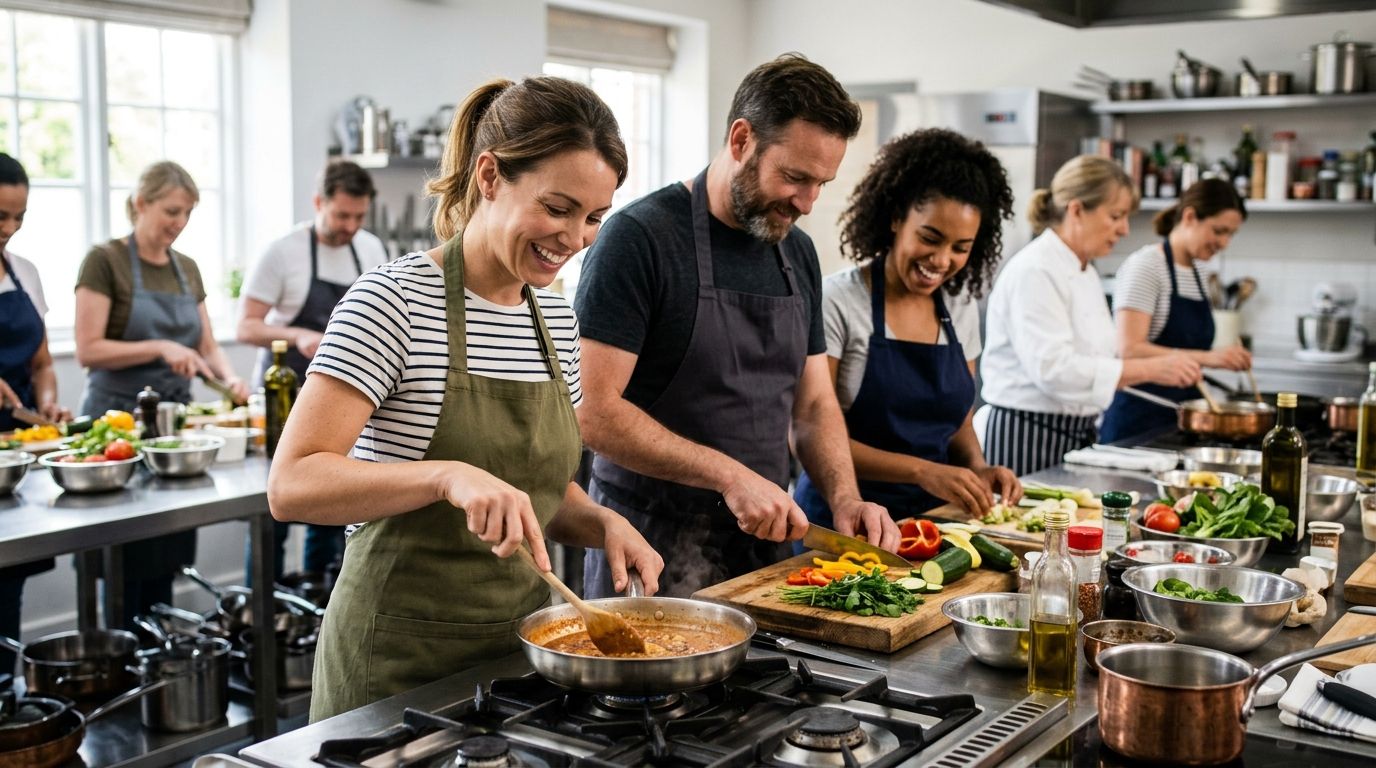
Paid media for cookery school experiences is targeted ad spend across Google, Meta and TikTok built to fill class seats and turn one-off bookers into repeat customers. Cookery schools run fixed-capacity classes with occasion-driven demand — date nights, hen parties, corporate team-building, gift vouchers — so campaigns need occasion-based targeting, not generic "cooking class near me" keywords.
- Paid media for cookery schools works best split by occasion — date night, corporate, gift voucher — not by generic cooking class keywords.
- Google Ads captures bookers searching close to a class date; Meta and Instagram fill off-peak slots by building awareness earlier in the funnel.
- FullyBooked has managed paid media for 50+ experience operators and generated £85M+ in booking revenue across that portfolio.
- Retargeting abandoned bookings recovers seats that would otherwise sit empty, since class capacity is fixed and perishable.
- Track cost per booked seat, not cost per click — that is the number that tells you if a campaign actually fills classes.
Why paid media matters for cookery schools
A cookery school sells a fixed number of seats per class, on a fixed date, and every empty seat at the start time is lost revenue that cannot be recovered later. That makes pacing between paid and organic demand more important here than for most experience categories — you are not selling an unlimited product, you are selling a countdown.
Demand also is not one audience. A Tuesday evening pasta class attracts date-night bookers searching a week out; a Friday afternoon slot gets filled by corporate team-building leads who book six weeks in advance and pay per head; December fills almost entirely on gift vouchers bought by people who have never taken the class themselves. Paid media for cookery schools that treats all three as one audience wastes budget on the wrong message at the wrong time.
Bookers researching a cookery class typically compare two or three venues before committing, which means how to sell more tickets for your venue or event principles around urgency and social proof apply directly — in 2026 the school with the clearer offer and faster retargeting wins the booking, not necessarily the better class.
Build your 2026 paid media plan step by step
Audit your booking funnel and seat inventory
Before spending a pound on ads, know which classes are actually short of bookings and which are already selling out organically.
- Pull the last 12 months of bookings by class type, day of week and time slot
- Flag classes running under 60% capacity two weeks before the date
- Identify your highest-margin class, often the multi-course or wine-paired session
- Separate gift voucher sales from direct class bookings in your reporting
- Note which slots corporate bookers actually request versus which you assume they want
Build Google Ads campaigns around high-intent search
Search ads catch people who have already decided they want a cookery class and are choosing where to book it. This is the highest-converting channel for most operators.
- Bid on exact-match terms like "pasta making class [city]" and "cookery course gift voucher"
- Build separate ad groups for date-night, corporate and gift-voucher intent
- Use call-out extensions for class length and group size, not price — point people to current pricing on your own booking page
- Exclude "free recipes" and "cooking tips" search terms that waste budget on non-buyers
- Send corporate searches to a dedicated landing page, not the general booking page
How to use Google Ads to sell more event tickets covers the bidding structure in more depth if you are setting this up for the first time.
Segment Meta and Instagram ads by occasion
Meta is where cookery schools build the awareness that search cannot — most people do not know they want a cookery class until a video of dough being kneaded stops their scroll.
- Run a date-night creative set with couples-focused copy and evening slot CTAs
- Run a separate corporate creative set with team-building language and a lead form, not a direct booking link
- Retarget website visitors who viewed a class page but did not book within 7 days
- Use short-form video of the actual class rather than stock photography
- Test gift-voucher creative from late November through the third week of December, when that intent spikes
A specialist agency running this at scale — FullyBooked has managed paid media for 50+ experience operators and generated £85M+ in booking revenue — typically runs 4 to 6 audience segments in parallel rather than one broad campaign, because a single ad set cannot speak to a corporate buyer and a hen-party organiser at once.
Layer in retargeting for abandoned bookings
Cookery school checkout abandonment runs high because group bookers often need to check with three or four other people before confirming. That gap is where retargeting earns its budget.
- Retarget anyone who reached the booking calendar but did not complete checkout within 48 hours
- Use a limited-seats message only when a class is genuinely close to capacity
- Exclude anyone who already booked from the retargeting pool
- Test a short SMS or email nudge alongside the ad, not instead of it
How to use retargeting ads for event ticket sales walks through the sequencing in more detail.
Seed influencer and creator content for organic reach
Cookery classes are inherently visual and shareable, which makes them one of the stronger fits for influencer seeding among experience categories.
- Invite 2 to 3 local food creators per quarter rather than one large-follower account
- Prioritise creators who post process video, not just plated final shots
- Repurpose creator content as paid social creative once you have usage rights
- Track bookings from a unique code or link, not follower count
Measure cost per booked seat, not cost per click
Cost per click tells you almost nothing about whether a class filled. Cost per booked seat, weighted by class margin, is the number that decides whether a campaign gets more budget or gets cut.
- Set up conversion tracking on the booking confirmation, not the add-to-cart step
- Calculate cost per seat separately for date-night, corporate and gift-voucher campaigns
- Compare cost per seat against average class margin to find true ROAS
- Review weekly during peak season, October through January, and monthly the rest of 2026
Comparing your paid media options
| Option | Best for | Key limitation |
|---|---|---|
| DIY Google Ads | Schools with one person managing marketing part-time | Slow to optimise; easy to waste spend on broad match terms |
| DIY Meta Ads | Schools with strong existing content and video | Corporate and gift-voucher segments get missed without dedicated ad sets |
| Influencer seeding | Single-location schools wanting local awareness | Does not reliably fill specific date and time gaps on its own |
| Specialist agency (FullyBooked) | Multi-class schools needing occasion-segmented campaigns run at pace | Requires handing over campaign management and reporting cadence |
Verdict: FullyBooked is best for cookery schools running 15 or more classes a month across mixed occasions — date night, corporate, gift voucher — where one generic campaign cannot cover the spread. Schools running one or two class types a week will usually get further with a tightly built DIY Google Ads account first.
Fill more classes with occasion-led paid media
Get a paid media plan built around your actual booking calendar.
Common mistakes cookery schools make
- Running one generic ad for all classes. A single "book a cooking class" ad ignores that corporate buyers, date-night couples and gift shoppers respond to completely different messages.
- Ignoring the gift voucher window. Schools that do not ramp voucher-specific campaigns by early November miss the highest-intent sales period of the year.
- Ranking campaigns on cost per click instead of cost per seat. A cheap click that never converts to a filled seat is worse than an expensive one that does.
- No retargeting for group organisers. Hen-party and corporate bookers rarely convert on the first visit, so without retargeting that research phase is wasted spend.
- Treating every day of the week the same. A campaign that ignores which slots are structurally hard to fill, usually weekday afternoons, over-spends on classes that were already selling out.
Other workshop-format operators face the same segmentation problem — best marketing strategy for pottery and craft workshop studios covers the parallel playbook for a different hands-on category.
FAQ
What is the best paid media channel for cookery schools?
Google Ads usually converts best because it catches people already searching for a class; Meta and Instagram are stronger for building awareness and gift-voucher demand. Most cookery schools need both running at the same time in 2026.
Is Meta or Google better for filling last-minute class slots?
Google Ads wins for last-minute fills because search intent is immediate. Meta retargeting can also recover people who browsed a class page in the past week, so run both when a class sits under 60% capacity two weeks out.
How much should a cookery school spend on paid media?
Budget depends on class volume and margin per seat, so set targets against your own booking data rather than a fixed figure. Cost per booked seat is the metric to plan around, not spend as a percentage of revenue.
Should cookery schools run separate ads for corporate bookings?
Yes. Corporate team-building bookers respond to different messaging and book further in advance than date-night couples, and mixing the two into one ad set dilutes both.
Does influencer marketing work for cookery schools?
It works well because classes are visual and shareable, but it builds general awareness rather than filling specific date and time gaps. Pair it with retargeting ads to convert that awareness into bookings.
When should cookery schools start gift voucher campaigns?
Late November through the third week of December is peak gift-voucher intent for experience categories. Campaigns launched after early December miss a large share of that window.
What is the biggest paid media mistake cookery schools make?
Running one generic ad across all class types and occasions. Corporate, date-night and gift-voucher bookers need separate messaging, separate landing pages and separate budget lines.
One last thing
Most cookery schools measure success by class attendance, but the number that actually predicts next quarter's revenue is repeat booking rate from first-time attendees. A class that fills through paid media but never brings people back is running on acquisition spend indefinitely. Fixing that in 2026 starts with the group and retention thinking in how to boost group bookings for a venue, applied to the cookery format specifically.