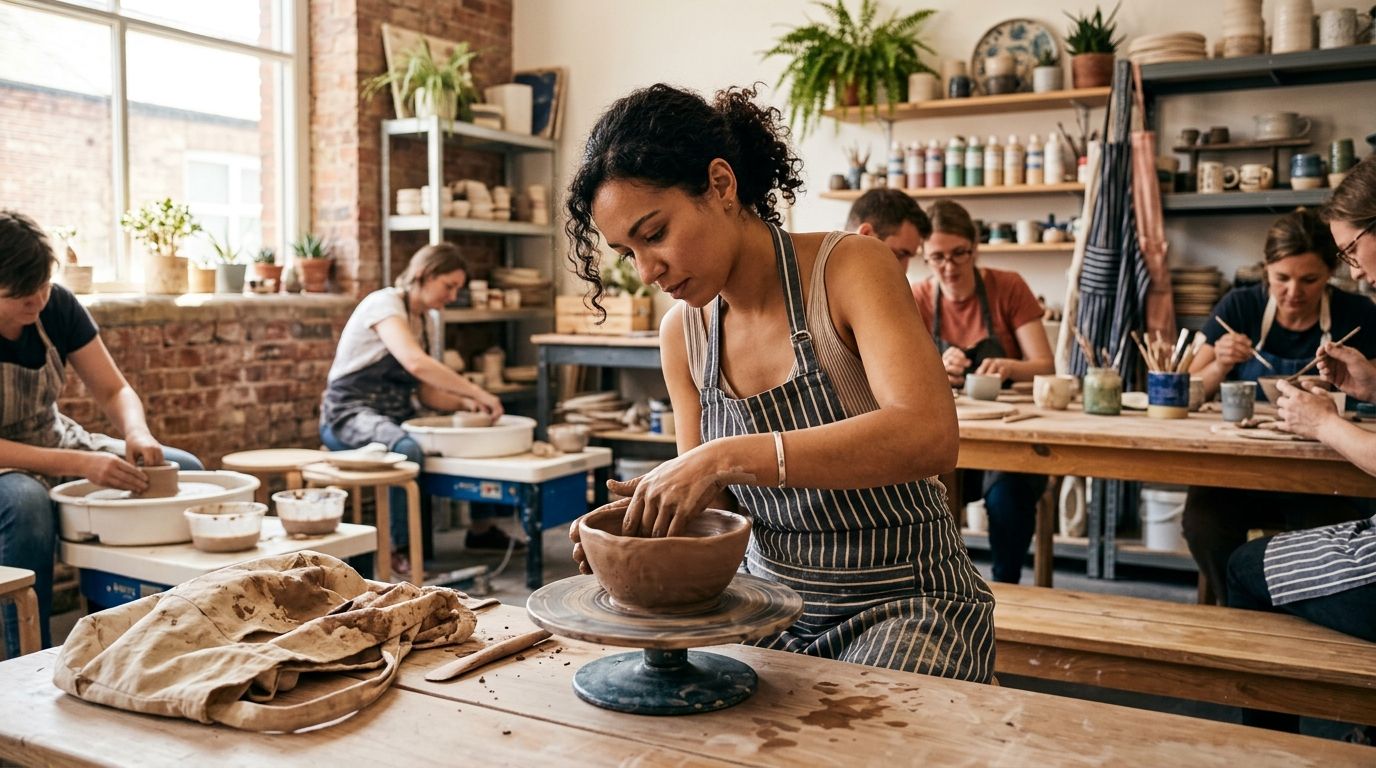
Pottery and craft workshop studios don't need a bigger marketing budget in 2026 — they need the right mix of channels for a business built on small class sizes, tactile content and repeat bookers. The best marketing strategy for pottery and craft workshop studios combines paid social built on UGC-style making footage, a fully optimised Google Business Profile, and retention marketing that turns one-off bookers into monthly regulars.
- Paid social with UGC-style making footage is the best marketing strategy for pottery workshop studios overall.
- Google Business Profile optimisation wins local searches like 'pottery classes near me' at zero media spend.
- Email and SMS retention marketing costs least per repeat booking once you have a list.
- Referral and loyalty programmes convert one-off bookers into recurring class members over 2026.
- Seasonal campaigns around date nights and gift vouchers drive the sharpest short-term revenue spikes.
Why this matters
Pottery and craft workshop studios sit in the same booking-driven category as paint-and-sip studios — low-margin classes, fixed seat counts, and a customer who books once out of curiosity and needs a reason to come back. Get the channel mix wrong in 2026 and you're either paying too much per seat filled or leaving a Saturday class half-empty.
Across managed venues and experience operators, £85M+ in revenue has been generated, 3M+ tickets sold, and 50+ operators managed on the same core principle: paid media fills the top of the funnel, but retention and local search decide whether the studio is profitable by month six. Craft workshops depend on this more than most categories because the product — sitting at a wheel or painting glaze — is inherently visual and inherently repeatable.
What makes the best marketing strategy for a pottery workshop studio
- Cost per booking efficiency across paid and organic channels
- Speed to fill recurring weekly or monthly class slots
- Impact on repeat bookings and class-to-class retention
- Local search visibility for "pottery classes near me" style queries
- Content production effort relative to a small studio team
- Scalability across more than one studio location
At a glance
| Strategy | Best for | Standout feature | Key limitation |
|---|---|---|---|
| Paid social with UGC content | Filling recurring class slots at scale | Turns the making process into scroll-stopping content | Needs a steady stream of fresh footage |
| Google Business Profile optimisation | Local discovery searches | Captures "near me" intent at zero media spend | Reach limited to your local area |
| Email and SMS retention marketing | Lowest cost per repeat booking | Reaches past attendees with no platform fees | Only works once you have a list to message |
| Influencer and local creator seeding | Building trust with a niche craft audience | Borrows an established audience's credibility | Harder to attribute direct bookings |
| Referral and loyalty programmes | Converting one-off bookers into regulars | Rewards the exact behaviour you want | Takes months to build real volume |
| Seasonal campaign calendar | Short-term revenue spikes around key dates | Predictable demand windows you can plan around | Underperforms outside the seasonal window |
1. Paid social with UGC content: best marketing strategy for filling recurring class slots
Meta and TikTok reward footage of hands on a wheel, glaze being poured, and finished pieces coming out of the kiln — content a craft studio already generates by running classes. Paid spend behind this footage, targeted around a 5-10 mile radius, fills recurring weekly slots faster than static ads or boosted posts ever will.
Paid social pros:
- Turns existing class content into ad creative with almost no extra production
- Local radius targeting matches how far most bookers will actually travel
- Performs well on both Meta and TikTok without separate creative sets
Paid social cons:
- Needs fresh footage every few weeks or performance flattens
- Requires someone comfortable filming during live classes
Verdict: Priority pick for 2026.
2. Google Business Profile optimisation: best marketing strategy for local discovery
A fully built-out profile — photos, class categories, opening hours, and regularly answered reviews — captures searchers typing "pottery classes near me" at the exact moment they're ready to book. This channel costs nothing beyond the time to maintain it, which makes it disproportionately valuable for a small studio.
Google Business Profile pros:
- Zero media spend required to appear in local map results
- Captures high-intent searchers already deciding where to book
- Reviews compound over time and keep improving ranking
Google Business Profile cons:
- Reach is capped by geography — it won't grow bookings beyond your area
- Slow to build without an active review request habit
Getting this right takes more than filling in fields — see the full breakdown on optimising a Google Business Profile for a venue.
Verdict: Priority pick for 2026.
3. Email and SMS retention marketing: best marketing strategy for the lowest cost per repeat booking
Once a studio has a list of past attendees, email and SMS reach them directly with zero platform fees per send. A simple sequence — thank you, gallery of their piece, invite to the next class — consistently outperforms paid ads on cost per repeat booking because there's no bidding involved.
Email and SMS pros:
- No media spend, so cost per repeat booking is the lowest of any channel here
- Direct reach to people who already know the studio
- Easy to automate once a booking triggers the sequence
Email and SMS cons:
- Only works once a list exists — new studios have nothing to send to at launch
- Needs a booking platform that captures email and phone at checkout
Verdict: Priority pick for 2026, but only once a list exists.
4. Influencer and local creator seeding: best marketing strategy for building trust in a niche audience
Seeding free or discounted sessions to local creators who cover craft, wellness or date-night content lends a studio credibility it can't buy through ads alone. This works particularly well for craft workshops because the content — a finished mug, a wobbly first attempt, a laugh at the wheel — is naturally shareable.
Influencer seeding pros:
- Borrows an audience that already trusts the creator
- Produces authentic-feeling content a studio couldn't produce in-house
- Works well for one-off bookings around gifting occasions
Influencer seeding cons:
- Harder to attribute bookings directly back to a single creator
- Quality varies enormously between creators
Verdict: Test first in 2026, then scale what works.
5. Referral and loyalty programmes: best marketing strategy for converting one-off bookers into regulars
Craft workshops lose most of their long-term profitability if every booker only ever comes once. A structured referral or loyalty mechanic gives past attendees a reason to bring a friend or book a second session, shifting the studio from constant new-customer acquisition to a base of repeat visitors.
Referral and loyalty pros:
- Rewards exactly the behaviour that improves studio economics — repeat visits
- Costs less per booking than acquiring a brand-new customer
- Compounds as the past-attendee base grows
Referral and loyalty cons:
- Takes months of consistent bookings to reach meaningful volume
- Needs simple tracking so rewards are actually honoured
Verdict: Priority pick once retention marketing is already running.
6. Seasonal campaign calendar: best marketing strategy for short-term revenue spikes
Date nights, hen and stag groups, Christmas gift vouchers and Mother's Day sessions create predictable demand windows a studio can plan media spend around months in advance. This channel produces the sharpest spikes of any strategy here but does nothing for the quiet weeks either side of the calendar.
Seasonal campaigns pros:
- Predictable timing means creative and media can be planned in advance
- Gift vouchers and date-night framing attract bookers who wouldn't otherwise search for pottery
- Pairs naturally with paid social and email at the same time
Seasonal campaigns cons:
- Underperforms badly outside the seasonal window
- Needs new creative angles every occasion rather than reusing assets
Verdict: Add later once the always-on channels are stable.
How we ranked
Each strategy was weighed against the six criteria above: cost per booking, speed to fill slots, repeat-booking impact, local search visibility, content effort, and scalability across more than one studio. Paid social and Google Business Profile scored highest on speed and cost combined, which is why they sit at the top of the ranking — retention and referral tactics score higher on long-term repeat-booking impact but need volume to already exist before they work.
Which marketing strategy should you choose?
Start with paid social and Google Business Profile optimisation together in 2026 — one fills slots fast, the other captures people already searching. Layer in email and SMS retention marketing the moment a list exists, then add referral and loyalty mechanics once repeat bookings are visible in the data. Save influencer seeding and seasonal campaigns for once the always-on channels are stable — they add spikes, not a foundation.
Want a marketing plan built for your studio?
Get a tailored booking strategy for your class calendar.
FAQ
What is the best marketing strategy for pottery workshop studios in 2026?
The best marketing strategy for pottery workshop studios in 2026 combines paid social built on UGC-style making footage, an optimised Google Business Profile for local search, and email or SMS retention marketing once a customer list exists.
Is paid social better than Google Business Profile for a craft studio?
Paid social fills recurring class slots faster because it reaches people who aren't yet searching, while Google Business Profile captures people already typing 'pottery classes near me'. Both should run at the same time rather than one replacing the other.
How much should a pottery studio spend on paid social?
Budget depends on class capacity and local competition, so check current ad platform costs directly rather than working from a fixed figure. Start with a small always-on budget behind UGC-style content and scale it against cost per booking.
Does influencer marketing work for pottery and craft workshops?
Influencer and local creator seeding works well for building trust in a niche craft audience, particularly around gifting occasions like date nights and hen parties. It's harder to attribute directly to bookings, so treat it as a trust-building layer rather than the primary channel.
How do craft studios increase repeat bookings?
Repeat bookings come from email and SMS retention marketing combined with a referral or loyalty programme, both of which target past attendees directly rather than acquiring new customers. This is consistently cheaper per booking than paid acquisition once a list exists.
When should a pottery studio run seasonal campaigns?
Seasonal campaigns around date nights, hen and stag groups, and gift vouchers for Christmas or Mother's Day produce the sharpest short-term spikes. They work best layered on top of always-on channels rather than as a studio's only strategy.
What marketing channel has the lowest cost per booking for a workshop studio?
Email and SMS retention marketing typically has the lowest cost per repeat booking because there are no platform fees and the audience already knows the studio. It only works once a booking list has been built.
One last thing
The studios that struggle most in 2026 aren't the ones with too little content — they're the ones treating every booker as a one-time transaction. A craft workshop that captures email and phone at checkout and follows up within 48 hours of a class converts far more of that audience into a second booking than one relying on paid social alone to keep refilling the top of the funnel.


