Paid media for cocktail bars and late-night lounges is the practice of buying targeted ad space across Google, Meta and TikTok to convert browsers into booked covers, built around the occasion-led, last-minute way drinkers actually decide where to go. A cocktail bar's booking window is shorter and more emotional than a restaurant's — most decisions get made the same day, often after 4pm, which changes what channels and creative actually work.
- Paid media for cocktail bars works best when campaigns target occasion and time-of-day, not just demographics.
- Google Search and Maps ads catch high-intent 'near me' searches in the hour before a booking decision.
- Meta and TikTok drive discovery for speakeasy bars, rooftop bars and late-night lounges through video-first creative.
- FullyBooked has run paid media across 50+ experience operators, generating £85M+ in tracked booking revenue.
- Retargeting site visitors who didn't book recovers covers that generic prospecting ads miss entirely.
Why this matters
Most cocktail bars still run their ad accounts the way a retail brand runs Black Friday — broad targeting, generic creative, and a single "book now" call to action aimed at anyone within a 10-mile radius. That approach burns budget on people who were never going out that night.
Late-night venues compete on a different clock. A drinker deciding on a Thursday evening isn't planning three weeks out — they're checking Instagram Stories, Google Maps and group chats within a two-hour window. Paid media for cocktail bars in 2026 has to be built around that window, not around a monthly content calendar.
Why paid media matters for cocktail bars and late-night lounges
Organic reach on Instagram and TikTok has flattened for hospitality accounts — a bar posting three times a week without spend behind it reaches a shrinking share of its own followers. Paid media is what puts a venue in front of people who aren't already following it, at the exact moment they're deciding where to spend a Friday night.
The venues getting this right treat speakeasy bars and cocktail bars as occasion businesses first: date nights, birthdays, pre-dinner drinks, after-work wind-downs. Each occasion needs its own ad angle, its own landing message, and its own bid strategy — a one-size campaign flattens all of that into noise.
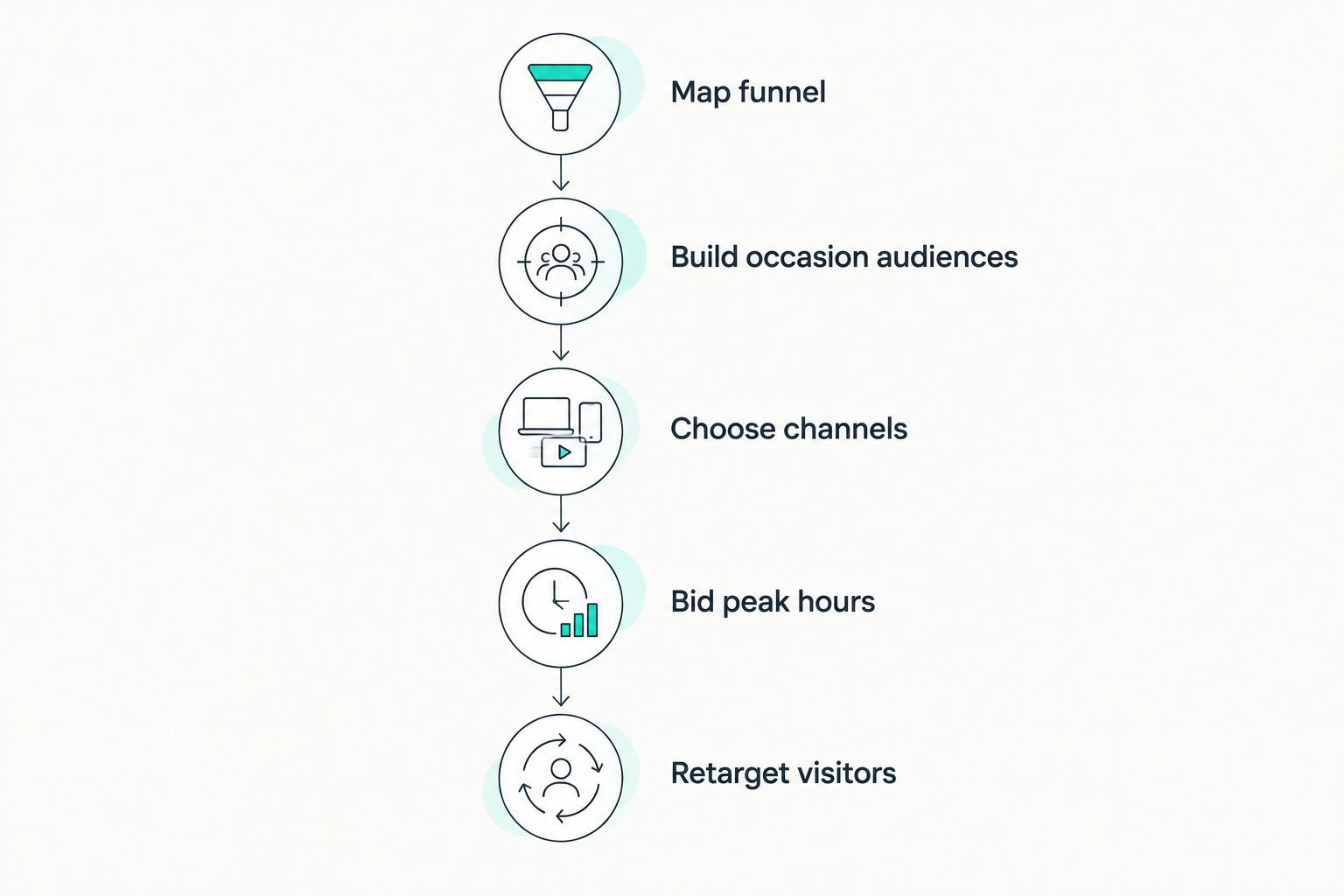
Map your booking funnel before spending a pound
Before any campaign goes live, know exactly where drop-off happens between ad click and confirmed booking.
- Check whether your booking widget loads in under 3 seconds on mobile
- Confirm the landing page shows opening hours, location and a clear reservation CTA above the fold
- Track cost per booked cover, not just cost per click, inside your ad platform
- Segment funnel data by day part — lunchtime browsers behave differently to 9pm decision-makers
- Audit whether Google Business Profile links straight to booking, not just to a homepage
Build audience segments around occasion, not demographics
Age and gender targeting tells you almost nothing useful for a cocktail bar. Occasion tells you everything.
- Build separate audiences for date-night searchers, birthday-party organisers and after-work groups
- Layer in custom audiences from past bookers for win-back campaigns
- Use lookalike audiences built from your highest-spend guests, not your total database
- Exclude existing loyal customers from acquisition campaigns to avoid wasted spend
- Test seasonal occasion sets — Valentine's, festive parties, summer rooftop season
Choose channels that match late-night browsing behaviour
Google Search and Maps catch people already deciding tonight. Meta and TikTok catch people deciding this week.
- Run Google Search ads on "cocktail bar near me" and location-modified terms during peak decision hours
- Use Google Maps ads to appear when someone's already searching the area
- Run Meta ads with video-first creative showing the room, not stock cocktail shots
- Test TikTok Spark Ads boosting organic content that already performed well
- Keep at least one channel running Thursday through Saturday afternoons, when weekend decisions get made
Bid for high-intent search terms during peak decision windows
Dayparting matters more for a cocktail bar than almost any other paid media category.
- Increase bids from 4pm to 8pm on weekdays and from midday Friday through Saturday evening
- Pause or reduce spend during dead hours — most late-night venues see near-zero conversion before noon
- Bid on competitor venue names only if your offer genuinely differentiates on occasion or location
- Add negative keywords for job searches, menu-only browsers and free events
Retarget site visitors who didn't book
A visitor who checked your booking page and left is a warmer lead than any cold audience.
- Set up a retargeting pool of site visitors from the last 14 days
- Serve a different creative angle on retargeting than on prospecting — urgency or social proof works better here
- Retarget cart-abandon-style drop-offs on the booking widget specifically
- Cap frequency so retargeting doesn't feel like harassment by the third day
This is also the point where an in-house team without ad platform access hits a ceiling — running dayparted bids, layered audiences and retargeting pools across three platforms simultaneously is where a specialist agency's tooling starts to pay for itself, but it's step five, not step one.
Layer influencer seeding into paid amplification
Organic influencer content that already resonates is the cheapest source of high-performing paid creative.
- Seed content with local nightlife and cocktail-focused creators before boosting anything
- Boost the top-performing organic posts as Spark Ads or boosted content rather than briefing new ad creative from scratch
- Track which creator content drove bookings, not just views or comments
- Reuse creator footage across Meta and TikTok ad sets to cut production cost
Track cost per cover, not vanity metrics
Click-through rate and impressions don't pay the bar bill. Cost per booked cover does.
- Set up conversion tracking on the booking confirmation page, not the landing page
- Compare cost per cover across channels monthly and shift budget toward the cheapest reliable source
- Factor average spend per cover into ROAS calculations, not just booking volume
- Review no-show rates by channel — some sources bring bookers who don't turn up
Comparison: paid media channels for cocktail bars and late-night lounges
| Channel | Best for | Key limitation |
|---|---|---|
| Google Search Ads | Same-day, high-intent "near me" searches | Limited reach for brand discovery or new-audience growth |
| Google Maps Ads | Location-triggered decisions in the final hour | Only works for venues with strong local search volume |
| Meta (Instagram/Facebook) Ads | Occasion-based targeting, retargeting, video creative | Requires fresh video content every 2-3 weeks to avoid fatigue |
| TikTok Ads | Younger late-night audience, viral discovery | Slower to build a stable, repeatable ROAS |
| Influencer seeding + boosted posts | Building trust and social proof before spend | Needs organic content already performing before it's worth boosting |
Get a paid media plan for your venue
FullyBooked has managed paid media for 50+ experience operators since launch.
Common mistakes cocktail bars and late-night lounges make
- Running one campaign for every occasion. A birthday-party ad and a quiet-date-night ad need different copy, imagery and even different landing pages.
- Ignoring dayparting entirely. Spending evenly across 24 hours wastes budget on hours when nobody is deciding where to drink that night.
- Using daytime or stock cocktail photography. Late-night venues sell atmosphere — ambient lighting, a full room, real guests — and generic product shots underperform against it.
- No no-show tracking by channel. Some acquisition sources bring bookers who don't show, which quietly inflates real cost per cover.
- Treating retargeting as an afterthought. Skipping a retargeting pool means paying full prospecting cost to re-win someone who already visited your booking page once.
Verdict: cocktail bars and late-night lounges that build campaigns around occasion and daypart their bids consistently outperform venues running flat, always-on spend — FullyBooked's 2026 data across 50+ operators backs this pattern.
FAQ
What's the best paid media channel for a cocktail bar?
Google Search and Maps ads capture same-day, high-intent bookers, while Meta and TikTok build discovery and retargeting reach. Most late-night venues in 2026 run at least two channels together rather than relying on one.
How much should a cocktail bar spend on paid media?
Budget should scale with cost per booked cover, not a fixed monthly figure — track that metric by channel and shift spend toward whichever source delivers the lowest cost per confirmed booking.
Is TikTok worth it for a late-night lounge?
TikTok works well for discovery among younger nightlife audiences but takes longer to reach a stable ROAS than Google Search or Meta retargeting. It's best layered in alongside those channels, not run alone.
When should a cocktail bar run its paid ads?
Peak decision windows for late-night venues run from roughly 4pm to 8pm on weekdays and from midday Friday through Saturday evening. Dayparting bids to these windows cuts wasted spend on dead hours.
Does influencer marketing help paid media performance?
Yes — organic influencer content that already performs well makes cheaper, higher-converting paid creative than ads briefed from scratch. Boosting proven content as Spark Ads is faster and less costly than a fresh production run.
How do I stop paying for people who don't show up?
Track no-show rates by acquisition channel, not just booking volume. If one channel consistently brings bookers who don't turn up, its real cost per cover is higher than the dashboard shows.
Should a cocktail bar hire an agency for paid media?
An agency earns its cost once campaigns need layered audiences, dayparted bids and retargeting running simultaneously across multiple platforms — a workload that outgrows most in-house teams by their second or third channel.
One last thing
The cocktail bars getting the most out of paid media in 2026 aren't spending more — they're spending on fewer hours of the day. Pull your ad platform's hour-by-hour conversion data and you'll likely find 60-70% of bookings cluster into a four-hour window; every pound spent outside that window is close to wasted. Fix the daypart before touching the budget.