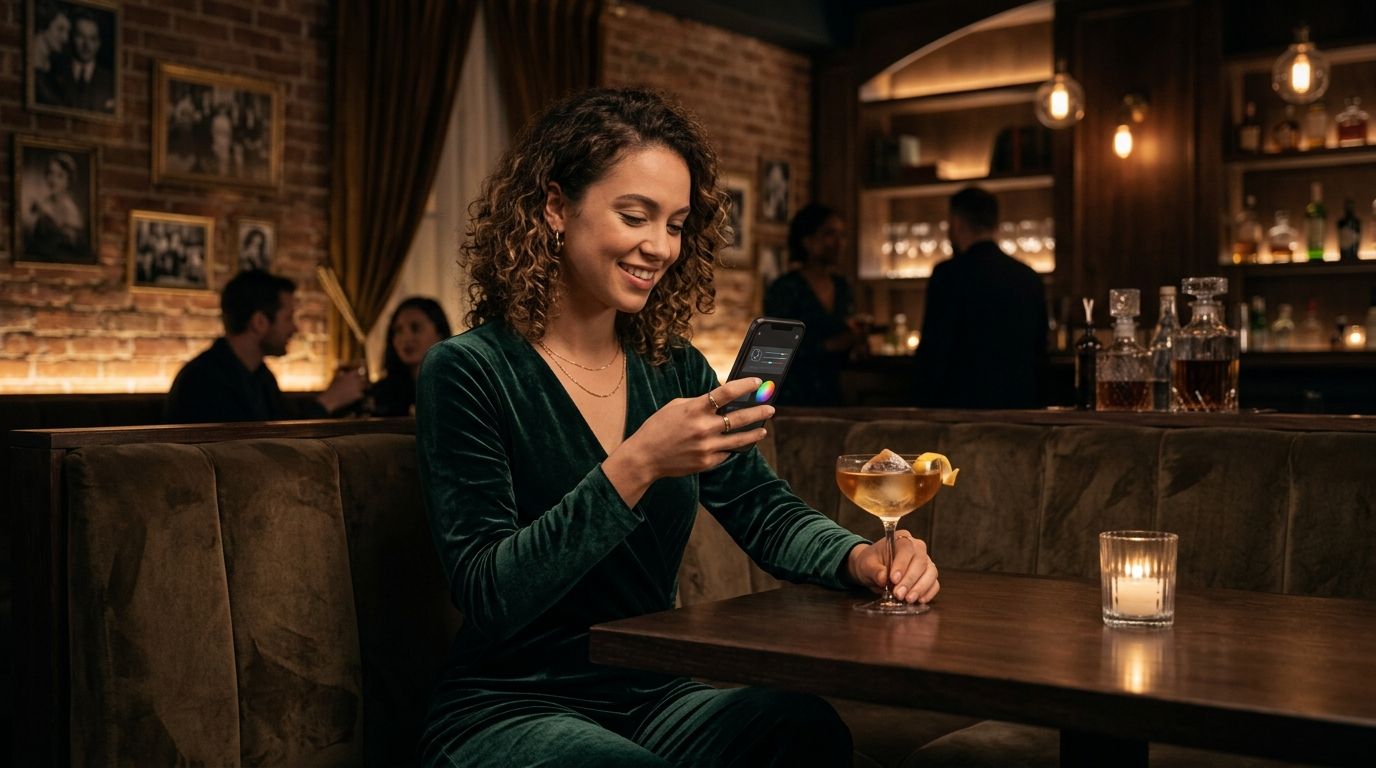
Influencer marketing for speakeasy bars is the practice of paying or gifting creators to post about a hidden-door venue with the goal of driving direct bookings without giving away the secrecy that makes the format work. It differs from mainstream bar or restaurant influencer work because the creative brief has a built-in contradiction: you want reach, but the whole appeal of a speakeasy is that it's hard to find.
A speakeasy bar's biggest constraint isn't budget — it's discretion. Post the address in a caption and you've killed the "find it" mechanic that gets people talking. Get the brief wrong and you end up with generic bar content that could be for any venue in the city. FullyBooked works with experience operators across the UK on exactly this problem, and the pattern holds across 2026 campaigns: the speakeasy bars that win treat influencer content as a discovery puzzle, not a menu showcase.
- Influencer marketing for speakeasy bars works best with nano and micro creators (2,000-40,000 followers) who protect the secrecy hook.
- Track bookings via unique promo codes per creator, not likes or views — reach alone doesn't fill tables.
- FullyBooked has generated £85M+ in booking revenue and sold 3M+ tickets across experience operators, including hidden-venue concepts.
- Seed content around themed or seasonal nights in 2026 rather than a single generic launch push.
- Mismatched follower-count chasing is the single biggest reason speakeasy influencer campaigns fail to convert.
Why influencer marketing matters for speakeasy bars
Speakeasy bars sell an experience that's almost impossible to describe in a Google Ads headline. "Hidden bar behind a fridge door" reads as a gimmick in text but performs as a hook on video — the reveal is the content. That's why influencer-driven discovery outperforms static search intent for this category: bookers aren't typing "speakeasy near me" nearly as often as they're scrolling a For You page and stopping on a door that isn't a door.
The operators managing this well in 2026 aren't running one splashy launch push and hoping it sustains bookings for a year. They're running a repeatable seeding motion — new creators, new content angles, same secrecy mechanic — tied to a booking system that tells them exactly which post converted.
Audit your venue's visual identity for creator fit
Before you contact a single creator, look at your speakeasy through a phone camera, not a design brief.
- Identify the one visual moment that reads as "secret" in under three seconds of video (the fridge door, the phone booth, the bookshelf)
- Check lighting for handheld phone footage — most speakeasies are lit for ambience, not content, and that's a problem for creators shooting after 8pm
- List two or three signature drinks or rituals a creator can film without a script
- Confirm what you're comfortable showing (interior, staff, the reveal) versus what stays off-camera to protect the surprise
Build a nano and micro-influencer seeding list
Speakeasy bars rarely need six-figure follower counts — they need local creators whose audience actually books.
- Search location tags and city-specific hashtags for creators already posting bar and nightlife content in your area
- Prioritise engagement rate over follower count; a 5,000-follower local food creator with a 6% engagement rate often outperforms a 200,000-follower national account for bookings
- Build a shortlist of 15-20 creators across nano (2,000-10,000), micro (10,000-40,000) and one or two larger local names
- Reach out with a specific ask: film the reveal, not a generic "come try this bar" post
Brief creators to protect the reveal, not spoil it
This is the step where most speakeasy campaigns go wrong — briefs written for a normal bar get reused and the secrecy angle disappears.
- Ask creators to withhold the exact address in the caption and direct followers to a bio link or DM instead
- Give a clear do/don't list: what's fine to show (the reveal, the drink, the room) versus what isn't (staff faces without consent, other guests, private areas)
- Supply two or three suggested hooks ("there's a bar hidden behind a laundromat") rather than a rigid script
- For campaigns that need booking-attributed tracking and a managed roster of vetted creators rather than one-off DMs, FullyBooked's influencer marketing work for cocktail masterclass venues follows the same secrecy-first brief model adapted for speakeasy concepts.
Layer in trackable booking links or promo codes
Reach numbers tell you nothing about revenue. A booking link or code per creator does.
- Give each creator a unique discount code or UTM-tagged booking link, never a shared one
- Match code redemption dates against the content's posting date to isolate the actual conversion window (usually 48-72 hours post-publish)
- Track cost per booking, not cost per view, as the primary KPI
- Compare code performance across creator tiers monthly to reallocate budget toward what's actually filling tables
Time drops around themed and seasonal nights
A speakeasy's content calendar should mirror its quietest and busiest periods, not run on a flat schedule.
- Schedule creator drops two weeks ahead of themed nights, seasonal events or new cocktail menu launches
- Use creator content to fill known off-peak slots — a Tuesday-specific promo code seeded through one creator can move a slow night measurably
- Avoid stacking every creator post around the same Friday/Saturday window; that just competes for the same already-full slots
- Cross-reference with venues running comparable secrecy-led formats, such as the approach detailed for influencer marketing at whisky tasting experiences, where seasonal timing drove repeat bookings rather than one-off spikes
Measure cost per booking, not reach
By 2026, most experience operators have stopped reporting influencer success in impressions. Bookings and revenue are the only numbers that matter to a P&L.
- Set a target cost-per-booking before the campaign starts, based on average ticket or table value
- Reconcile creator-attributed bookings against total bookings monthly to catch cannibalisation from organic search or paid media
- Flag any creator whose content drove views but zero code redemptions after 30 days and drop them from the next round
- Retain the top 20% of creators by cost-per-booking as an ongoing roster instead of re-sourcing from scratch each quarter
Turn top-performing creators into retained partners
One-off gifted posts rarely compound. A retained roster does.
- Offer your best-converting creators a standing monthly or quarterly slot rather than a single transaction
- Give retained creators early access to new drink menus or themed nights before public launch
- Build a referral or affiliate structure so repeat creators earn from ongoing bookings, not just the first post
- Review the roster every quarter against cost-per-booking data, not gut feel
Fill your speakeasy's quiet nights
Booking-attributed influencer campaigns for hidden-venue concepts.
Comparing your options
| Option | Best for | Key limitation |
|---|---|---|
| DIY creator outreach | Single-site bars testing the channel for the first time | Time-intensive; secrecy briefs are easy to get wrong without experience |
| Micro-influencer marketplace platforms | Fast, high-volume seeding across many small creators | Little control over tone; secrecy briefs often get ignored |
| Boutique PR or influencer agency | A one-off launch push around opening night | Rarely tracks bookings back to a specific post |
| FullyBooked | Speakeasy and multi-site operators wanting booking-attributed, retained campaigns | Not built for a single occasional promotion — designed for ongoing programmes |
Verdict: for a speakeasy bar running more than one campaign a year, a managed programme with booking attribution beats DIY outreach or a one-off PR push on cost-per-booking, not just reach.
Common mistakes speakeasy bars make
- Putting the address in the caption. This kills the discovery mechanic that makes the format shareable in the first place.
- Chasing follower count over local engagement. A creator with 150,000 followers and a 1% engagement rate rarely outperforms a local 8,000-follower creator with a 5% rate.
- No unique code or link per creator. Without it, every booking gets credited to "organic" and the campaign looks like it failed even when it didn't.
- Running only one drop around opening night. Hype from a launch push fades within weeks without a retained content cadence.
- Ignoring hen and stag audiences. Speakeasy bars are a natural fit for group celebrations, and campaigns that skip this segment miss one of the highest-value booking types — see influencer marketing for hen and stag do venues for group-specific creator tactics.
FAQ
Is influencer marketing worth it for a speakeasy bar in 2026?
Yes, when campaigns use trackable booking links or codes per creator. Without attribution, it's impossible to tell whether a post drove revenue or just views.
What size influencer works best for a speakeasy bar?
Nano and micro creators with 2,000 to 40,000 followers typically convert better than larger accounts because their local, engaged audiences are more likely to actually book.
Should a speakeasy hide its exact address from influencers?
Creators can know the address, but captions and content should avoid stating it directly. Directing followers to a bio link or DM protects the discovery hook that makes speakeasy content shareable.
How do you measure ROI from a speakeasy influencer campaign?
Assign a unique promo code or UTM-tagged link to each creator and track redemptions against posting dates. Cost per booking, not reach or views, is the metric that matters.
Is TikTok or Instagram better for speakeasy discovery?
Both work, but TikTok's For You algorithm tends to surface "hidden door" reveal content to non-followers more effectively than Instagram's feed-based distribution in 2026.
How many creators should a speakeasy bar work with per month?
Most operators run 3-6 active creators monthly, rotating in new names while retaining the 1-2 top converters from the previous cycle.
Is PR different from influencer marketing for a speakeasy?
Yes. PR typically targets press and one-off features around launch, while influencer marketing is an ongoing, booking-tracked content programme aimed at consistent bookings.
Do speakeasy bars need a different approach than regular cocktail bars?
Yes. The secrecy mechanic requires briefs that withhold location details, which standard bar or restaurant influencer templates don't account for.
One last thing
The speakeasy bars getting the most out of influencer marketing in 2026 aren't the ones with the biggest creator budgets — they're the ones who figured out that a hidden door is a content format, not just a design feature, and built their entire brief around protecting that reveal instead of explaining it away.


