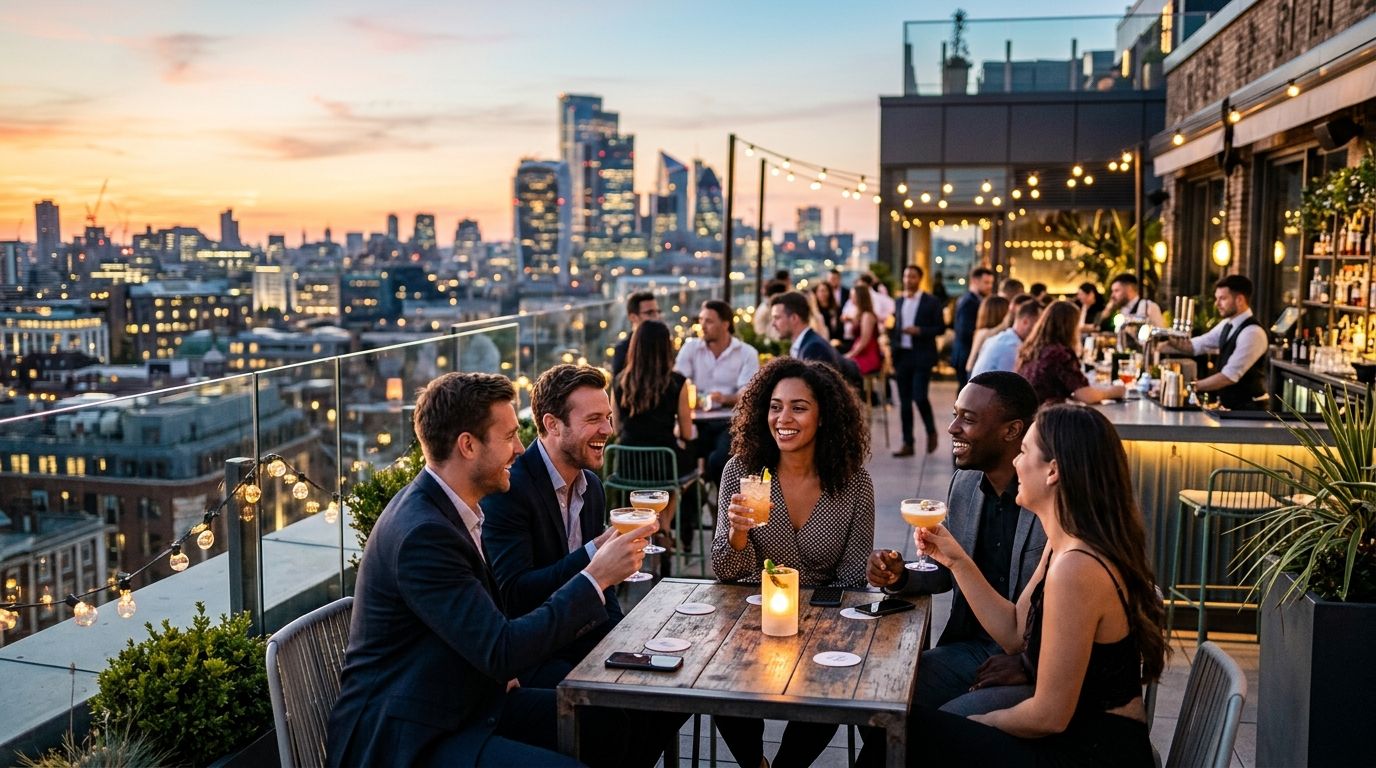
Paid media for rooftop bar experiences works when ad spend moves with the weather, golden hour and group-booking demand — not when it runs on the same flat daily budget as a standard bar or restaurant. A rooftop venue sells a view and a window of good weather as much as it sells drinks, and the media plan has to treat both as targeting signals.
- Paid media for rooftop bars performs best when budget shifts with 14-day weather forecasts, not a flat daily spend.
- FullyBooked has generated £85M+ in ticket and booking revenue across 50+ experience operators.
- Retargeting recovers browsers who checked availability but did not book — rooftop bars often see a 2-3 day gap between the two.
- Group bookings and private hire enquiries need separate campaigns from date-night and after-work targeting.
- Google Search catches high-intent rooftop bar near me searches; Meta drives the golden-hour demand that fills weekend slots.
Why paid media matters for rooftop bar experiences
A rooftop bar's demand curve moves faster than almost any other experience business. A sunshine forecast 48 hours out lifts search volume for rooftop terms; a rained-out Saturday drops walk-in traffic to near zero regardless of ad spend. Generic hospitality paid media — flat daily budgets, one creative set, monthly reporting — misses both signals.
The operators who get this right run FullyBooked campaigns that pace budget against forecast windows and split creative by time of day. The ones who don't spend the same amount on a grey Tuesday as a golden-hour Friday, then wonder why cost per booking swings week to week.
Rooftop bars also carry two distinct booking types under one roof: walk-in date-night covers and pre-booked group or private hire. Treating them as one audience in Meta or Google wastes spend on both.
The 7-step approach to paid media for rooftop bars
1. Audit your booking funnel before you spend on ads
Most rooftop venues send ad traffic to a booking page nobody has checked for mobile completion — and most weekend traffic arrives from an Instagram Story tap on a phone.
- Confirm GA4 or your booking platform tracks completed reservations, not just page views
- Time the gap from first visit to booked table — rooftop bars often see 2-3 days
- Find the exact step where availability checks drop off before payment
- Test the mobile checkout yourself on mobile data, not office wifi
- Check whether group enquiries route to a different form than single-table bookings
2. Build a weather-and-season aware ad calendar
A rooftop bar's 2026 ad calendar should look nothing like a standard restaurant's.
- Pull a 14-day forecast for your city every Monday and pencil in spend shifts
- Increase budget 24-48 hours ahead of forecast sun on weekends
- Pause open-air creative during forecast rain and switch to covered-area messaging
- Split ad sets by daypart: lunch, golden hour, late-night
- Build the wet-weather creative set in advance so it is ready to switch on, not built reactively
FullyBooked builds weather-triggered budget rules for venue clients so spend shifts on a rule rather than on someone remembering to check the forecast.
3. Target proximity and dwell-time audiences on Meta and Google
After-work traffic and weekend destination traffic are different audiences and need different radius settings.
- Use a 1-3 mile radius for weekday after-work campaigns aimed at commuters
- Widen to 8-10 miles for weekend destination-trip campaigns
- Layer age and demographic brackets against your actual guest data, not assumptions
- Test Google Performance Max against manual search campaigns pointed at the booking page
- Build a 90-day warm audience from Instagram and TikTok engagers for retargeting
4. Optimise your Google Business Profile alongside paid search
Searches for rooftop bar near me surface Google Business Profile results above paid ads on mobile — a weak profile undercuts every pound spent on search in 2026.
- Upload current photos of the view at different times of day, refreshed seasonally
- Keep opening hours and weather-dependent closures current in real time
- Respond to every review within 48 hours, especially weather-related complaints
- Add booking links directly to the profile, not just a phone number
- Work through optimising a Google Business Profile for a venue before scaling paid search
5. Retarget past visitors and booking abandoners
The gap between checking availability and confirming a table is where most rooftop bookings get lost.
- Build a retargeting list of everyone who viewed the booking page in the last 14 days
- Serve availability-specific creative to warm traffic, not generic brand ads
- Exclude anyone who already booked to avoid wasted frequency
- Run a separate sequence for group enquiries that stalled
- Follow the full sequence in retargeting ads for event ticket sales
6. Test dynamic creative for golden hour and view-led visuals
A rooftop bar's core product is visual, so creative fatigue arrives faster than at a venue selling an activity.
- Rotate creative by daypart so golden-hour shots run in the 90 minutes before sunset
- Refresh guest and staff UGC monthly, not quarterly
- Test sunset video against static photography
- Run countdown-style formats during the last hour of good weather
- Swap creative the moment frequency crosses 3-4 within a 7-day window
7. Track cost per booking and group value, not cost per click
Rooftop bars reporting on CPC alone miss that a group booking is worth several times a single cover.
- Set up booking value tracking in the ad platform, not just lead volume
- Segment cost per acquisition by daypart, since golden-hour CPA usually runs higher
- Track group booking CPA separately from walk-in CPA
- Review weekly, not monthly — weather moves performance faster than a monthly cadence catches
- Blend ROAS across walk-in and pre-booked revenue before judging any single campaign
Bottomless brunch operators face a near-identical golden-hour and group-booking problem. The playbook in paid media for bottomless brunch venues maps closely onto rooftop trading patterns.
Paid media channel comparison for rooftop bars
| Option | Best for | Key limitation |
|---|---|---|
| Google Search Ads | High-intent rooftop bar near me searches | Weak at showcasing the view or atmosphere |
| Meta and Instagram Ads | Weekend destination trips and golden-hour demand | Needs constant creative refresh to avoid fatigue |
| TikTok Ads | Reaching under-30 group-booking audiences fast | Weaker for weekday after-work last-minute traffic |
| Programmatic retargeting | Recovering visitors who checked availability but did not book | Needs enough site traffic to stay cost-efficient |
| Specialist agency management | Operators with no in-house media buying or forecast tracking | Requires handing over day-to-day budget control |
Meta and Instagram win the golden-hour visual push that fills weekend slots; Google Search wins the last-minute high-intent booker. Most rooftop bars in 2026 need both running at once, split by daypart rather than blended into one campaign.
Common mistakes rooftop bars make with paid media
- Spending a flat daily budget through a rained-out week — CPA spikes because demand collapsed and spend did not
- Targeting one city-wide audience instead of splitting radius by after-work versus weekend traffic
- Running one creative set for couples and eight-person groups when intent and booking value are completely different
- Not separating group booking CPA from single-cover CPA, which hides which audience is actually profitable
- Ignoring Google Business Profile while paying for search, so paid clicks compete with a weak organic listing above them
Get a rooftop bar media audit
See where current spend leaks against weather and booking demand.
FAQ
What is the best paid media channel for rooftop bar experiences?
Meta and Instagram win for golden-hour visual demand and weekend destination bookings, while Google Search catches high-intent last-minute searches. Most rooftop bars in 2026 run both at once, split by daypart.
Is Meta or Google better for rooftop bar ads?
Neither wins outright. Meta drives visual discovery and weekend trip planning, Google Search catches people ready to book now, and tracking cost per booking separately for each shows which is pulling weight.
Does weather really affect rooftop bar ad performance?
Yes. Demand climbs ahead of a forecast sunny weekend and collapses during forecast rain, so pacing budget against a 14-day forecast avoids paying full price for dead traffic.
How do you target group bookings for rooftop bars with paid media?
Run a separate campaign and landing page for group and private hire enquiries rather than folding them into single-cover targeting. Group bookings carry a longer decision window and higher value, so blending them hides which audience is profitable.
Should rooftop bars use TikTok ads?
TikTok works for reaching under-30 group-booking audiences and building golden-hour content, but it is weaker than Google Search for last-minute weekday traffic. Treat it as a discovery channel, not a booking-completion channel.
How much should a rooftop bar budget for paid media in 2026?
There is no fixed figure, because it depends on average booking value, seasonality and how many weather-dependent months the venue trades. Benchmark against cost per booking weekly and adjust rather than fixing one annual number.
How does FullyBooked run paid media for rooftop bar experiences?
FullyBooked builds weather-paced budgets, splits creative by daypart and separates group booking campaigns from walk-in targeting. The approach draws on work across 50+ experience operators and £85M+ in generated revenue.
What is the biggest paid media mistake rooftop bars make?
Running a flat daily budget through a full week regardless of forecast. Cost per booking climbs on rained-out days and nobody notices until the monthly report lands.
One last thing
Build the wet-weather creative set before you need it. Venues that pre-build a covered-area or indoor-bar campaign switch spend within hours of a forecast change in 2026, instead of burning a whole weekend of budget on golden-hour ads for a terrace nobody can sit on.


