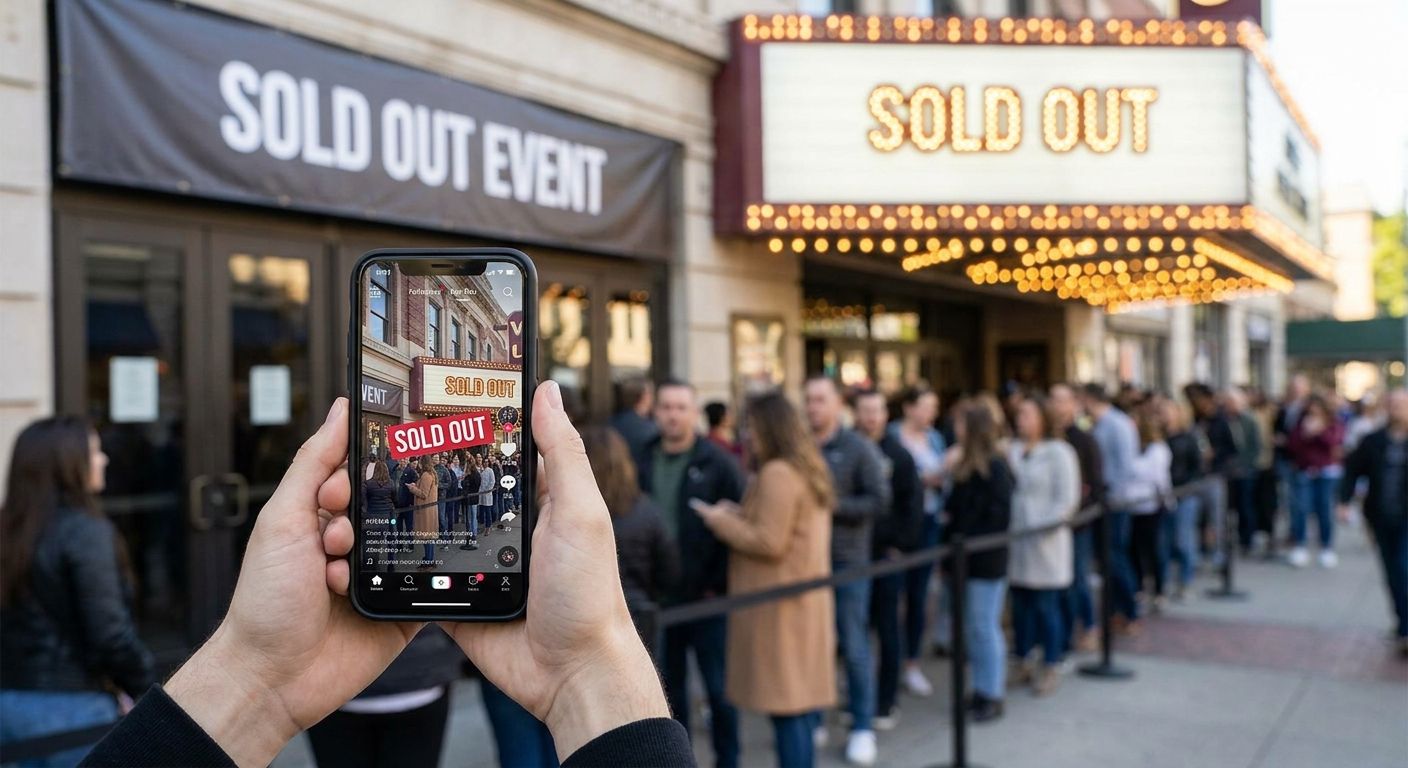
TikTok sells out events when you combine daily organic content, a handful of paid Spark Ads on your best-performing video, and at least one creator partnership tied to your event date. The channel that gets skipped is retention: a TikTok spike fills a room once, but without a follow-up system (email, loyalty, retargeting) that same audience won't come back for the next date.
- How to use TikTok to sell out an event: post daily behind-the-scenes content, boost the top organic clip with Spark Ads, and seed 2-3 micro-influencers before the date.
- Organic reach wins on cost, paid Spark Ads win on speed when a date is close to selling out.
- Watch-through rate matters more than views for TikTok's algorithm in 2026 - a 15-second video watched to the end beats a 60-second video abandoned at 10.
- Start TikTok promotion 3-4 weeks before an event date, not the week of.
- FullyBooked has generated 85M+ pounds in ticket revenue across 50+ experience operators using this exact mix.
Why this matters
Most venue operators treat TikTok like Instagram with a different logo - post the same reel, hope for the same result. It doesn't work that way. TikTok's discovery engine pushes content to strangers based on watch-through rate, not follower count, which means a venue with 200 followers can outsell a venue with 20,000 if the video holds attention.
That's the opportunity and the trap. Experience businesses - escape rooms, comedy clubs, immersive shows, trampoline parks - have the most inherently watchable product on the platform: real people reacting in real time. The operators who sell out use that footage on a schedule. The ones who don't post once, get a few hundred views, and decide TikTok "doesn't work for us."
FullyBooked has run a TikTok marketing approach built specifically for experience brands across dozens of venues, and the pattern repeats in 2026: content cadence and paid amplification matter more than production quality.
How do you use TikTok to sell out an event?
Follow this sequence starting 3-4 weeks out from your event date:
- Post daily, not weekly. One video a day for the four weeks before the event beats five videos posted in the final week - the algorithm needs a data set to learn who to show your content to.
- Film the reaction, not the room. A wide shot of an empty venue gets scrolled past in under a second. A close-up of someone's face mid-scream, mid-laugh, or mid-surprise is what stops the thumb.
- Use a countdown sticker and a link in bio. Every video should make it obvious a date exists and obvious where to book - don't make viewers hunt for the ticket link.
- Boost your best organic video with Spark Ads. Once one video clearly outperforms the rest on watch-through and shares, put paid spend behind that exact post rather than building a new ad from scratch.
- Seed 2-3 micro-influencers before the date, not after. A creator posting the week before drives bookings; a creator posting the week after just drives views on a show that's already happened.
- Track saves and shares, not just views. A save means someone plans to attend later; a share means they're telling a friend to come with them. Both predict ticket sales better than raw view count.
Organic TikTok vs paid Spark Ads vs influencer seeding
| Channel | Cost to run | Best for | Verdict |
|---|---|---|---|
| Organic TikTok content | Time only, no media spend | Building a content library and testing hooks | Do this first |
| Paid Spark Ads | Media spend on a proven post | Filling seats fast once a video is validated | Do this second |
| Micro-influencer seeding | Gifted tickets or a flat fee | Reaching an audience your own account can't | Do this in parallel |
“If your first three seconds don't hold attention, the algorithm never shows the video to anyone else.”
Why TikTok results vary from venue to venue
Same platform, same effort, different outcomes. Here's what drives the gap:
- Watch-through rate on the first few posts. TikTok decides how far to push a video early based on completion rate, so a weak opening clip suppresses everything that follows it.
- How visual the experience is. Escape rooms, immersive shows and axe-throwing venues have an easier time than seated talks or quiet exhibitions - the format rewards motion and reaction.
- Whether creators are paid or gifted. A paid creator post is produced on schedule; a gifted post depends entirely on the creator's own calendar and enthusiasm.
- Posting cadence around the event date. Content posted 3-4 weeks before a date has time to compound. Content posted the week of is competing with everyone else's last-minute push.
- How fast the link in bio converts. A viewer who has to click through three pages to find a date and price will abandon - the booking page needs to be one tap away.
- Whether the account has posted before. A brand-new TikTok account with no watch history takes longer for the algorithm to learn than an account that's been posting for months.
A venue running a comedy night can pair this with tactics for last-minute bookings at a comedy club when TikTok drives interest but the date is close.
Get a TikTok plan for your venue
FullyBooked builds paid and organic TikTok campaigns for experience operators.
Do you need a big following to sell tickets on TikTok?
No - a big following is not required to sell tickets on TikTok in 2026, because the platform distributes on watch-through rate and engagement rather than existing audience size. Accounts with a few hundred followers regularly outperform accounts with tens of thousands when the content is watched to the end and shared. Consistency matters more than follower count: venues posting daily for several weeks build enough data for the algorithm to find the right audience.
Should you run paid TikTok ads or stay organic?
Start organic, then add paid - that's the sequence, not an either/or choice. Organic posting for 2-3 weeks tells you which video, hook and angle actually holds attention, and Spark Ads spent on that proven post convert far better than spend on an untested clip. Skipping straight to ads usually means paying to promote a video nobody wanted to finish watching.
How soon before an event should TikTok promotion start?
TikTok promotion should start 3-4 weeks before the event date, which gives daily content time to build momentum and leaves runway to add paid Spark Ads once a top performer emerges. Starting in the final week limits you to organic reach alone, since paid campaigns need several days to optimise before the date arrives. Recurring events - weekly comedy nights, monthly pop-ups - do better on an always-on cadence than a stop-start campaign tied to one date.
FAQ
What's the best way to use TikTok to sell out an event?
The best way to use TikTok to sell out an event is daily organic posting for 3-4 weeks, paid Spark Ads on the top-performing video, and 2-3 micro-influencer partnerships timed before the date. Watch-through rate on those early posts determines how far the algorithm pushes everything that follows.
How many TikTok videos should you post before an event?
Post one video a day for the 3-4 weeks leading up to an event rather than a handful in the final week. Daily posting gives the algorithm enough data to identify which hook is working and enough time for reach to compound before the date.
Do you need influencers to sell tickets on TikTok?
No, influencers are not required, but 2-3 paid or gifted micro-influencer posts timed before the event date reach an audience your own account can't. Organic content should still run in parallel, since influencer posts alone rarely sustain momentum.
Is TikTok better than Instagram for selling event tickets?
TikTok reaches new audiences faster than Instagram for ticketed events because it distributes on watch-through rate rather than follower count. Instagram still performs well for retargeting people who already follow the venue, so the two channels work best combined.
How much should you spend on TikTok ads for a ticketed event in 2026?
Ad spend for a ticketed event in 2026 depends on ticket price, venue capacity and how close the date is to selling out, so no single figure fits every event. Start with a small test budget on your best organic video, then scale spend behind whichever creative shows the strongest watch-through and click rate.
When should you start TikTok promotion before an event?
Start TikTok promotion 3-4 weeks before the event date so organic content has time to build and paid ads have time to optimise. Promotion that begins the week of the event is limited to organic reach alone.
Can a small venue sell out using only organic TikTok content?
Yes, a small venue can sell out on organic TikTok content alone if videos are watched to the end and shared, because TikTok distributes on engagement rather than account size. Adding Spark Ads on the strongest post accelerates the result but isn't strictly necessary for a smaller room.
What TikTok content converts best for ticketed events?
Close-up reaction footage - people mid-laugh, mid-scream or mid-surprise - converts best because it holds attention in the first three seconds. Wide shots of an empty venue and static promotional graphics get scrolled past and rarely reach a wide audience.
One last thing
The operators still selling out dates in 2026 after the initial spike fades are the ones who treat TikTok as a content library, not a campaign. Footage filmed three months ago still gets discovered and still converts if the hook holds. Build that library before you need it, not the week your next event goes on sale.