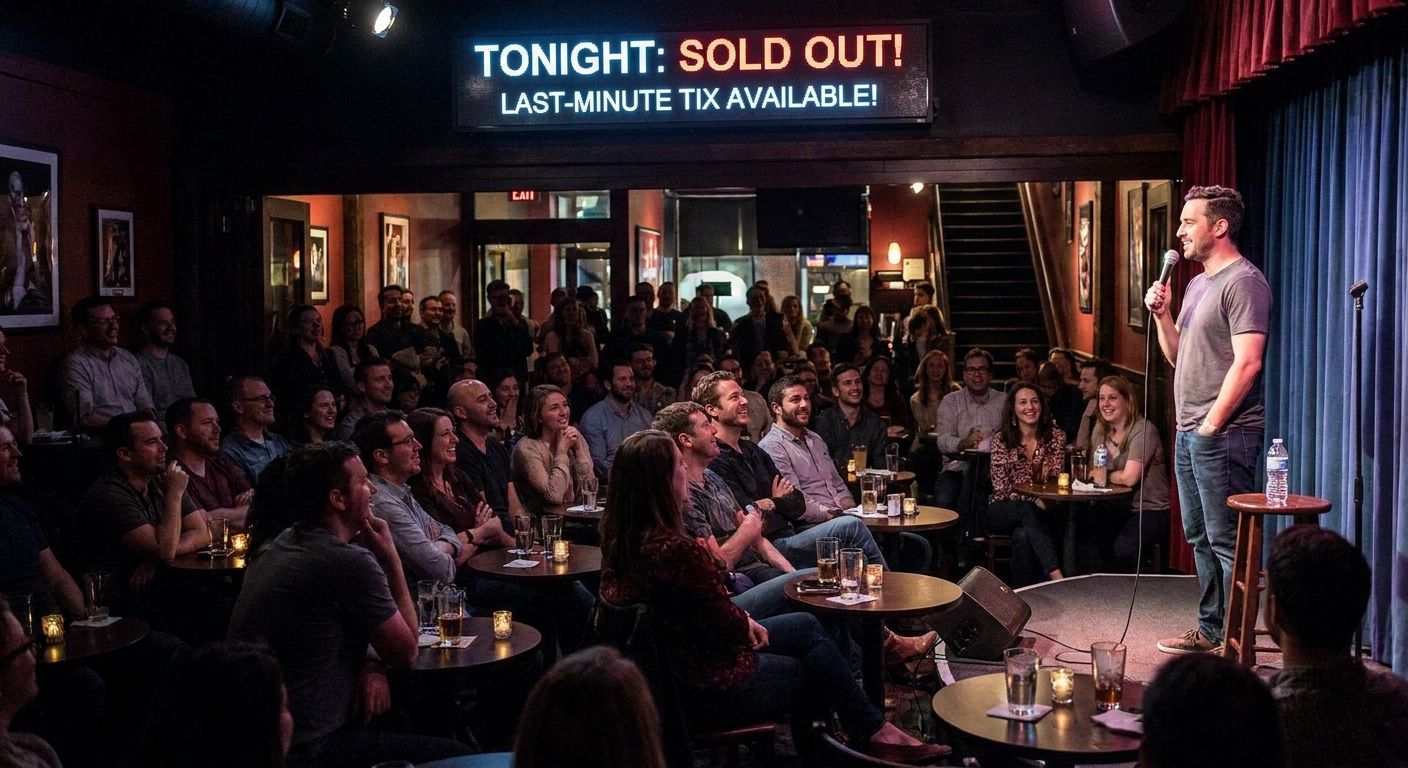
Comedy clubs lose more money to Tuesday's half-empty room than to any competitor down the street. A seat unsold by 6pm on show night is gone forever — no refund policy fixes that. This guide breaks down exactly how to increase last-minute bookings for a comedy club, step by step, using the tactics that fill seats inside 72 hours of doors.
- Increasing last-minute bookings for a comedy club takes a 72-hour flash sale, not a permanent discount code.
- Dynamic pricing recovers empty seats faster than blanket promo codes — cut by show, not by season.
- Retargeting ads to warm site visitors fill seats within 48 hours when paired with a scarcity deadline.
- SMS drops convert faster than social posts for same-week comedy tickets — send 24 hours before doors.
- Fill rate should be tracked by day-of-week; Thursday shows need different tactics than a Saturday sellout.
Why this matters
An unsold comedy club seat has a shelf life measured in hours, not days. Once the room opens, that inventory is worthless — there's no back-order, no delayed shipment, nothing to sell tomorrow instead. Venues that treat last-minute inventory the same way they treat advance sales leave 15-30% of capacity on the table most weeks, especially Tuesday through Thursday.
FullyBooked has managed marketing for 50+ experience operators and generated £85M+ in booking revenue across live events, attractions and venues. The pattern holds across every comedy room: the operators who build a specific last-minute system outperform the ones who just "post about it on the day." Paid media for comedy clubs needs a different structure than advance-sale campaigns — shorter windows, tighter targeting, harder urgency.
2026 changes nothing about the fundamentals: same-day and next-day bookings still come from three channels — email/SMS to people who've been before, paid retargeting to people who looked but didn't buy, and organic urgency posts that create FOMO. The mistake most clubs make is running all three the same way every week until the list burns out.
What you'll need
- A ticketing or POS system that supports dynamic pricing or promo codes with expiry timestamps
- An email list segmented by attendance recency (last 30/60/90 days)
- An SMS opt-in list or a tool that supports one (Klaviyo, SimpleTexting, or your ticketing platform's native SMS)
- A paid ad account (Meta and/or Google) with the pixel installed on your booking page
- A countdown or "X seats left" mechanism on your booking widget
- 48-72 hours of lead time before the show to execute the plays below
The steps
1. Segment your list by recency and distance
A blanket email to your entire database performs worse than a targeted send to people who attended in the last 90 days and live within a 30-minute radius. Recency and proximity are the two strongest predictors of a same-week booking. Pull that segment first — it should convert at 2-3x the rate of your full list.
Common mistake: sending the same flash-sale email to everyone on the list, including people who last attended 18 months ago. That group needs a re-engagement campaign, not a last-minute offer.
2. Set a decay-based pricing rule, not a flat discount
Instead of a flat 20% off code that runs all week, set pricing that steps down as showtime approaches: full price until 72 hours out, 10% off at 48 hours, 20% off at 24 hours. This protects margin on shows that are already filling and only discounts the ones genuinely at risk.
Dynamic pricing also trains your list correctly — customers learn that waiting is a gamble, not a guarantee of a discount. Flat, predictable codes teach the opposite lesson and quietly kill your advance sales over time.
3. Launch a 72-hour countdown email
Send the first flash-sale email exactly 72 hours before doors, with a hard deadline in the subject line and a countdown timer in the body if your email tool supports it. State the seat count explicitly — "14 seats left for Saturday's 8pm show" beats "limited availability" every time.
Expected outcome: this single email typically drives the largest single spike in same-week bookings of any tactic on this list, because it hits a warm, recent, geographically close audience with a real deadline.
4. Run retargeting ads to warm site visitors
Anyone who viewed your booking page in the last 14 days but didn't purchase is your highest-intent retargeting audience. Build a Meta and/or Google retargeting campaign that activates automatically 48 hours before each show, using the same scarcity messaging as the email. Paid media for comedy clubs works best when ad creative and email copy match — repetition across channels closes bookings that a single touch wouldn't.
Common mistake: running the retargeting campaign continuously instead of activating it in the 48-hour window. Always-on ads with no urgency waste spend on people who were never going to convert without a deadline.
5. Push an SMS 24 hours before doors
SMS open rates dwarf email for same-day urgency. Send one text 24 hours out and, for shows still under-filled, a second one on the morning of the show itself. Keep it to one line: show, time, seats left, link.
Expected outcome: SMS typically recovers the last 5-10 seats that email and ads couldn't close, because it reaches people at the moment they're deciding what to do that night.
6. Release day-of urgency posts on organic social
Stories and posts on the day of the show, showing the room filling up or a countdown graphic, catch people scrolling with no plans that evening. This channel won't fill a room on its own, but it's free reach that stacks on top of email, SMS and ads.
7. Track fill rate by day of week and adjust your cutoff
A Tuesday show and a Saturday show need different last-minute windows. If Saturdays consistently sell out by Thursday, don't discount them — reserve your dynamic pricing and flash campaigns for the days that actually need help. Reviewing fill rate weekly is what separates operators using best last-minute booking campaigns for venues from ones guessing at the same tactics every week regardless of demand.
Fill more seats on short notice
Get a last-minute booking system built for your comedy club.
Troubleshooting
Same faces show up to every flash sale, nobody new. Your segment is too narrow or too repetitive. Rotate in a secondary segment (60-90 day attendees) every third campaign so your most engaged customers aren't the only ones seeing the discount.
The list has stopped responding to discounts at all. You've trained them to wait for a bigger one. Pause discount-based offers for 4-6 weeks and switch to non-price urgency — a guest comedian, a bonus set, a seat-count countdown with no price cut.
Tuesday and Wednesday shows never fill regardless of tactics. The problem may not be marketing — it's demand. Consider bundling weekday shows with a food or drink add-on rather than discounting the ticket itself, which protects the price anchor for weekend shows.
Retargeting audience is too small to spend against. If your booking page gets under a few hundred visits a week, retargeting alone won't move the needle. Lean harder on email and SMS, and build the pixel audience over several months before expecting retargeting to carry last-minute sales.
SMS opt-in rate is low. Add an SMS opt-in checkbox at checkout with a clear reason to sign up — "text alerts for sold-out show releases" performs better than a generic "get updates" ask.
Tools and resources
- Ticketing platform with dynamic pricing or timed promo codes
- Email platform with segmentation by recency and location
- SMS tool integrated with your booking flow
- Meta and Google ad accounts with pixel/conversion tracking installed
- Best email marketing strategy for ticketed events for building the segmented flows referenced in step one
- Best last-minute booking campaigns for venues for a broader playbook beyond comedy-specific tactics
What to do next
Once last-minute fill rate is stable, shift attention to advance sales so you're not relying on flash tactics every single week. How to sell more tickets for your venue or event covers the acquisition side — the campaigns that fill shows three and four weeks out, before a comedy club ever needs a 72-hour countdown.
FAQ
What's the best way to increase last-minute bookings for a comedy club?
A 72-hour flash sale sent to a segment of recent, local attendees, backed by retargeting ads and a same-day SMS, recovers the most seats in 2026. Flat discount codes run all week train customers to wait rather than book early.
Is dynamic pricing better than a discount code for filling seats fast?
Yes — dynamic pricing that steps down as showtime nears protects margin on shows that are already filling. A flat code discounts every seat regardless of demand, which costs more over a full year of shows.
How much notice do comedy clubs need to run a last-minute campaign?
48 to 72 hours is enough time to segment a list, launch a flash email, activate retargeting ads and send a follow-up SMS. Anything under 24 hours limits you to SMS and organic social only.
Does SMS marketing actually help fill last-minute comedy show seats?
Yes, SMS typically closes the final 5-10 seats email and ads couldn't convert, because it reaches people at the moment they're deciding their evening plans. Send it 24 hours before doors for the best response.
Should every show get the same last-minute discount?
No. Track fill rate by day of week and only discount shows that consistently under-sell. Discounting a Saturday show that already sells out by Thursday trains your best customers to wait for a lower price.
How do you stop customers from always waiting for a discount?
Pause price-based offers for 4-6 weeks and replace them with non-price urgency like a guest comedian or a strict seat-count countdown. This resets the expectation that a discount is always coming.
What's the biggest mistake comedy clubs make with last-minute marketing?
Sending the same flash-sale email to the entire list instead of segmenting by recency and location. A targeted send to recent, nearby attendees converts at two to three times the rate of a full-list blast.
Can paid ads fill seats within 48 hours of a comedy show?
Retargeting ads to people who visited the booking page in the last 14 days can convert within 48 hours when paired with a real deadline and matching email or SMS messaging. Cold prospecting ads rarely convert fast enough for same-week urgency.
One last thing
The clubs that struggle most with last-minute sales usually aren't short on demand — they're short on a deadline. A seat count that never actually hits zero teaches your list that urgency is fake, and every future flash sale converts a little worse than the last. Fix the deadline before you touch the discount.


