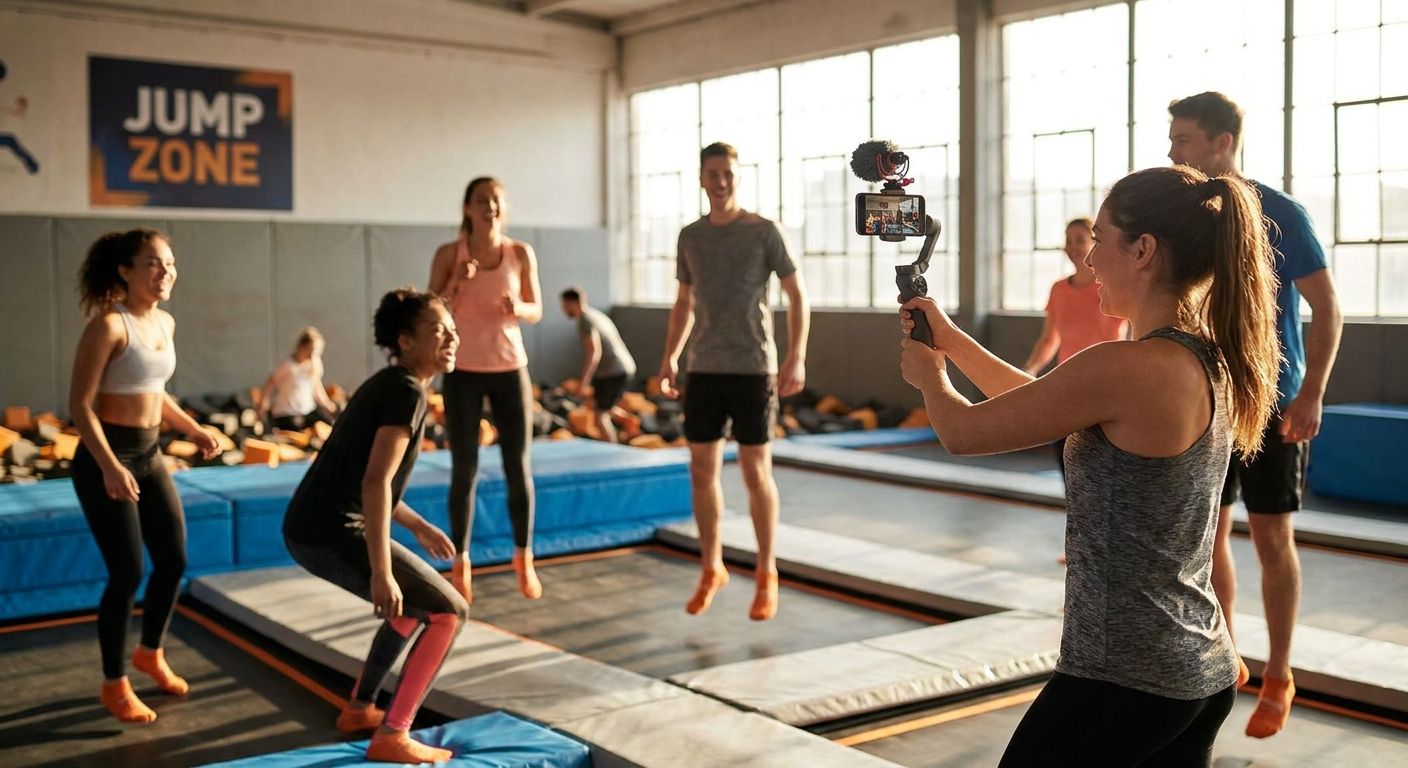
Running influencer campaigns for a trampoline park without a booking-linked plan burns budget on follower counts instead of ticket sales. This guide breaks down the exact steps to build a campaign that fills sessions, not just comment sections.
- Book 4-6 local micro-influencers (5k-50k followers) over a single 3-week content window, not one big-name creator once a year.
- Track every campaign with unique discount codes or UTM links — impressions mean nothing without a booking attached.
- Family and teen niche creators outperform generic lifestyle accounts for trampoline park bookings in 2026.
- Repurpose creator content into paid social ads within 48 hours of posting — organic reach alone rarely fills off-peak sessions.
- Skip anyone who won't share usage rights; paid amplification is where the real booking volume comes from.
Why this matters
Trampoline parks live or die on off-peak fill rate — weekday afternoons, rainy Tuesdays, the sessions that don't sell themselves. Influencer content solves a specific problem paid ads can't: it shows real families and teens having fun in your space, which builds trust faster than a static ad ever will. Done right, influencer marketing for trampoline parks becomes a repeatable booking channel, not a one-off stunt for social proof.
The operators who get this wrong in 2026 treat influencer marketing like a favour exchange — free jump passes for a story that disappears in 24 hours. The operators who get it right treat every collaboration as a paid media asset with a tracked booking outcome attached.
What you'll need
- A booking system that supports unique discount codes or trackable links
- A shortlist of 8-12 local creators to whittle down to 4-6
- A content brief (not a script) covering key selling points: session times, party packages, safety features
- A small paid media budget (£300-£800 per campaign is typical for boosting creator content)
- 3-4 weeks lead time before your target fill period (school holidays, weekends, wet-weather season)
- Someone on your team to manage outreach, briefing and reporting — this isn't a set-and-forget channel
The steps
1. Set a booking-linked goal before you contact a single creator
Decide what "success" looks like in bookings, not likes. A realistic goal for a first campaign in 2026 is 30-50 tracked bookings across 4-6 creators over three weeks. Vague goals like "more awareness" lead to vague briefs, which lead to content nobody can measure. Write the number down before outreach starts.
Common mistake: chasing follower count as the success metric instead of the number tied to your booking system.
2. Build a shortlist of local micro and mid-tier creators
Search Instagram and TikTok for parent creators, family lifestyle accounts and teen/tween content creators within a 15-20 mile radius of your park. Accounts in the 5k-50k follower range typically deliver stronger engagement rates and cheaper collaboration costs than accounts over 100k. Cross-check engagement by watching their last 10 posts — a creator with 20k followers and 40 comments per post has an audience that isn't real.
Common mistake: picking the creator with the biggest number instead of the one whose audience actually lives near your venue.
3. Negotiate deliverables and usage rights up front
Agree on exact deliverables before any content gets shot: one in-feed Reel, two Stories, one TikTok, whatever mix fits your budget. Critically, negotiate paid usage rights into every deal — the ability to run their content as a paid ad through your own ad accounts. Without usage rights, you're stuck relying on their organic reach alone, which caps out fast.
Common mistake: agreeing to a free-visit exchange with no usage rights clause, then finding out you can't legally boost the content later.
4. Send an experience brief, not a script
Give creators the practical details — session times, party packages, price points, safety rules — and let them film it their own way. Scripted content reads as an ad and gets skipped; a creator genuinely enjoying a session with their kids reads as proof. Include 3-4 key phrases you want mentioned (opening hours, booking link, any current offer) but don't dictate every line.
Common mistake: over-scripting the content until it looks and sounds like a TV ad, which kills the trust the format is built on.
5. Track every post with a unique code or link
Assign each creator a unique discount code or a trackable booking link before content goes live. This is the single step that separates campaigns you can optimise from campaigns you can only guess about. Without it, you have no way to know which creator, which platform or which content format actually drove a session booking.
Common mistake: using one generic code across all creators, which makes it impossible to attribute a single booking to a single post.
6. Run the content in a tight, concentrated window
Space creator posts across a 2-3 week window rather than one per month. Concentrated timing creates a sense that "everyone's talking about this park right now," which drives faster booking decisions than a slow drip of content spread across a quarter. Align the window with a fill target — a school holiday period, a wet-weather forecast, a slow month you need to prop up.
Common mistake: spacing content so thinly that no single week ever builds real momentum.
See how the TikTok marketing approach for experience brands guide breaks down platform-specific timing and format choices for family attractions in more depth.
7. Repurpose creator content into paid ads within 48 hours
Once a post goes live and performs, pull it into your paid social ad account and start boosting it to a lookalike audience within your radius. Organic reach for a 20k-follower creator typically caps in the low thousands; paid amplification through the same content can reach tens of thousands of local parents for a modest spend. The 48-hour window matters — content feels stale fast once the original post has already peaked.
Common mistake: waiting weeks to decide whether content is "worth boosting," by which point the momentum has died.
8. Report on bookings, reach and cost per booking — not vanity metrics
Close out every campaign with three numbers: total tracked bookings, total spend (creator fees plus paid boost), and cost per booking. Compare that cost per booking against your average paid media cost per booking to judge whether influencer content is pulling its weight as a channel in 2026, not just as a nice-to-have.
Common mistake: reporting reach and impressions to stakeholders instead of the booking number they actually care about.
Troubleshooting
Creator content gets high views but zero tracked bookings. Check whether the booking link or code was actually included and legible in the post — captions get cut off, Stories links expire after 24 hours. Re-brief the creator to pin the link or code in a comment as backup.
A creator no-shows or delays posting past the agreed date. Build a 48-hour buffer into every contract and always have a backup creator lined up. A single missed post shouldn't derail a whole campaign window.
Engagement looks strong but the audience isn't local. Pull the creator's audience location data before signing anything — most platforms show this in their media kit or via a quick DM request. National reach is wasted spend for a single-site trampoline park.
Paid boosting of creator content underperforms your usual ads. Test a narrower radius targeting (5-10 miles) and a parent-specific audience rather than broad interest targeting — creator content converts best when it lands with people who can actually visit that week.
Budget gets spent on the wrong platform. If your core booker is a parent aged 30-45, Instagram Reels and Facebook typically outperform TikTok for direct booking intent, even though TikTok drives more raw reach. Split budget based on booking data, not platform hype.
Get a trampoline park campaign built for you
FullyBooked plans, briefs and reports on influencer campaigns tied to bookings.
Tools and resources
- Booking software with promo code or referral link tracking built in
- A shared content calendar (Notion, Airtable or a simple spreadsheet works) covering creator names, deliverables, deadlines and tracked codes
- Native platform ad managers (Meta Ads Manager, TikTok Ads Manager) for boosting creator content post-approval
- A media kit request template to vet audience demographics before signing any creator
- FullyBooked's own campaign structures across experience operators, covering everything from creator selection to paid amplification
What to do next
Once your first influencer campaign is tracked and reported, the next move is pairing it with a paid media plan built specifically for trampoline park booking patterns — peak weekends, school holidays and the slow weekday sessions that need the extra push. That's a separate discipline from creator outreach, but the two compound each other fast when they're run together in 2026.
FAQ
How much does it cost to run an influencer campaign for a trampoline park?
A first campaign with 4-6 local micro-influencers typically runs £300-£800 for creator fees plus paid boosting, excluding any free session value offered as part of the deal. Costs scale with creator follower size and the length of the content window.
What size influencers work best for trampoline park bookings?
Micro-influencers in the 5k-50k follower range, especially local parent and family accounts, typically deliver stronger booking conversion than large national creators. Bigger accounts bring reach but rarely local booking intent.
Is TikTok or Instagram better for trampoline park influencer marketing?
Instagram Reels and Facebook generally convert better for direct parent bookers, while TikTok drives broader reach among teens and families discovering the park for the first time. Most successful campaigns in 2026 run both, splitting budget based on tracked booking data.
How do you track ROI on influencer content for a trampoline park?
Assign every creator a unique discount code or trackable booking link before content goes live, then compare tracked bookings against total campaign spend to calculate cost per booking. Without unique tracking per creator, ROI is a guess, not a number.
Should free tickets be part of an influencer deal?
Free session access is common as part of the deal, but it should never replace a negotiated fee and usage rights clause for paid amplification. Content that can't be boosted with paid budget caps out at the creator's own organic reach.
How many influencers should a trampoline park work with at once?
4-6 creators posting across a concentrated 2-3 week window typically outperforms one big creator posting once, because it creates the impression of sustained local buzz. Spacing content too thin across months weakens momentum.
What content works best for trampoline park influencer campaigns?
Unscripted family visits showing real session time, party packages and safety features convert better than scripted, ad-like content. Give creators an experience brief with key details to hit, not a word-for-word script.
One last thing
The single biggest lever most trampoline park operators skip in 2026 is the 48-hour paid boost window after a creator post goes live. Organic reach from a 20k-follower local creator plateaus fast; the same content pushed through paid social to a tight local radius routinely reaches a bigger local audience than the original post ever touched organically. Treat every creator collaboration as raw material for a paid ad, not a finished campaign in itself.


