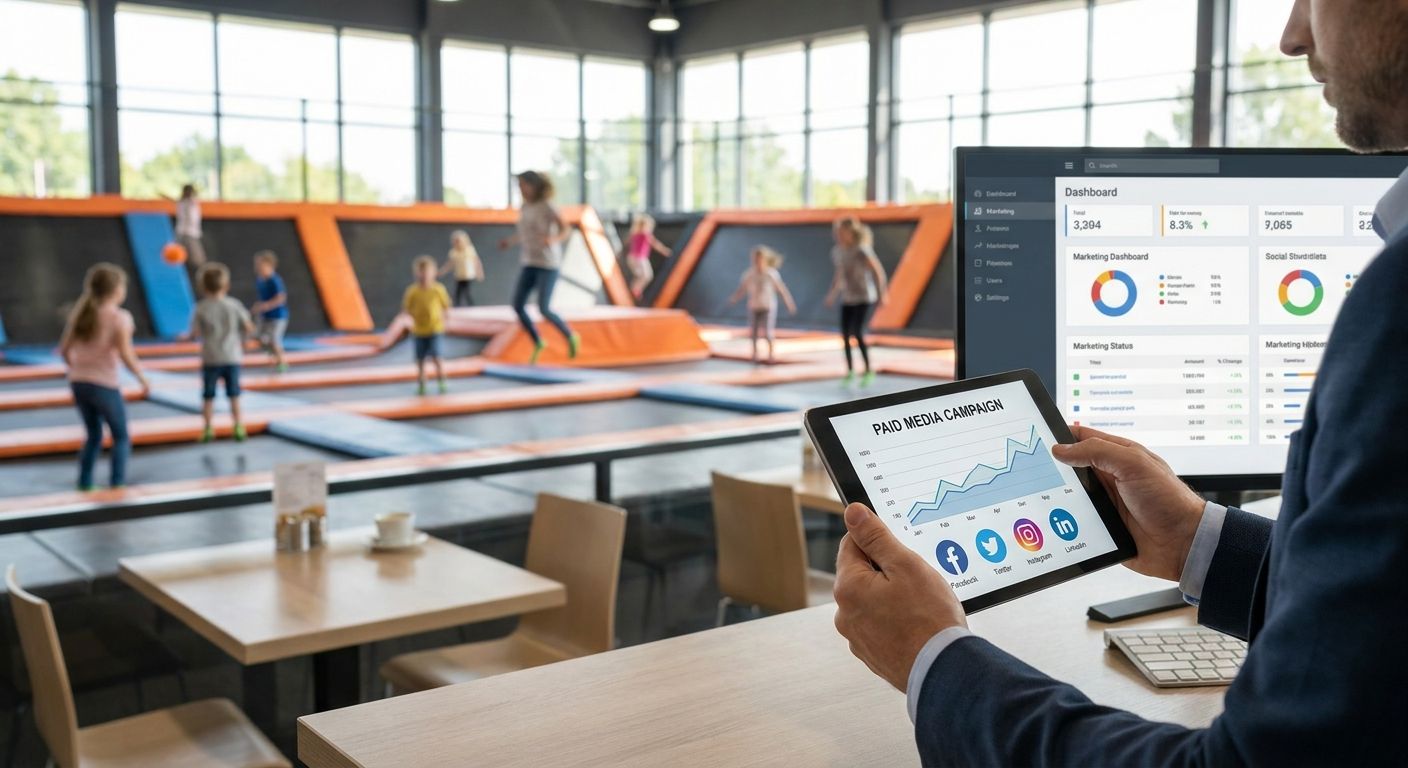
Trampoline parks earn most of their revenue in short, predictable windows — weekends, school holidays, birthday party season — and a single-channel paid media plan cannot flex fast enough to catch every spike. The best paid media strategy for trampoline parks in 2026 splits budget across short-form video, local search intent and retention spend rather than betting everything on one platform.
- The best paid media strategy for trampoline parks in 2026 splits budget across Meta, TikTok and Google Local Services Ads.
- Meta video ads win for volume and are the safe first spend for most parks — Buy.
- TikTok is the wildcard channel for reaching parents and teens fast in 2026 — Consider.
- Retention and lifecycle campaigns protect margin once acquisition slows — Buy.
Why this matters
A trampoline park has a fixed number of jump sessions per day and a hard ceiling on capacity, so wasted ad spend does not just cost money — it costs bookable slots you can never sell back. Most operators still run one campaign type (usually Meta) year-round and wonder why Tuesday afternoons sit empty while Saturday sells out. Fixing that split matters more than fixing any single ad's creative, and it's covered in detail in how to sell more tickets for your venue or event.
Pricing pressure in 2026 makes this worse. Cost-per-click on generic "trampoline park near me" search terms keeps climbing as more parks compete for the same postcode, so the parks winning are the ones diversifying acquisition instead of outbidding each other on Google Search alone.
How this list was built
This ranking weighs channels on three things: how fast they fill off-peak slots, how cheaply they reach local parents and families, and how well they support repeat visits rather than one-off jumps. Every channel below is judged against those three jobs, not against vanity reach numbers. The verdicts assume a park running a normal weekly schedule with peak weekend demand and softer weekday capacity — the exact pattern most trampoline parks report in 2026.
The ranked list
1. Meta Ads (Facebook and Instagram) — the volume driver
Meta remains the highest-volume channel for local family businesses in 2026 because Instagram and Facebook still carry the largest parent-age audience with usable location and interest targeting. Video-first creative — kids mid-jump, party footage, a countdown clock to a holiday session — consistently outperforms static images for trampoline parks. Run separate campaigns for weekday off-peak fill and weekend/holiday demand rather than one blended campaign; the audiences and messaging need to differ. Verdict: Buy — this is the channel to fund first and fund heaviest during school holiday weeks.
2. TikTok Ads — the wildcard for family reach
TikTok's ad platform now reaches well beyond teenagers into the 25-44 parent demographic that books trampoline park sessions, and its algorithm rewards native-feeling video over polished ads. A 15-second clip showing the actual bounce experience — sound on, no voiceover script — tends to hold attention longer than a branded promo. The catch: TikTok creative fatigues fast, so plan to refresh assets every two to three weeks rather than running one video for a full quarter. Verdict: Consider — strong for brand discovery and off-peak awareness, weaker for last-minute conversion than Meta or Search.
3. Google Search + Performance Max — the safe pick for intent
Anyone searching "trampoline park [town]" or "kids activities this weekend" is close to booking, which makes Search the highest-intent channel available. Performance Max extends that reach into Google's Display, YouTube and Discover inventory using the same booking-page signals, useful for filling gaps Search alone can't reach. Bid aggressively on branded and near-branded terms first — losing your own name to a competitor's ad is the single most common self-inflicted waste in this channel. Verdict: Buy — non-negotiable for capturing people already deciding where to jump today.
4. Google Local Services Ads — the pay-per-lead shortcut
Local Services Ads charge per qualified lead rather than per click, which suits a business selling a fixed local service like jump sessions and party bookings. It sits above standard Search results with a "Google Guaranteed" badge, which builds trust with parents who have never visited before. It only works well in markets where Google has rolled it out for the relevant local service category, so availability varies by region in 2026. Verdict: Consider — check availability in your postcode before allocating meaningful budget here.
5. Influencer seeding — the trust builder
A five-minute video from a local parenting or family-lifestyle creator does something paid ads cannot: it shows real proof the experience is worth the drive. Nano and micro creators with genuinely local, family-focused audiences outperform larger national influencers on cost-per-booking because their followers are geographically relevant. This works best layered on top of paid media, not instead of it — seeding builds the trust that makes your Meta and TikTok ads convert better. The mechanics of picking creators, briefing them and measuring the payoff are covered in influencer marketing for trampoline parks. Verdict: Buy — the cheapest trust signal available to a local venue in 2026.
6. Retention and lifecycle campaigns — the repeat-visit engine
Acquisition spend gets a family through the door once; retention spend gets them back for the birthday party, the season pass renewal and the half-term rebooking. Email and SMS flows triggered by visit date, party booking or membership expiry recover revenue that paid acquisition alone leaves on the table, and they cost a fraction of new-customer ad spend to run. The same logic applies across active-leisure venues — see how it plays out in retention marketing for climbing gyms for a comparable membership-and-repeat-visit model. Verdict: Buy — the highest-margin line item on this list once your acquisition channels are stable.
7. School holiday geo-targeted bursts — the seasonal multiplier
Half-term and summer holiday weeks concentrate a disproportionate share of annual trampoline park revenue into a handful of dates, so treating every week the same in your media plan wastes the opportunity. Layer a geo-targeted burst — tighter radius, higher daily budget, holiday-specific creative — on top of your always-on Meta and Search campaigns two to three weeks before each school break. Verdict: Buy — skip this and you're leaving your busiest weeks under-promoted.
Comparison table
| Channel | Best for | Funnel stage | Verdict |
|---|---|---|---|
| Meta Ads | Off-peak fill, party promos | Awareness to conversion | Buy |
| TikTok Ads | Discovery, brand reach | Awareness | Consider |
| Google Search + PMax | Ready-to-book families | Conversion | Buy |
| Google Local Services Ads | Local trust, first-time visitors | Conversion | Consider |
| Influencer seeding | Building trust pre-purchase | Awareness to consideration | Buy |
| Retention/lifecycle | Repeat visits, renewals | Post-purchase | Buy |
| Holiday geo-bursts | Peak week capacity | Conversion | Buy |
Where to get it executed
Running seven channels well is a full-time job, and most trampoline park operators do not have that headcount in-house.
- In-house: works if you already have a marketer running paid media daily — otherwise campaigns drift and budget gets wasted on stale creative.
- Freelancer: fine for a single channel (Meta only, for example) but rarely covers Search, TikTok, influencer briefing and retention all at once.
- Specialist agency: the right call once you're running three or more channels and need someone accountable for the split, not just the spend. FullyBooked has managed paid media across 50+ experience operators and generated £85M+ in booking revenue doing exactly this kind of multi-channel work.
Get a paid media plan for your park
Talk through your channel mix and off-peak fill strategy.
FAQ
What's the best paid media strategy for trampoline parks in 2026?
The best paid media strategy for trampoline parks in 2026 splits spend across Meta video ads, Google Search for intent capture, and retention campaigns for repeat visits. Relying on one channel alone leaves off-peak slots unsold.
Is TikTok or Meta better for trampoline park ads?
Meta wins on volume and conversion for most trampoline parks, while TikTok performs better for reaching parents through discovery-style video. Run Meta as the core channel and TikTok as a supplementary awareness layer.
How much should a trampoline park spend on paid media?
Budget should scale with unsold capacity, not a fixed percentage of revenue — weekdays and off-peak hours need more media weight than weekends that already sell out. Season and school holiday timing should drive the biggest swings in spend.
Do trampoline parks need influencer marketing as well as paid ads?
Influencer seeding is not a replacement for paid media, but it lowers the cost of every paid click by building trust before the ad is even seen. Nano and micro local family creators tend to outperform national influencers on cost-per-booking.
Should trampoline parks run Google Local Services Ads?
Local Services Ads are worth testing where Google has rolled out the category in your area, because they charge per lead rather than per click. Availability varies by postcode in 2026, so check before committing budget.
What's the biggest paid media mistake trampoline parks make?
The most common mistake is running one blended campaign for both weekday off-peak fill and weekend peak demand instead of separating them. The audiences, messaging and budget needs are different for each.
Does retention marketing count as paid media for trampoline parks?
Retention marketing usually runs through email and SMS rather than paid ad platforms, but it works alongside paid media to recover repeat visits and renewals. It typically costs far less per booking than new-customer acquisition ads.
How often should trampoline parks refresh their ad creative?
TikTok creative should be refreshed every two to three weeks due to fast audience fatigue, while Meta and Search assets can run longer if performance holds. School holiday campaigns need entirely new creative for each break, not recycled assets.
One last thing
The channel operators skip most often — retention and lifecycle campaigns — is usually the cheapest one to run and the first thing that should get funded once acquisition spend is stable, because a family who already jumped once costs far less to bring back than a new one costs to find. If your 2026 media plan only has acquisition line items, that's the gap to close first.