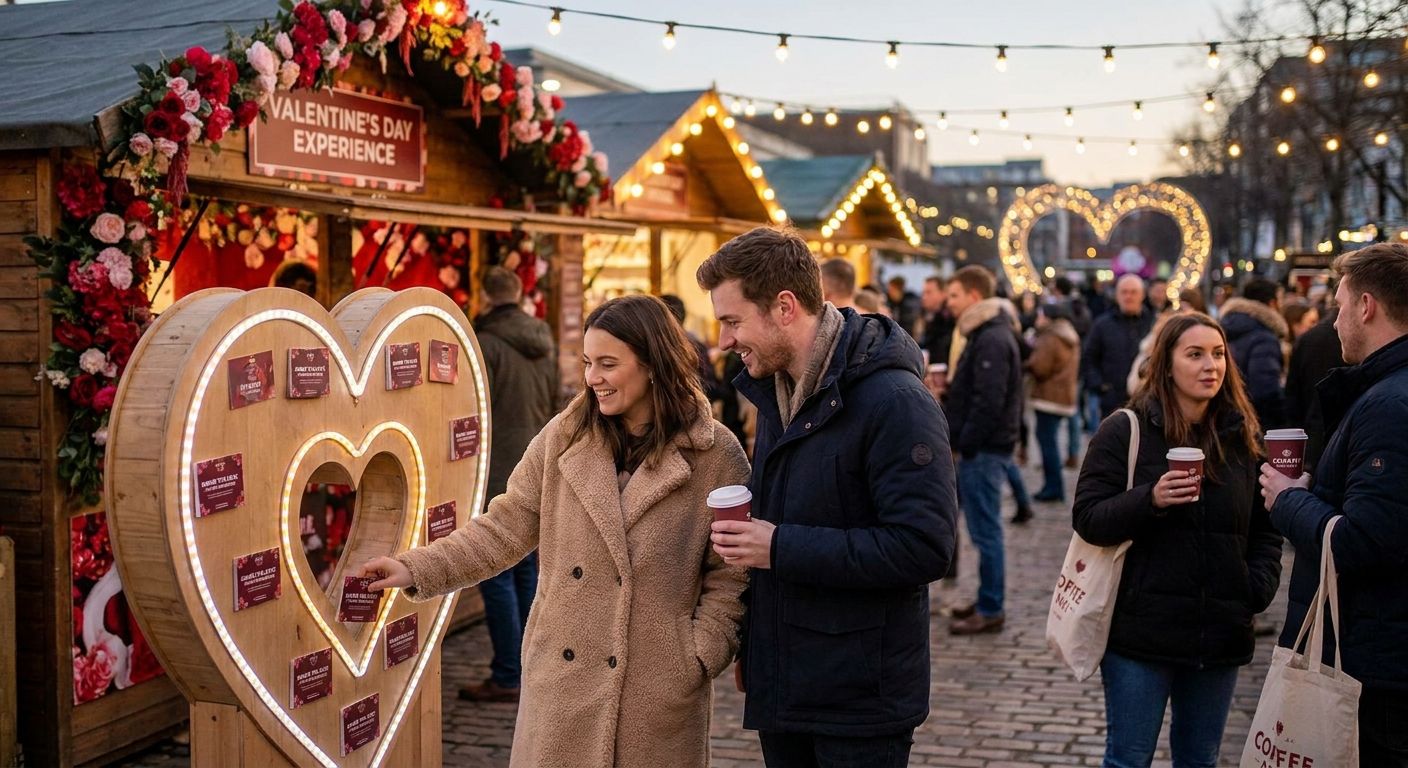
A Valentine's Day experience marketing campaign needs a 6-8 week runway before February 14th, built around a dedicated date-night offer, retargeting, and a post-Valentine's retention sequence. The number operators get wrong isn't the run-up — it's the two weeks after Valentine's Day, when bookings collapse unless the follow-up campaign is already built and waiting to catch deferred bookers.
- A valentines day experience marketing campaign needs a 6-8 week runway, not a 2-week push.
- Split budget across paid social, email, and influencer seeding, weighted toward whichever channel your audience already trusts.
- Post-Valentine's retention emails recover bookers who hesitated — most venues skip this and lose the fortnight after.
- Retargeting ads against site visitors who didn't book convert deferred date-night traffic in the final 10 days.
- Escape rooms, wine tastings, immersive dining and comedy clubs carry the strongest date-night intent for February 14th 2026.
Why this matters
Valentine's Day 2026 falls on a Saturday, which means every restaurant, hotel and experience venue in your postcode is bidding on the same date-night keywords in the same seven-day window. Ad inventory gets expensive fast, and if your campaign only starts the week before, you're paying peak rates for traffic that's already decided where to book.
FullyBooked has run seasonal marketing campaigns for family attractions across 50+ operators and £85M+ in generated revenue, and the pattern repeats every year: venues that start 6-8 weeks out outcompete venues that start 2 weeks out, regardless of budget size. Timing beats spend on a single-day demand spike like this one.
How to plan a Valentine's Day experience marketing campaign
The campaign runs in four phases, each with its own job. Skipping the first phase to jump straight to paid ads is the single most common mistake operators make in January.
- Lock the offer and ticket type — decide whether you're selling a couples-only slot, a date-night bundle, or opening the whole calendar with Valentine's branding.
- Build the landing page and retargeting pixel — the page needs to exist before any ad spend starts, so every click gets tracked from day one.
- Seed influencers and local press — local date-night content needs lead time to shoot, edit and post before demand peaks.
- Launch paid social and email — this is when spend actually starts, roughly 3 weeks before February 14th.
- Push retargeting hard in the final 10 days — this is where the bulk of last-minute date-night bookers convert.
- Run the retention sequence for two weeks after — this catches everyone who looked, hesitated, and never booked.
Weeks 8-6 out: offer and landing page
This phase has zero ad spend and all the groundwork. Get the ticket type finalised, the landing page live, and the retargeting pixel firing on every visitor — even before a single ad runs, organic and referral traffic to the page builds your retargeting pool for later.
Weeks 5-3 out: influencer seeding and paid launch
Local influencers with a food, date-night or lifestyle following need 2-3 weeks lead time to produce content that doesn't feel rushed. Paid social launches at the tail end of this window, once the landing page has enough visitors to make retargeting worthwhile.
Final 10 days: retargeting and last-minute push
This is where most Valentine's Day bookings actually convert — date-night planning is notoriously last-minute, and the reduce no-shows for ticketed events approach matters here too, since last-minute bookers are more prone to no-showing than early planners. Retargeting spend should roughly double against the site-visitor audience built in the earlier phases.
Weeks 1-2 after: retention and rebooking
The day itself sells out or it doesn't — either way, the campaign isn't finished on February 14th. Everyone who visited the landing page, opened an email, or clicked an ad without booking becomes the audience for a rebooking sequence: a follow-up offer, a "missed Valentine's" angle, or a straightforward reminder that the experience is still available.
“The week after Valentine's Day is where campaigns die, not the week of.”
Why Valentine's campaign performance varies
No two operators see the same result from the same playbook. The gap usually comes down to a handful of factors:
- Ticket type — a couples-only experience converts differently than a general-admission venue running Valentine's branding.
- Local competition density — restaurants and hotels absorb most of the local date-night ad budget in February, pushing up costs for everyone bidding the same audience.
- Which day of the week Valentine's falls on — a Saturday (as in 2026) behaves differently than a midweek date, since weekend dates get booked further in advance.
- Existing email list size and warmth — a warm list converts on a single send; a cold list needs paid media to do the work instead.
- Whether a loyalty or repeat-customer base already exists — venues with a loyalty programme already in place can activate existing customers instead of starting from zero.
- Budget split across channels — paid social alone underperforms paid social plus retargeting plus an owned email list working together.
Plan your Valentine's campaign now
Get the 6-8 week runway built before ad inventory gets expensive.
When should you start a Valentine's Day marketing campaign?
Start 6-8 weeks before February 14th, which for Valentine's Day 2026 means the campaign groundwork should begin in late December. Anything shorter than 3 weeks means competing for last-minute ad inventory at peak local demand pricing.
Should Valentine's Day marketing only target couples?
No — couples are the core audience, but a secondary "Galentine's" or friend-group angle widens the pool without diluting the date-night positioning. Family attractions in particular can run this as a parallel offer rather than replacing the main campaign.
What's the biggest mistake in Valentine's Day experience marketing?
The biggest mistake is treating February 14th as the finish line instead of the midpoint. Bookings that don't convert during the campaign don't disappear — they need a retention sequence in the two weeks after to get recovered.
FullyBooked builds this exact runway for venue and experience operators — locking the offer early, layering paid media with influencer seeding, and closing the loop with retention rather than letting the campaign end on Valentine's Day itself.
FAQ
How much does a Valentine's Day experience marketing campaign cost?
Cost scales with how many weeks of paid media you run and how competitive your local date-night market is, so budget by channel — paid social, email, influencer seeding — rather than a single flat figure.
When should you start marketing for Valentine's Day?
Start 6-8 weeks before February 14th, locking the ticket offer and landing page first so retargeting has time to build an audience before paid spend kicks in.
What's the best marketing channel for Valentine's Day ticket sales?
Paid social paired with email to your existing list converts fastest because date-night bookers decide within days, and retargeting recovers the ones who don't book on the first visit.
Should family attractions run Valentine's Day campaigns?
Family attractions can run a parallel Galentine's or family-focused angle alongside the core date-night campaign, rather than replacing it, since the primary Valentine's audience is couples-focused experiences.
Is influencer marketing worth it for Valentine's Day?
Yes for visual, date-night-friendly venues like immersive dining, wine tasting and escape rooms, provided influencer content is seeded 2-3 weeks ahead rather than the week of.
What happens to bookings after Valentine's Day?
Bookings typically drop sharply the week after February 14th unless a retention or rebooking sequence is already running to catch people who visited but didn't book.
Does Valentine's Day falling on a weekend change the campaign?
Yes — Valentine's Day 2026 falls on a Saturday, which means weekend date-night bookers plan further in advance than they would for a midweek date, so the campaign runway should start earlier.
One last thing
Build the rebooking email before the campaign launches, not after. Operators who write the post-Valentine's follow-up in advance send it within 48 hours of February 14th; operators who wait until bookings slow down usually don't send it until the audience has already moved on.


