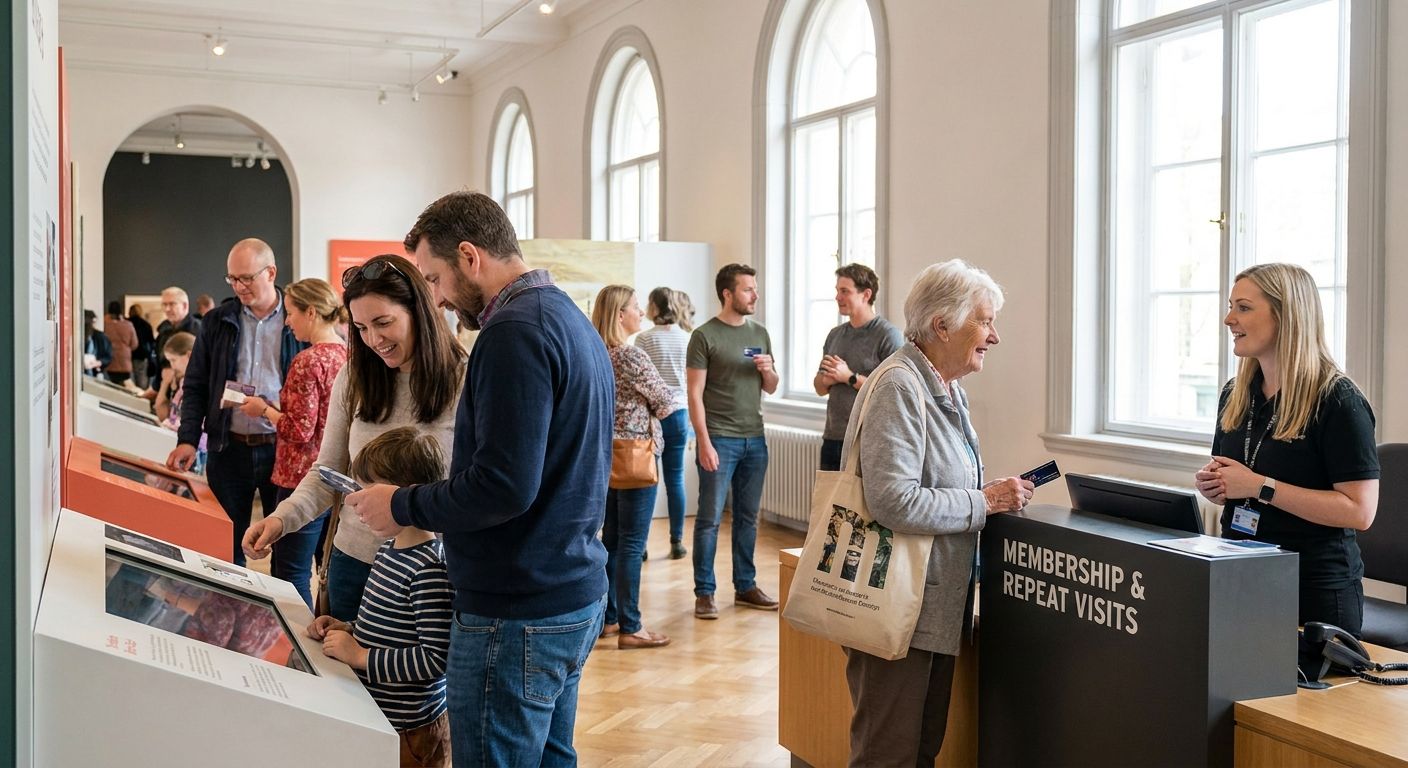
Repeat visits are the cheapest bookings a museum or gallery will ever sell — and most venues still market as if every visitor is a first-timer. Growing repeat visits in 2026 means building a reason to return, then reminding past visitors of it before they forget.
- Membership and loyalty schemes are the single highest-leverage lever for repeat visits to a museum or gallery in 2026.
- Lifecycle email and SMS campaigns that trigger 60-90 days after a visit outperform generic newsletters for reactivation.
- Retention-focused paid media (retargeting past bookers) costs less per conversion than always-on new-visitor prospecting.
- Rotating exhibitions and programming give lapsed visitors an actual reason to rebook, not just a discount.
- FullyBooked has managed retention strategy across 50+ experience operators and generated £85M+ in booking revenue.
Why this matters
A visitor who has already been through the door is dramatically easier to convert a second time than a stranger scrolling past a paid ad. They already trust the venue, they already know what a ticket costs, and they don't need to be sold on the concept — just reminded there's a new reason to come back. Museums and galleries that treat every visitor as a one-off transaction leave that lower-cost revenue on the table every single month.
FullyBooked runs retention marketing for museums and galleries as a distinct discipline from acquisition, because the tactics, timing and messaging are different. A membership push in month two after a first visit reads completely differently to a cold prospecting ad — and it should.
How to grow repeat visits to a museum or gallery
The playbook that works in 2026 has four parts, in order of priority:
- Launch or refresh a membership/loyalty programme — give visitors a structural reason to return rather than relying on goodwill.
- Build a lifecycle email and SMS sequence — trigger messages at 30, 60 and 90 days post-visit, timed to new exhibitions or programming.
- Retarget past bookers with paid media — separate this budget from new-visitor prospecting entirely.
- Rotate programming and promote it to past visitors first — a new exhibition is only a repeat-visit driver if lapsed visitors actually hear about it.
| Tactic | Best for | Typical cadence |
|---|---|---|
| Membership/loyalty programme | Venues with permanent collections and repeat local audiences | Ongoing, renewed annually |
| Lifecycle email/SMS | Reactivating visitors within 3-6 months of last visit | Triggered at 30/60/90 days |
| Retargeting paid media | Past bookers who haven't returned in 6+ months | Always-on, separate budget line |
| New exhibition promotion | Time-boxed programming changes | Per exhibition launch |
Membership and loyalty programmes: the highest-leverage lever
A membership scheme turns a single ticket sale into a recurring relationship — the visitor pays once (or on a recurring basis) and gets a reason to keep coming back rather than a reason to decide again each time. For galleries with rotating exhibitions, membership also solves the discovery problem: members get told about new shows automatically instead of stumbling across them.
What separates a membership programme that drives repeat visits from one that just sits on a website unused is promotion timing — pitch it at the point of highest satisfaction, which is typically as a visitor leaves or within 48 hours of their visit, not buried in a generic post-visit survey. FullyBooked's work on best loyalty programme ideas for experience brands covers structuring tiers so the highest-value visitors get retained, not just the most price-sensitive ones.
Lifecycle email and SMS: reactivate before visitors forget you exist
A visitor who hasn't heard from a museum in six months isn't lapsed by choice — they've simply moved on to whatever else is competing for attention. A lifecycle sequence solves this by triggering messages automatically at set intervals after a visit, rather than relying on a monthly newsletter that reaches everyone at the same generic cadence regardless of where they are in the visitor journey.
The sequence that performs best for museums and galleries in 2026 follows this shape:
- Day 7: thank-you plus a soft nudge toward membership or a return offer.
- Day 30: what's new since their visit — a new gallery wing, a rotating exhibition, an event.
- Day 60-90: a specific reason to return, tied to programming rather than a generic discount.
FullyBooked's best email marketing strategy for ticketed events breaks this cadence down by venue type, because a science museum with school-holiday programming needs a different trigger schedule to a contemporary art gallery running quarterly shows.
Retention marketing beyond email: paid media and social
Retargeting past bookers on paid social and search costs less per conversion than prospecting cold audiences, because the audience already knows the venue and doesn't need to be convinced the concept works — only reminded there's a reason to come back now. This budget line should sit separately from new-visitor acquisition spend, with its own creative built around "what's new" rather than "what we are."
Social proof plays a role here too. User-generated content from past visitors — photos, reels, reviews — reads as more credible to a lapsed visitor than a paid ad, because it comes from someone who's already been. FullyBooked's best social media strategy for entertainment venues covers how to source and reuse this content specifically to reactivate past bookers rather than only to acquire new ones.
“A visitor who has already walked through the door is the cheapest booking a museum will ever make twice.”
Why repeat visit rates vary
Repeat visit performance differs from venue to venue for reasons that are mostly structural, not down to luck:
- Programming cadence — venues with rotating exhibitions have a natural, recurring reason for repeat visits; permanent-collection-only venues have to manufacture that reason through events or membership perks.
- Membership pricing and value — a membership that's priced too close to a single ticket gives visitors no reason to commit annually.
- Local vs tourist visitor mix — a venue drawing mostly tourists has a structurally lower repeat-visit ceiling than one drawing local audiences, regardless of marketing quality.
- Email/SMS cadence and timing — sequences triggered at the wrong intervals (too soon, too generic) get ignored or unsubscribed from.
- Budget split between acquisition and retention — venues that spend 100% of paid media on new-visitor prospecting have no retargeting engine to bring past bookers back. FullyBooked's best retention marketing tactics for experience businesses covers how to split this budget properly.
- Ease of rebooking — friction at checkout (account creation, unclear membership benefits) suppresses repeat bookings even when the marketing works.
Get a retention audit for your venue
FullyBooked reviews your membership, email and paid retention setup.
Related questions
What's the best way to build a museum membership programme?
The best membership programmes for museums and galleries in 2026 are pitched at the point of highest visitor satisfaction — at exit or within 48 hours of a visit — rather than buried in a post-visit survey. Tier the offer so it rewards frequent visitors specifically, not just anyone willing to pay upfront.
How often should a museum email past visitors to drive repeat bookings?
A triggered sequence at 30, 60 and 90 days after a visit outperforms a flat monthly newsletter for reactivating lapsed visitors, because each message lands at a natural decision point rather than a generic calendar date. The 60-90 day message should carry a specific reason to return, not a blanket discount.
Do loyalty programmes work better than paid ads for repeat visits?
Loyalty programmes and retargeted paid media work best combined, not as a substitute for each other — the membership gives visitors a structural reason to return, and retargeting reminds them of it when they're not actively thinking about the venue. Running only one leaves the other half of the repeat-visit funnel empty.
FAQ
How do you increase repeat visits to a museum or gallery in 2026?
Increase repeat visits by combining a membership or loyalty programme with a triggered email/SMS sequence at 30, 60 and 90 days post-visit, plus paid retargeting aimed specifically at past bookers. Rotating programming gives lapsed visitors an actual reason to rebook rather than just a reminder.
What's the best loyalty programme structure for a gallery?
The best structure tiers benefits by visit frequency and pitches the offer at the point of highest satisfaction, typically at exit or within 48 hours of a visit. A flat, single-tier membership priced too close to a single ticket gives visitors little reason to commit.
Is email or paid social better for reactivating museum visitors?
Email and SMS work best for reactivating visitors within the first 3-6 months post-visit, while retargeted paid social works better for visitors who've lapsed 6+ months. Running both in sequence, not as alternatives, covers the full reactivation window.
How much does retention marketing cost compared to new-visitor acquisition?
Retargeting past bookers typically costs less per conversion than prospecting cold new-visitor audiences, because the audience already knows the venue and needs less convincing. Exact costs vary by platform and audience size, so budgets should be tested rather than assumed.
What programming drives the most repeat visits?
Rotating or time-boxed exhibitions drive more repeat visits than permanent collections alone, because they give past visitors a specific, recurring reason to return. Permanent-collection venues need to manufacture that reason through membership perks or events instead.
Should a museum run its own retention marketing or hire an agency?
Venues with in-house teams that already run lifecycle email and paid retargeting can manage retention internally; venues without that infrastructure typically see faster results working with a specialist agency. FullyBooked manages retention strategy for 50+ experience operators as a distinct service from new-visitor acquisition.
What's a realistic first step for a small gallery with no marketing team?
Start with a simple triggered email sequence at 30 and 90 days post-visit before building a full membership scheme. It requires the least setup and immediately targets the audience most likely to rebook.
One last thing
The venues that grow repeat visits fastest in 2026 aren't the ones with the biggest acquisition budgets — they're the ones that split spend deliberately between new-visitor ads and retention campaigns aimed at people who've already walked through the door. Check the current split on your own media plan before adding a single pound to prospecting.


