Candle making workshops sell out on TikTok discovery and Valentine's Day gifting, then sit half-empty on a wet Tuesday in February — the studios that fix that gap run a deliberate mix of local SEO, paid social and retention marketing, not a single channel.
- Local SEO plus paid social is the best overall marketing strategy for candle making workshops in 2026 — it wins near-me searches and fills off-peak slots.
- Group and hen-do bookings are the highest-value segment for candle workshop studios and need a dedicated funnel, not a generic ad.
- Influencer and UGC seeding is the best budget option for new studios still building booking volume.
- Email and SMS retention converts one-off bookers into repeat class-takers and referral sources.
Why this matters
Candle making workshops sit in a crowded corner of the experience economy — pottery painting, cocktail masterclasses and paint-and-sip studios all fight for the same hen-do and gifting bookings. A marketing strategy for candle making workshops that ignores seasonality or group demand leaves revenue on the table every single month.
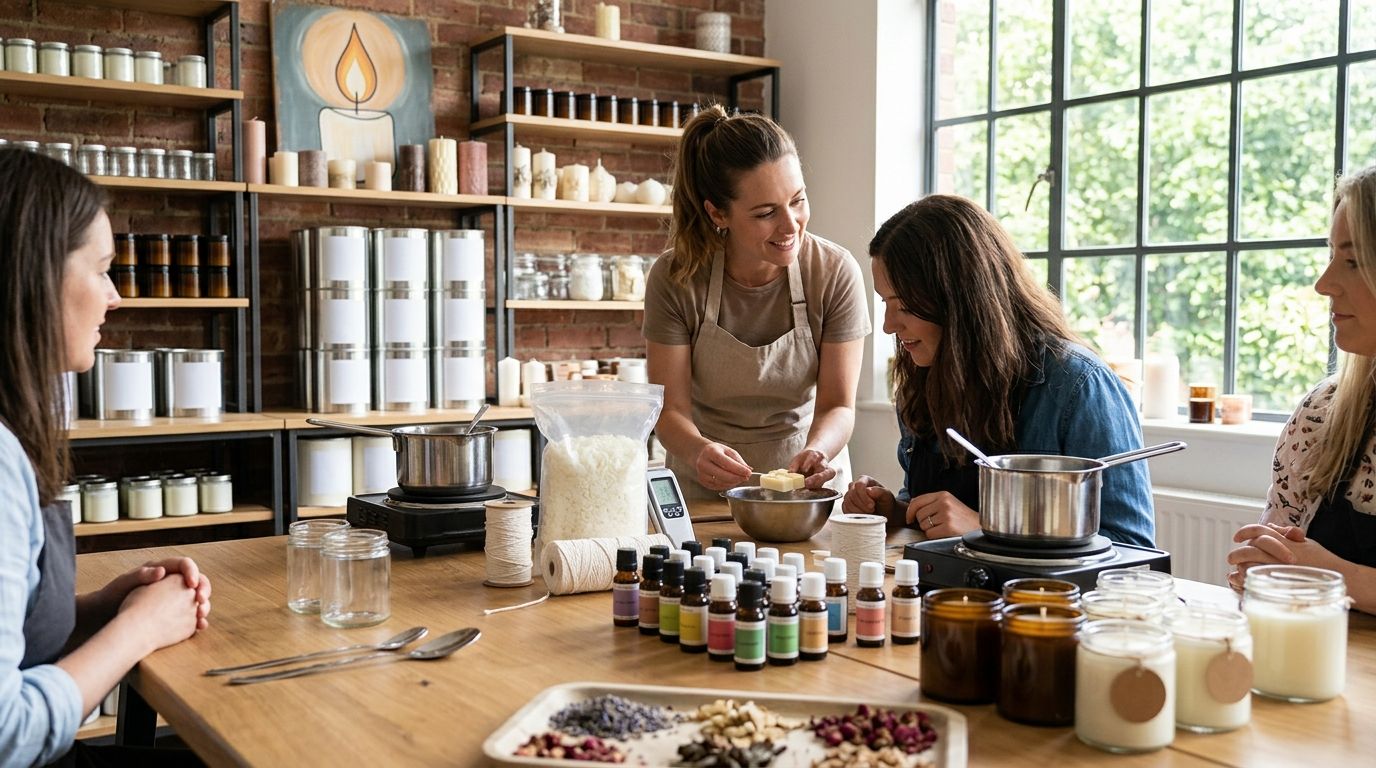
The format is naturally visual (pouring wax, choosing scents, a finished product to photograph), which makes it a strong fit for influencer and social content — but that alone won't fill a Tuesday afternoon slot in January. Studios that build repeat revenue in 2026 stack channels: search visibility for intent-driven bookers, paid social for group occasions, and retention email for the customers who already loved their first class.
Same lesson applies across the wider crafts space — the approach that works for a candle making workshop largely mirrors what pottery and craft studios run, because the booking behaviour (gifting, hen dos, repeat hobbyists) is nearly identical.
What makes the best marketing strategy for candle making workshops
- Search intent capture — ranking for "candle making workshop near me" and "candle making class for hen do"
- Group and corporate booking share — hen dos, birthdays and team-building often make up the highest-margin bookings
- Seasonal gifting spikes — Christmas, Valentine's Day and Mother's Day drive disproportionate demand
- Repeat visit and referral rate — one-off bookers converted into returning hobbyists
- Cost per booking relative to class price — a £45-£65 class needs a tight acquisition cost to stay profitable
- Social shareability — the finished candle and the making process both photograph well, which fuels organic and paid content alike
At a glance: ranked strategies for candle workshop studios
| Strategy | Best for | Standout feature | Key limitation |
|---|---|---|---|
| Local SEO & Google Business Profile | Near-me search capture | Free, compounding visibility | Slow to build, no quick fix |
| Paid social (Meta/TikTok ads) | Filling off-peak slots and group bookings | Fast, targetable demand | Costs scale with competition |
| Influencer & UGC seeding | Discovery among first-time bookers | Low cash cost, high shareability | Hard to attribute directly to bookings |
| Group & corporate booking funnel | Hen dos, birthdays, team-building | Highest average order value | Needs a dedicated landing page and sales process |
| Email & SMS retention | Repeat bookings and referrals | Lowest cost per booking over time | Needs an existing customer list to work |
| Seasonal campaign calendar | Gifting-driven demand spikes | Predictable, recurring revenue windows | Concentrated risk if a season underperforms |
1. Local SEO & Google Business Profile: best for near-me search capture
Most candle workshop bookings start with a location-qualified search — "candle making class [city]" or "candle workshop near me" — which makes Google Business Profile and on-site local SEO the foundation, not an optional extra.
Local SEO pros:
- Captures bookers who are already looking to buy, not browsing
- Compounds over time without ongoing ad spend
- Reviews and photos on the profile double as social proof
Local SEO cons:
- Takes months to build meaningful ranking, not days
- Limited reach outside a booker's immediate search radius
- Needs consistent review generation to stay competitive
Studios optimising their Google Business Profile properly — categories, booking links, photo uploads, review responses — see it work the same way it does across experience venues generally, where local search is often the single largest booking source.
Verdict: run this now. It's the cheapest channel with the longest payoff and every studio should have it live before spending on ads.
2. Paid social (Meta/TikTok ads): best for filling off-peak slots
Paid social lets a candle workshop target specific occasions — hen-do planners, date-night couples, corporate event organisers — and specific days, which is exactly the lever needed to fill a quiet Wednesday afternoon.
Paid social pros:
- Precise targeting by occasion, location and demographic
- Fast to launch and adjust based on performance
- Video ad formats suit the visual, hands-on nature of candle making
Paid social cons:
- Costs rise as more experience operators bid on the same audiences
- Requires ongoing creative refreshes to avoid ad fatigue
- Weak without a conversion-optimised booking page behind it
Verdict: run this now, alongside local SEO. Paid media is what actually moves the needle on off-peak occupancy in the near term.
3. Influencer & UGC seeding: best for discovery among first-time bookers
Candle making is inherently photogenic — pouring, scent-blending, a finished jar to hold up to camera — which makes creator seeding one of the most cost-efficient discovery channels available to a new studio.
Influencer & UGC pros:
- Low cash outlay compared with paid media, especially with gifted classes
- Generates reusable content for paid social and the website
- Builds trust faster than brand-run advertising
Influencer & UGC cons:
- Attribution to actual bookings is harder to track cleanly
- Quality varies hugely creator to creator
- Needs volume of activations to produce consistent results
Verdict: test this now with a small, defined budget. It's the best budget option for studios that don't yet have ad spend to commit.
4. Group & corporate booking funnel: best for hen dos and team-building
Group occasions — hen parties, birthdays, corporate team-building — typically book at higher average order values than solo classes, which means they deserve a dedicated landing page, group pricing structure and a direct enquiry route rather than being squeezed into the standard booking flow.
Group funnel pros:
- Highest revenue per booking of any segment
- Predictable lead time for staffing and materials
- Corporate bookings often repeat annually
Group funnel cons:
- Requires manual sales follow-up, not pure self-serve
- Longer sales cycle than an impulse solo booking
- Needs capacity planning to avoid overbooking a single studio slot
Verdict: build this now if you don't have it. It's the segment most studios under-serve, and the easiest place to add revenue without adding new customers.
5. Email & SMS retention: best for repeat bookings and referrals
A candle workshop customer who had a good experience is a warm lead for a return visit, a gift voucher purchase, or a referral — but only if there's a system nudging them, which is what email and SMS retention does.
Retention marketing pros:
- Lowest cost per booking of any channel once a list exists
- Drives repeat visits and gift-voucher sales year-round
- Segments well by past booking type (solo, group, corporate)
Retention marketing cons:
- Only works once a studio has built an email list
- Needs regular content to avoid list fatigue
- Slower to show impact than paid acquisition channels
The mechanics here match what's already proven across ticketed experiences more broadly — the email marketing strategy for ticketed events playbook of segmentation, post-visit follow-up and voucher prompts applies directly to candle workshops.
Verdict: phase this in once you have 500+ contacts. Below that, focus budget on acquisition first.
6. Seasonal campaign calendar: best for gifting-driven demand spikes
Christmas, Valentine's Day and Mother's Day drive a disproportionate share of annual bookings for candle workshops because the class itself doubles as a gift experience — a seasonal calendar built months in advance captures that demand instead of reacting to it late.
Seasonal calendar pros:
- Predictable, recurring revenue windows every year
- Justifies a temporary lift in ad spend with clear ROI
- Gift voucher sales compound the effect
Seasonal calendar cons:
- Concentrated risk if one key season underperforms
- Requires planning and creative production weeks ahead
- Off-season months need separate strategy to stay profitable
Verdict: plan this now for the next 12 months. Studios that map their calendar in January outperform those still reacting to demand in November.
How this ranking was built
Each strategy above is scored against the criteria set out earlier: search intent capture, group booking value, seasonal reliance, repeat visit rate, cost per booking, and social shareability. Local SEO and paid social rank highest because they address the two biggest gaps most candle workshop studios face — near-me discovery and off-peak occupancy — while the remaining tactics compound results once those two are in place.
Which marketing strategy should you choose?
For most candle making workshop studios in 2026, the default combination is local SEO plus paid social, with a dedicated group booking funnel running in parallel to capture hen-do and corporate demand. Add influencer seeding for discovery if budget allows, then layer in email retention once a booking list of meaningful size exists.
Studios that already have strong occupancy should shift budget toward retention and seasonal campaigns rather than continuing to spend heavily on acquisition. The right mix changes as a studio matures — but a single-channel approach rarely holds up past the first year.
Get a marketing plan built for your studio
Paid media, influencer and retention strategy for experience operators.
FAQ
What's the best marketing strategy for candle making workshops in 2026?
The best overall approach combines local SEO for near-me search capture with paid social ads to fill off-peak slots and target group occasions. Layer in email retention and seasonal campaigns as the studio grows.
Is influencer marketing worth it for a candle making workshop?
Yes, especially for new studios with limited ad budget — the visual, hands-on nature of candle making suits creator content well. Attribution to direct bookings is harder to measure than paid social, so treat it as a discovery channel rather than a conversion channel.
How do you get more hen do and group bookings for a candle workshop?
Build a dedicated group booking landing page with clear pricing and a direct enquiry route, then target hen-do planners and corporate organisers with paid social. Group bookings carry higher average order value than solo classes, so they deserve their own funnel.
Does Google Business Profile actually matter for candle workshop studios?
Yes — most bookings start with a location-qualified search, and an optimised profile with reviews, booking links and photos captures that intent directly. It's free and compounds over time, making it the foundation before any paid spend.
What's the best season for candle workshop marketing campaigns?
Christmas, Valentine's Day and Mother's Day drive the largest gifting-related demand spikes for candle workshops. A calendar planned months ahead of each season outperforms reactive, last-minute campaigns.
Should candle making workshops use TikTok?
TikTok suits candle workshops well because the process (pouring, scent-blending) and the finished product are naturally shareable video content. It works best paired with paid amplification rather than relying on organic reach alone.
How do you reduce no-shows for candle making classes?
SMS and email reminders sent close to the class time, combined with a clear deposit or prepayment policy, reduce no-shows significantly. Retention systems that already track a customer's booking history make these reminders easy to automate.
How much of a candle workshop's revenue should come from group bookings?
There's no universal figure, but group and corporate bookings typically carry a higher average order value than solo classes, which is why studios build a dedicated funnel for them. Tracking group bookings as a separate revenue line makes it easier to judge whether that funnel is working.
One last thing
The studios that struggle in 2026 aren't the ones with weak creative — they're the ones running paid social with no local SEO underneath it, so every click costs more than it should because organic search isn't doing any of the work for free.


