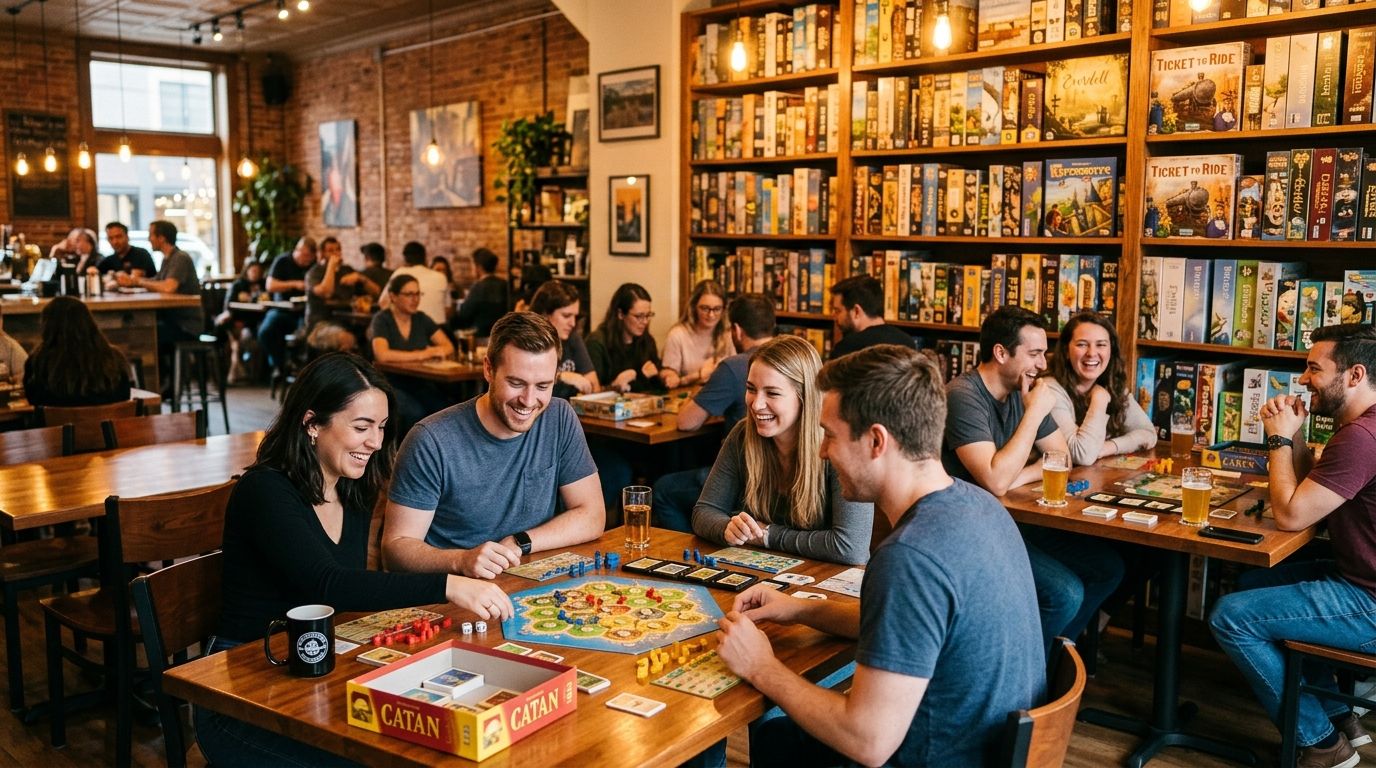
Board game cafes live and die on midweek covers, and the channel that fills a Tuesday table looks nothing like the channel that sells out a Saturday tournament. Best overall: TikTok and short-form video. Best for local discovery: Google Business Profile and local SEO. Best budget option: referral and word-of-mouth programmes. This guide ranks the marketing channels board game cafes actually convert with in 2026, with the trade-offs each one carries.
- TikTok and short-form video win overall for board game cafes chasing new footfall in 2026.
- Google Business Profile and local SEO capture near me searches at close to zero ongoing spend.
- Email and loyalty programmes fill off-peak tables at the lowest cost per repeat booking.
- Referral programmes and tabletop influencer partnerships build credibility faster than generic paid social.
- Paid social ads on Meta still convert best for group bookings and ticketed events.
Why this matters
Board game cafes run on thin margins per cover and long dwell times, so the channel that fills a table at 2pm on a Wednesday needs to look completely different from the channel that sells a Friday night tournament ticket. FullyBooked has managed marketing across 50+ experience operators and generated £85M+ in booking revenue, and the channel mix that repeats across board game cafes is narrower than most owners expect.
Get the priority order wrong in 2026 and you'll spend the whole quarter building brand awareness on TikTok while off-peak slots sit empty and your loyalty list stays flat. The channels below aren't interchangeable — each solves a different booking problem.
What makes the best marketing channel mix
- Cost per booking relative to your average table spend
- Speed to fill off-peak weekday slots, not just weekend covers
- Video and photo friendliness — can the channel actually show the experience
- Repeat-visit potential through memberships, loyalty and groups
- Local discoverability for "board game cafe near me" searches
- Scalability if you run more than one site
Marketing channels for board game cafes at a glance
| Channel | Best for | Standout feature | Key limitation |
|---|---|---|---|
| TikTok / short-form video | New customer discovery | Shows the room, the games and the vibe in seconds | Slow to convert without a strong content cadence |
| Google Business Profile & local SEO | "Near me" searches | Captures high-intent local demand passively | Doesn't build a repeat-visit habit on its own |
| Email & loyalty programmes | Off-peak fill, repeat visits | Owned list, no platform algorithm risk | Needs an existing customer base to work |
| Tabletop influencer partnerships | Credibility, event launches | Trusted voices inside a niche community | Harder to measure ROI directly |
| Referral / word-of-mouth | Lowest cost per booking | Community-driven, cheap to run | Slow to scale without a nudge (perk or incentive) |
| Paid social ads (Meta/Instagram) | Group bookings, ticketed events | Precise targeting by location and interest | Costs rise fast without retargeting discipline |
1. TikTok and short-form video: best for new customer discovery
Short-form video does what no static post can: it shows a full table mid-game, the noise, the snacks, the win. For board game cafes, that's the single best format for pulling in people who've never heard of your venue.
The TikTok marketing approach for experience brands that works for venues isn't polished ads — it's staff and regulars playing games on camera, posted consistently.
TikTok pros:
- Free organic reach if content is genuinely watchable
- Shows the experience instead of describing it
- Builds a content library you can repurpose for ads later
TikTok cons:
- Needs weekly filming discipline, not a one-off video
- Algorithm reach is inconsistent month to month
- Doesn't directly capture booking intent the way search does
Best for: venues under three years old still building awareness. Verdict: Buy.
2. Google Business Profile and local SEO: best for near me searches
Someone searching "board game cafe near me" on a Friday afternoon is closer to booking than someone scrolling TikTok. An optimised Google Business Profile with current hours, photos and reviews captures that demand without ongoing spend.
Local SEO pros:
- Highest intent traffic of any channel on this list
- Costs nothing beyond time to maintain
- Reviews compound — more reviews, more visibility, over time
Local SEO cons:
- Doesn't help you reach people who aren't already searching
- Ranking takes months to build in competitive cities
- Limited control over how competitors also appear nearby
Best for: any board game cafe with a fixed location and foot traffic catchment. Verdict: Buy.
3. Email marketing and loyalty programmes: best for off-peak fill
Once someone has visited once, email and a loyalty structure are the cheapest way to bring them back on a Tuesday instead of only a Saturday. This is the channel most board game cafes under-invest in.
Email/loyalty pros:
- Directly targets your least-booked time slots
- Owned audience — no algorithm dependency
- Cheapest cost per repeat booking on this list
Email/loyalty cons:
- Needs an existing customer list to have any reach
- List growth is slow without a prompt at checkout or table
- Requires ongoing content, not a single blast
Best for: venues with 12+ months of trading history and a real customer database. Verdict: Buy.
4. Tabletop influencer and community partnerships: best for credibility
Board game communities trust other players far more than they trust a venue's own account. A tabletop content creator reviewing a game night at your cafe carries more weight than an ad for the same event.
Influencer partnerships pros:
- Borrowed trust from an established niche audience
- Strong for launching new game nights or tournament formats
- Content produced can be reused across your own channels
Influencer partnerships cons:
- Right-fit creators in the tabletop niche are limited in number
- Harder to attribute bookings directly to the partnership
- Quality varies — vetting takes real time
Best for: launching a new event format or expanding to a second location. Verdict: Hold — worth testing once local SEO and email are already running.
5. Referral and word-of-mouth programmes: best for lowest cost per booking
Board game cafes are inherently social venues — groups book together, and a structured referral nudge (a free game credit, a discount on the next visit) turns that social pattern into a repeatable acquisition channel.
Referral programmes pros:
- Cheapest acquisition cost of any channel here
- Fits naturally with a group-booking business model
- Rewards your best customers instead of new, unproven traffic
Referral programmes cons:
- Needs a clear incentive to move past casual mentions
- Volume stays modest without a larger existing customer base
- Hard to scale fast if you need bookings this month
Best for: venues with steady repeat traffic looking to lower blended acquisition cost. Verdict: Buy.
6. Paid social ads (Meta/Instagram): best for group bookings and ticketed events
When you need to fill a specific date — a tournament, a private hire slot, a themed night — paid social targeting by location and interest still outperforms organic reach on a deadline.
This is where dedicated paid media for board game cafes campaigns earn their keep, particularly for group and event-specific pushes.
Paid social pros:
- Fastest channel to move when you need bookings by a fixed date
- Precise geographic and interest targeting
- Retargeting recovers visitors who didn't book on the first visit
Paid social cons:
- Costs escalate without retargeting and creative refresh
- Needs ongoing management, not a set-and-forget budget
- Weaker for building long-term brand awareness than video
Best for: venues running recurring ticketed events or needing to fill a specific date fast. Verdict: Buy for event pushes, Wait if your main goal is general brand awareness — TikTok does that cheaper.
How we ranked
Each channel above is scored against the six criteria listed earlier: cost per booking, speed to fill off-peak slots, video/photo friendliness, repeat-visit potential, local discoverability and scalability. No channel wins on all six — that's why the ranking is a decision tree by use case, not a single leaderboard.
Get your channel mix audited
FullyBooked reviews your current spend and tells you what to cut and what to scale.
Which marketing channel should you choose?
If you're starting from zero awareness in 2026, TikTok and short-form video is the default pick — it's the only channel on this list that shows the experience for free. If your venue already has foot traffic and reviews, Google Business Profile and local SEO deserves the next hour of your time, not another ad campaign. Once you have a customer list of any size, email and loyalty programmes become the cheapest lever for fixing your off-peak problem.
Most board game cafes that plateau in 2026 are running one channel well and ignoring the other five — the fix is rarely a bigger budget, it's a wider spread.
FAQ
What's the best marketing channel for a board game cafe in 2026?
TikTok and short-form video is the best overall channel for new customer discovery in 2026, because it shows the in-venue experience directly. Google Business Profile and local SEO wins for near me search intent, and email/loyalty wins for repeat visits.
Is paid social better than organic TikTok for board game cafes?
Paid social on Meta converts faster for a specific date, like a tournament or private hire slot. Organic TikTok builds broader awareness more cheaply over time but takes longer to show results.
How do board game cafes get more midweek bookings?
Email marketing and a loyalty programme targeting existing customers is the most reliable way to fill off-peak slots. Referral incentives also help because board game cafes already attract group bookings.
Do influencer partnerships work for board game cafes?
Tabletop content creators build credibility faster than a venue's own account, especially for launching new game nights. The limitation is a small pool of right-fit creators and harder attribution.
Should a new board game cafe start with paid ads or organic content?
A new venue with no existing awareness should start with organic short-form video, since it's free and builds a content library. Paid social becomes more efficient once you have creative that already performs organically.
How much of a marketing budget should go to social media for a board game cafe?
Budget splits vary by venue size and location, so review current spend against booking data rather than a fixed formula. A specialist can audit the current split against actual channel performance.
What's the cheapest marketing channel for board game cafes?
Referral and word-of-mouth programmes carry the lowest cost per booking because they rely on existing customers rather than new acquisition spend. Local SEO is a close second since it requires time rather than ad budget.
Can one marketing agency run all these channels for a board game cafe?
Yes — an experience-marketing specialist typically runs paid media, influencer partnerships and retention campaigns together rather than as separate vendors. Coordinating them under one strategy avoids duplicate spend on the same audience.
One last thing
The channel most board game cafes skip entirely is referral — not because it doesn't work, but because nobody sets up the mechanism. A group that already booked a table is your cheapest source of the next booking; a structured nudge is what turns that into a repeatable channel instead of a lucky coincidence.


