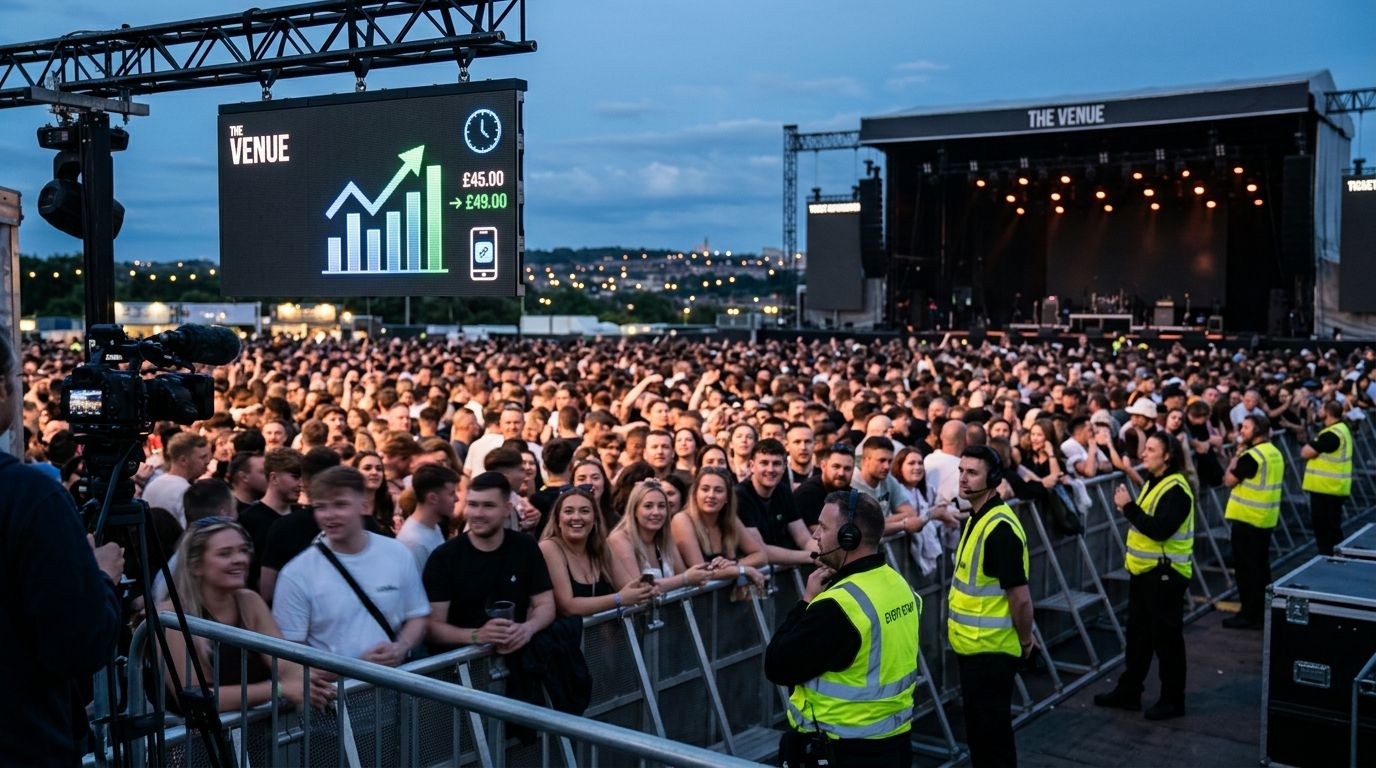
Dynamic pricing raises ticket revenue by charging more for high-demand slots and less for quiet ones — instead of a single flat price that leaves peak nights underpriced and off-peak nights empty. The hidden cost most operators miss: pricing alone doesn't fill a calendar; it only works when paired with demand data and active marketing to steer bookers toward the slots you're trying to move.
- Dynamic pricing ticket revenue models charge more on high-demand nights and less on quiet ones — flat pricing leaves money on the table both ways.
- Three variants cover most experience venues in 2026: time-based, demand-based and access-tier pricing.
- FullyBooked has generated £85M+ in ticket revenue across 50+ operators by pairing pricing structure with paid media.
- Pricing changes without a demand-generation plan just redistribute the same bookings — they don't create new ones.
- Test price increments in small steps and watch conversion rate before scaling a tier across the calendar.
Why this matters
Most experience operators still run one price for a Tuesday afternoon and a Saturday night. That's the single biggest revenue leak in ticketed venues heading into 2026 — not low traffic, but flat pricing against variable demand.
Dynamic pricing fixes the mismatch. It doesn't mean random price hikes; it means a structured model that reflects how demand actually moves through your week, your season and your remaining capacity. Get the structure right on pricing tickets for an immersive experience and you're adjusting yield, not guessing at it.
How to use dynamic pricing to increase ticket revenue
Building a dynamic pricing model for ticket revenue follows the same five steps regardless of venue type:
- Segment your calendar by demand — group slots into high, medium and low demand based on historic sell-through, not gut feel.
- Set a price floor and ceiling — decide the minimum price that still covers your margin and the maximum the market will bear before conversion drops.
- Layer in time-based tiers — early-access pricing for advance bookers, standard pricing for the mid-window, and a premium tier for last-minute high-demand slots.
- Test increments in small moves — shift price by one tier at a time and track conversion rate before scaling the change across the calendar.
- Feed pricing data back into acquisition — use paid media and email to push traffic toward the slots you need filled, not just the ones already selling themselves.
The order matters. Skip step 1 and you're pricing blind. Skip step 5 and the pricing model just sits there while your quiet slots stay quiet.
Time-based pricing
Time-based pricing charges differently depending on when the booking is made relative to the event date. Early-bird pricing rewards advance commitment and gives you cash flow and forecast accuracy months out. Day-of pricing captures the premium that last-minute, high-urgency bookers are willing to pay — especially for date nights, group celebrations and one-off events.
Best for: venues with predictable weekly demand cycles — comedy clubs, escape rooms, immersive experiences. Verdict: Adopt.
Demand-based pricing
Demand-based pricing moves price up or down in near real time based on how a specific slot is selling relative to its historic pattern. A Friday night that's tracking ahead of last month's equivalent slot gets a price bump; a Tuesday afternoon lagging behind gets a nudge down or a targeted push through retargeting.
Best for: high-volume attractions with enough booking data to spot patterns fast — trampoline parks, karting tracks, VR arcades. Verdict: Adopt with data.
Access-tier pricing
Access-tier pricing doesn't change the base price — it adds tiers above it. VIP access, priority entry, extended time slots or bundled extras sit on top of the standard ticket, giving high-intent bookers a way to spend more without changing what everyone else pays.
Best for: venues where a subset of bookers is clearly willing to pay more for a better experience — immersive experiences, live music venues, food festivals. Verdict: Test.
Why ticket prices vary
A dynamic pricing model only works if it reflects real drivers, not arbitrary swings. The factors that should move your price:
- Day of week and time of day — weekend evenings carry different demand curves than weekday mornings.
- Remaining capacity — the closer a slot gets to sold out, the more room there is to raise price without losing volume.
- Lead time to the event — bookings made 30 days out behave differently to bookings made 3 days out.
- Seasonality and local events — school holidays, bank holidays and nearby competing events all shift demand.
- Marketing spend timing — a paid push into a quiet slot changes its demand profile, which should feed back into price.
- Competitor activity — if a comparable venue nearby runs a promotion, your pricing model needs to account for the pull on demand.
Pricing without acquisition strategy behind it just reshuffles existing demand. FullyBooked builds pricing models alongside paid media and retention campaigns specifically so the two work together — a price change on a quiet Tuesday means nothing if nobody sees the offer. Operators trying to fix off-peak slots at an attraction usually need both levers pulled at once, not one or the other.
“The biggest revenue leak isn't the price you charge on your busiest night — it's the price you never raise on your second-busiest one.”
Build a pricing model that fills the calendar
FullyBooked pairs pricing structure with paid media for experience operators.
Does dynamic pricing scare off bookers?
Dynamic pricing doesn't scare off bookers when the model is transparent and predictable — the resistance comes from pricing that feels arbitrary, not from pricing that varies by demand. Airlines, hotels and ride-share apps have normalised the idea that price reflects timing and demand; ticketed venues running the same logic in 2026 face little pushback as long as the tiers are visible upfront.
How is dynamic pricing different from discounting?
Dynamic pricing raises and lowers price based on demand signals, while discounting only ever moves price down. A discount is a one-way lever that trains bookers to wait for the next one; a dynamic pricing model moves both directions, protecting margin on high-demand nights while still filling quiet ones.
Can dynamic pricing work for a single-night event?
Dynamic pricing works for a single-night event through time-based tiers rather than real-time demand tracking — early-bird, standard and last-chance pricing bands give you the revenue lift without needing months of historic data. It's the simplest variant to launch and the one most one-off event organisers should start with before layering in anything more complex.
FAQ
What is dynamic pricing for ticket revenue?
Dynamic pricing for ticket revenue means charging different prices for the same ticket based on demand, timing or remaining capacity, rather than one flat price for every slot. It lets high-demand nights carry a premium while quiet slots stay accessible enough to sell.
How much can dynamic pricing increase ticket revenue?
The uplift depends on how mismatched your current flat pricing is against real demand — venues with big swings between peak and off-peak slots typically see the largest gains. FullyBooked builds these models alongside paid media to compound the effect rather than relying on pricing alone.
Is dynamic pricing the same as surge pricing?
Surge pricing is one type of dynamic pricing — a real-time upward adjustment during spikes in demand. Dynamic pricing is the broader category and includes time-based tiers, access-tier upsells and seasonal adjustments alongside surge-style moves.
Should small venues use dynamic pricing?
Small venues should start with simple time-based tiers — early-bird versus day-of pricing — before attempting real-time demand-based pricing, which needs more booking volume to generate reliable signals.
Does dynamic pricing hurt customer loyalty?
Dynamic pricing doesn't hurt loyalty when it's transparent and paired with retention strategy — bookers who understand why prices vary and who get rewarded for repeat visits stay loyal regardless of price movement.
What's the easiest dynamic pricing model to launch first?
Time-based pricing is the easiest model to launch first because it only needs a calendar and a handful of price bands, not real-time demand data. Most operators can set it up in 2026 without new booking software.
How does dynamic pricing affect no-shows?
Dynamic pricing on its own doesn't reduce no-shows — that's a separate lever tied to deposit structure and reminder sequencing. Pricing and no-show reduction work best run as parallel strategies, not substitutes for each other.
One last thing
Operators who launch dynamic pricing usually watch the top tier obsessively and ignore the bottom one. That's backwards — the quiet slots are where flat pricing costs you the most, because they're sitting unsold at a price nobody was ever going to pay anyway. Fix the floor before you chase the ceiling.


