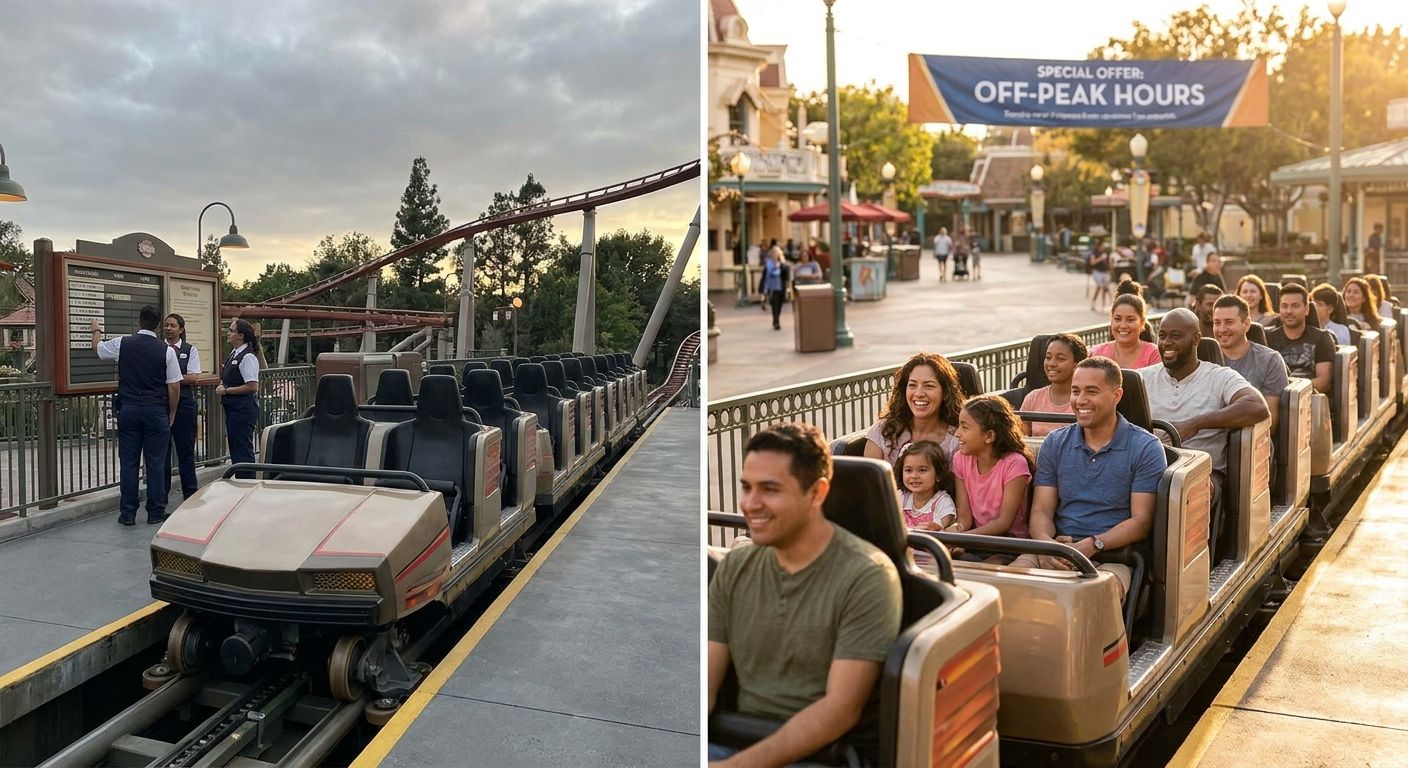
Off-peak slots fill when you combine time-based pricing, paid acquisition aimed at flexible bookers, and retention campaigns that redirect existing customers into quiet windows — not by discounting and hoping. Attractions that treat Tuesday mornings and mid-week evenings as a separate demand pool, with separate offers, consistently outsell attractions that run one blanket promotion across every slot.
- Filling off-peak slots means running a different offer, audience and channel mix than your weekend campaigns — not just a discount.
- Retention marketing to past bookers fills quiet slots faster than cold paid media because the audience already trusts the venue.
- Dynamic pricing signals value shifts by time, but it only works alongside a campaign that actually reaches flexible bookers.
- Group and corporate bookings absorb weekday capacity that consumer marketing rarely touches.
- 2026 booking behaviour still rewards last-minute, time-boxed offers over open-ended discounts.
Why this matters
Empty slots are sunk cost. Staff, lighting, heating and booking software run whether three people or thirty walk through the door, so every unfilled Tuesday 11am slot is pure margin loss, not just missed revenue. Most operators respond by cutting price across the board, which trains regular customers to wait for discounts even on Saturday nights.
The fix is segmentation, not blanket discounting. A properly built last-minute booking campaign targets people who are already searching or already on your list, and it only fires when a slot is genuinely at risk of going empty — not on a fixed weekly schedule that eventually gets ignored.
How do you fill off-peak slots at an attraction?
- Segment your calendar by demand, not just day of week. Pull the last few months of bookings and flag which specific slots underperform — school-term weekday mornings often look different from summer-holiday weekday mornings.
- Price the slot differently, visibly. Time-based pricing only works if the customer can see the saving against a peak slot on the same booking page.
- Build a separate audience for flexible bookers. Retired visitors, remote workers, parents on term-time days, and local residents without weekend commitments all behave differently from your Saturday crowd.
- Run a paid channel that matches that audience, not the same creative you use for weekend acquisition.
- Email and SMS your existing database before you spend on new acquisition — filling a Tuesday slot with a past visitor costs less than acquiring a stranger.
- Chase group and corporate bookings for weekday capacity. A 12-person birthday party or a team offsite fills a slot that consumer marketing struggles to touch.
- Set a budget split so off-peak activity has its own spend rather than whatever's left over after weekend campaigns — see the marketing budget split guidance for attraction operators for how that allocation typically breaks down.
Dynamic pricing for off-peak windows
Dynamic pricing works by lowering the visible price on slots with weaker historical demand and raising it on slots that sell out anyway. The mechanism is simple, but it fails on its own — a cheaper Tuesday slot nobody sees is still an empty Tuesday slot. Pricing has to sit inside a campaign, not replace one.
Verdict: dynamic pricing is a lever, not a strategy. Attractions that pair it with a targeted push fill slots; attractions that just adjust the price and wait usually see no change in the quiet-hour numbers.
Retention marketing to redirect existing customers
Past visitors are the fastest audience to move into off-peak slots because they've already converted once and already trust the experience. A well-timed email or SMS offering a specific off-peak window — not a generic discount — converts at a higher rate than cold acquisition, because the customer isn't being asked to take a first-time risk.
Retention plays work especially well for repeat-visit formats like escape rooms, climbing gyms and immersive experiences, where lapsed customers are easy to identify from booking history. General retention tactics for experience businesses cover the segmentation and cadence in more depth.
“An email that only goes out on Friday is training customers to only book on Friday.”
Group bookings and corporate slots
Group and corporate bookings are the single most reliable way to fill weekday daytime capacity, because they're planned in advance and rarely compete for weekend slots. Birthday parties, school groups, hen and stag parties, and corporate team days all skew toward the exact hours consumer marketing struggles to fill.
A venue that builds a distinct group sales funnel — different landing page, different sales process, different follow-up cadence — converts these enquiries at a noticeably higher rate than one that routes group enquiries through the same booking flow as individual tickets.
Paid media for flexible-schedule bookers
Paid social and search campaigns aimed at off-peak slots need their own creative and their own targeting, not a repurposed weekend ad with a different date. Copy that speaks to flexibility — "no queue, same experience, Tuesday 11am" — outperforms copy built around urgency and scarcity, which is the language that works for weekend and holiday slots.
2026 comparison: peak vs off-peak campaign approach
| Factor | Peak slot campaign | Off-peak slot campaign |
|---|---|---|
| Core message | Scarcity, sell-out risk | Flexibility, no queue |
| Best audience | Broad local + lookalike | Past visitors, retirees, remote workers |
| Channel priority | Paid social, search | Email/SMS first, then paid |
| Pricing signal | Full or premium price | Visible discount vs peak |
| Booking window | Weeks ahead | Days ahead, last-minute |
Why off-peak demand varies
- School term dates shift which weekday hours are genuinely quiet versus which just look quiet on paper.
- Local competing events (festivals, matches, concerts) pull demand away from a slot regardless of your pricing.
- Weather patterns matter more for outdoor and semi-outdoor attractions than for indoor formats like escape rooms or VR arcades.
- Public transport timetables affect footfall for city-centre venues more than for destination attractions people drive to.
- Ticket type mix — a venue selling mostly single tickets sees different off-peak patterns than one selling mostly group packages.
- Staffing and rota constraints sometimes create artificial quiet slots that have nothing to do with actual demand.
Get a plan to fill your quiet slots
FullyBooked builds off-peak campaigns for attraction operators from scratch.
Related questions
What counts as off-peak for an attraction?
Off-peak is whichever slots consistently sell below your average occupancy across a rolling few months, not a fixed set of hours copied from another venue. A comedy club's off-peak might be Tuesday and Wednesday nights; an escape room's might be weekday mornings before noon.
Does dynamic pricing actually fill empty slots on its own?
Dynamic pricing alone rarely fills empty slots — it needs a campaign that puts the lower price in front of a flexible-schedule audience. Price adjustment without visibility just quietly reduces revenue on slots that were going to sell anyway.
How much notice do people need for a last-minute off-peak offer?
Most last-minute off-peak offers convert within a short window before the slot, which is why email and SMS outperform display advertising for this specific use case. Booking behaviour through 2026 still shows flexible bookers responding fastest to offers sent the same day or the day before.
FAQ
How do you fill off-peak slots at an attraction?
You fill off-peak slots by combining visible time-based pricing, a paid campaign built for flexible-schedule audiences, and retention emails to past visitors rather than running one blanket discount across the whole calendar.
What is the fastest way to fill a quiet weekday slot?
Emailing or texting past visitors with a specific off-peak offer is usually the fastest fix, because that audience already trusts the venue and converts faster than cold paid traffic.
Does discounting off-peak tickets hurt full-price sales?
Discounting hurts full-price sales only when it isn't segmented — if the same offer reaches weekend bookers, they'll wait for it. Time-locked, slot-specific offers avoid that leakage.
Are group bookings good for filling off-peak capacity?
Group and corporate bookings are one of the most reliable ways to fill weekday daytime capacity, since they're booked in advance and rarely clash with weekend demand.
Should off-peak marketing use the same creative as weekend campaigns?
No — off-peak campaigns should lead with flexibility and no queues, while weekend campaigns lead with scarcity and sell-out risk; the two audiences respond to opposite messaging.
How far in advance should off-peak offers go out?
Off-peak offers convert best when sent close to the date, often same-day or next-day, because flexible bookers decide quickly once they see a specific slot and price.
Can paid media alone fill off-peak slots?
Paid media alone rarely fills off-peak slots as efficiently as retention marketing to your existing database, though it's useful for reaching new flexible-schedule audiences once retention has been tapped out.
One last thing
The operators who fill off-peak slots fastest in 2026 aren't the ones with the biggest discount — they're the ones with a separate calendar view for quiet hours, built months ahead of the slot going empty, not the week of. Build the segment before you need it.


