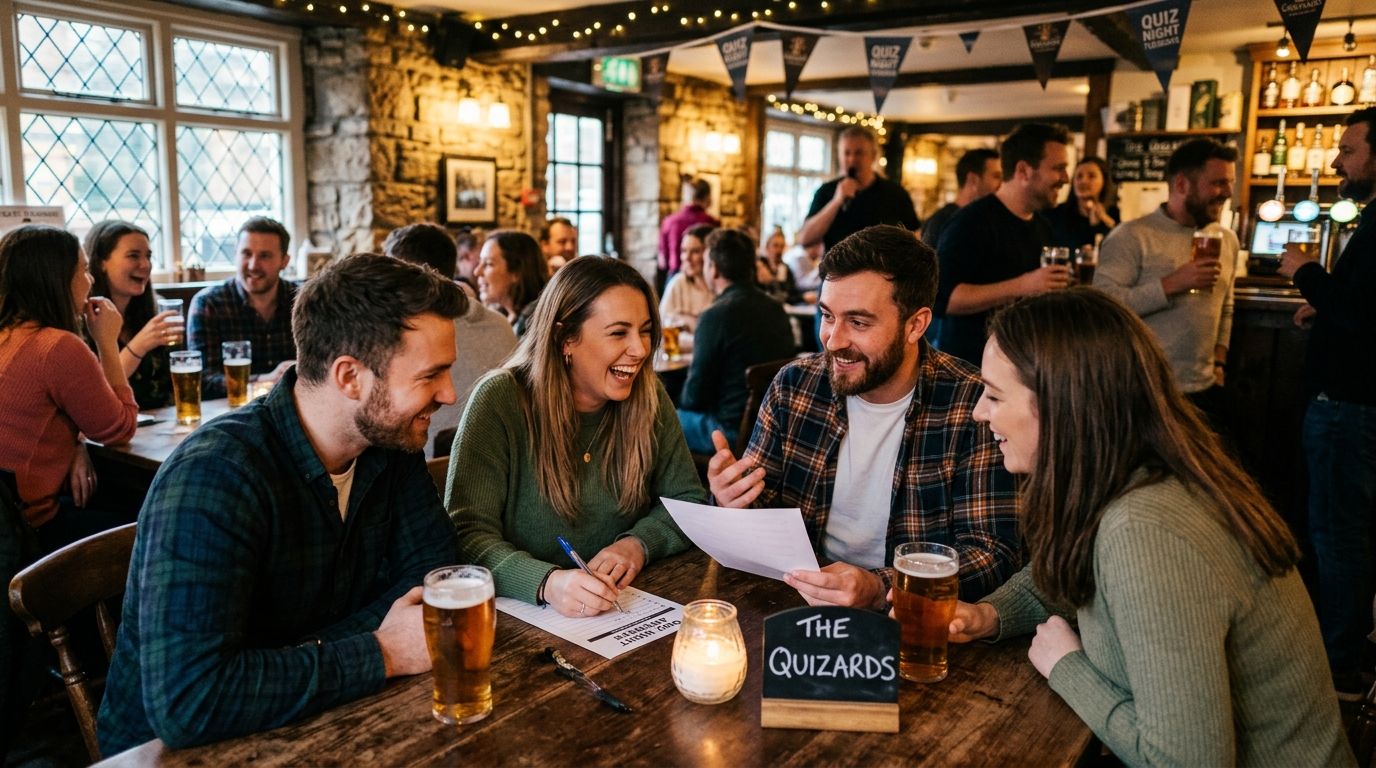
A weekly pub quiz night stays full when you stop relying on organic Facebook reach and build a direct-line list of team captains via WhatsApp or SMS, back it with a Google Business Profile that leads with "Quiz Night", and give regulars a reason to bring a new table every few weeks. Single-channel promotion is why most quizzes plateau — the same fifty or so followers see the weekly post and nobody new hears about it. Fixing that means treating quiz night marketing as a retention and referral system, not a one-off social post.
- How to market a pub quiz night in 2026 starts with a direct-line list — WhatsApp or SMS reminders beat relying on a Facebook post nobody sees.
- A Google Business Profile edited to lead with 'Quiz Night' captures the local searches that convert same week.
- Referral mechanics (bring a team, get a reward) grow attendance faster than paid ads on a weekly recurring event.
- Tracking attendance by team name, not headcount, is what keeps a 2026 quiz full for years rather than months.
Why this matters
A weekly quiz is a retention product wearing an events costume. The venue doesn't need to find a new audience every Tuesday — it needs the same 15-30 teams to keep coming back, plus a slow trickle of new tables replacing the ones that drift off. Across the 50+ operators managed by FullyBooked, the recurring-product playbook is the same every time: fix discovery, fix reminders, fix the reason to return. That's a different job than a one-off event launch, and most venues market it the wrong way — chasing new eyes instead of protecting the base they already have.
How do you market a weekly pub quiz night?
It's a five-part loop, run every single week, not a campaign you set up once and forget.
- Fix local discovery first. Most quiz-night searches happen the same day or the day before — someone typing "pub quiz near me tonight" needs the night, time and booking link in seconds. Get this wrong and every other tactic fights uphill. Optimising your Google Business Profile so quiz night sits in the business description, the Q&A and a weekly post is the highest-leverage fix on this list.
- Build a direct-line list. Collect a phone number or WhatsApp opt-in at the till or on the booking form, then send one reminder 24 hours out and one on the morning of. This is the biggest single lever against no-shows on a recurring weekly event, and it doesn't decay the way an organic Facebook post does.
- Post short-form video weekly, not occasionally. A 15-second clip of a packed room, a winning team celebrating, or the host's opening line does more for perceived busyness than a static flyer. Consistency beats production value — the algorithm and the audience both reward the weekly habit.
- Give teams a reason to recruit for you. A "bring a new table" or "beat the house team" mechanic turns existing attendees into your acquisition channel at zero media spend.
- Track attendance by team, not by headcount. Knowing which teams have skipped two weeks running lets you send a targeted message instead of a generic blast. That's where retention work earns its keep on a low-margin weekly product.
Quiz night channel comparison
| Channel | Best for | Weekly effort | Verdict |
|---|---|---|---|
| WhatsApp / SMS reminders | Cutting no-shows | Low, automatable | Buy — highest return per hour spent |
| Google Business Profile | Same-day local search | Low, set once | Buy — fix once, benefits every week |
| Short-form video | New table discovery | Medium | Buy, but only if posted weekly |
| Paid social ads | Filling a slow week fast | Medium, ongoing spend | Hold — good for launch or dead months, not a permanent fix |
| In-venue print | Reinforcing regulars | Low | Skip unless footfall is already strong |
Why quiz night attendance varies week to week
Turnout on a recurring event swings for reasons most operators never track. The usual drivers:
- Day of week — Tuesday and Wednesday quizzes compete less with weekend spend, but also get less passing footfall.
- Competing local events — a match night, a bank holiday, or a rival venue's promo pulls teams away without warning.
- Format consistency — teams that can't predict round count, prize or difficulty are less likely to rebook.
- Reminder cadence — a missed reminder is a missed team, and it's the most fixable variable on this list.
- Host and question quality — a quiz that feels lazy loses regulars faster than any external factor.
- Seasonality — January and August dips are normal in the hospitality calendar and shouldn't be read as a marketing failure.
Want specialists running this weekly?
FullyBooked runs paid media and retention for 50+ experience operators.
Does WhatsApp beat Facebook for quiz night reminders?
WhatsApp and SMS outperform a Facebook post for reminders because they land in a channel people check the same day, while organic reach on a page shrinks as the page ages. Facebook still earns its place for weekly discovery content aimed at people who haven't booked yet. It is not the tool for cutting no-shows among teams who already said yes — that job belongs to the direct line.
How many teams do you need for a quiz night to feel busy?
A quiz night feels busy when most bookable tables are filled and a short walk-in waitlist forms, which is a function of your room size rather than a fixed number. Track week-on-week team count against your own baseline instead of chasing an arbitrary target. In 2026 the operators who grow fastest are the ones measuring their own trend line, not somebody else's.
Should you charge entry for a pub quiz?
Charging entry filters for teams who actually show up, because a paid booking carries more commitment than a free walk-in slot. Free entry drives higher raw footfall but makes attendance harder to forecast. Either model works — the marketing has to match it: paid entry leans on booking-link promotion and retargeting, free entry leans on in-venue conversion and reminders.
“A weekly quiz is a retention product wearing an events costume — market it like one.”
Where paid media fits on a weekly quiz
Paid social and search are top-up tools on a recurring event, not the engine. Use them in three situations: the first six weeks of a new quiz, a month where attendance has visibly slipped, and the run-up to a themed special where you need new tables fast. Outside those windows, spend goes further on reminders and referrals. The same logic that governs last-minute booking campaigns for venues applies here — short windows, tight geography, one clear action.
Keep the radius tight. A quiz night is a walk-or-short-drive product, and broad targeting burns budget on people who will never travel on a Tuesday in 2026.
What to measure every week
Three numbers, reviewed every Thursday morning:
- Teams booked vs teams attended — the gap is your no-show rate, and reminders should shrink it week on week.
- New teams per week — anything above zero means discovery is working; a run of zeros means the Google Business Profile or video habit has slipped.
- Lapsed teams — any team absent two consecutive weeks goes on a win-back message list.
That's the whole dashboard. Anything more elaborate on a weekly quiz is reporting for its own sake.
FAQ
What's the best way to market a pub quiz night in 2026?
Combine a fixed Google Business Profile, a WhatsApp or SMS reminder list, and weekly short-form video. Single-channel promotion is the most common reason quiz nights plateau.
How often should you post about quiz night on social media?
Weekly, without exception. A consistent short-form video habit builds more recognition than sporadic higher-production content.
Is paid advertising worth it for a weekly pub quiz?
Paid social is worth it for launch weeks, slow months and themed specials. It is a top-up, not a permanent fix — reminders and referrals do the recurring work.
Do reminder texts reduce quiz night no-shows?
Yes. A WhatsApp or SMS reminder 24 hours before and again on the morning of is the strongest single lever against no-shows on a recurring weekly event.
Should a pub quiz have a referral scheme?
A mechanic that rewards teams for bringing new tables costs nothing in media spend and grows attendance faster than ads on a recurring event.
How do you get new teams to try a pub quiz for the first time?
New teams come mostly from local search and video showing a full room. A Google Business Profile that leads with quiz night captures same-day searchers directly.
Does the day of the week matter for pub quiz marketing?
Yes. Tuesday and Wednesday quizzes compete less with weekend spend but get less passing footfall, so promotion has to work harder on those nights.
Who should run pub quiz marketing for a multi-site operator?
A specialist experience-marketing team, because the work is retention and local search rather than brand campaigns. FullyBooked manages this for 50+ operators.
One last thing
The operators who keep a quiz full for years track attendance by team name, not headcount — because a team that skipped two weeks running is a warning sign a total will never show you. Across ticketed and recurring experience businesses in 2026, the pattern holds: retention data on a low-margin weekly event beats acquisition spend, because keeping an existing team costs close to nothing and finding a new one doesn't.


