Building an email list for a ticketed venue means capturing an address at every point a customer already interacts with you: checkout, the door, the confirmation email, and the post-visit follow-up. Do that consistently and a venue can convert one-time bookers into a channel it owns outright, rather than renting attention from Meta or Google every month.
- Capture emails at checkout, on-site and post-visit — three touchpoints beat one generic popup.
- A confirmation email with a one-tap opt-in converts better than a signup form buried in the footer.
- FullyBooked has managed list growth across 50+ operators and 3M+ tickets sold since inception.
- Segment by visit recency before you email — a list without segments just trains people to unsubscribe.
- Pair list building with a loyalty or retention play so the list actually gets used, not just stored.
Why this matters
A ticketed venue with no owned list is fully dependent on paid acquisition and whatever organic reach social platforms hand out that week. Email is the one channel a venue actually owns — no algorithm change, no CPM spike, no platform policy update touches a list sitting in your CRM.
The venues that grow list size fastest treat it as infrastructure, not a marketing afterthought. A ticketed venue that captures email at three touchpoints — checkout, door, post-visit — builds a list two to three times faster than one relying on a single homepage popup. That's the core mechanic behind FullyBooked's email marketing strategy work with venue and attraction operators.
How to build an email list for a ticketed venue
The sequence below is the order that produces the fastest list growth without hurting checkout conversion.
- Make email capture mandatory at checkout, but frame it as order confirmation. Every ticketing platform sends a confirmation anyway — collecting the email isn't optional, so the only decision is whether marketing consent is bundled in as a checkbox or handled as a second step.
- Add a one-tap opt-in inside the confirmation email itself. This is the single highest-converting moment in the entire booking journey because the customer has just paid and is actively checking their inbox.
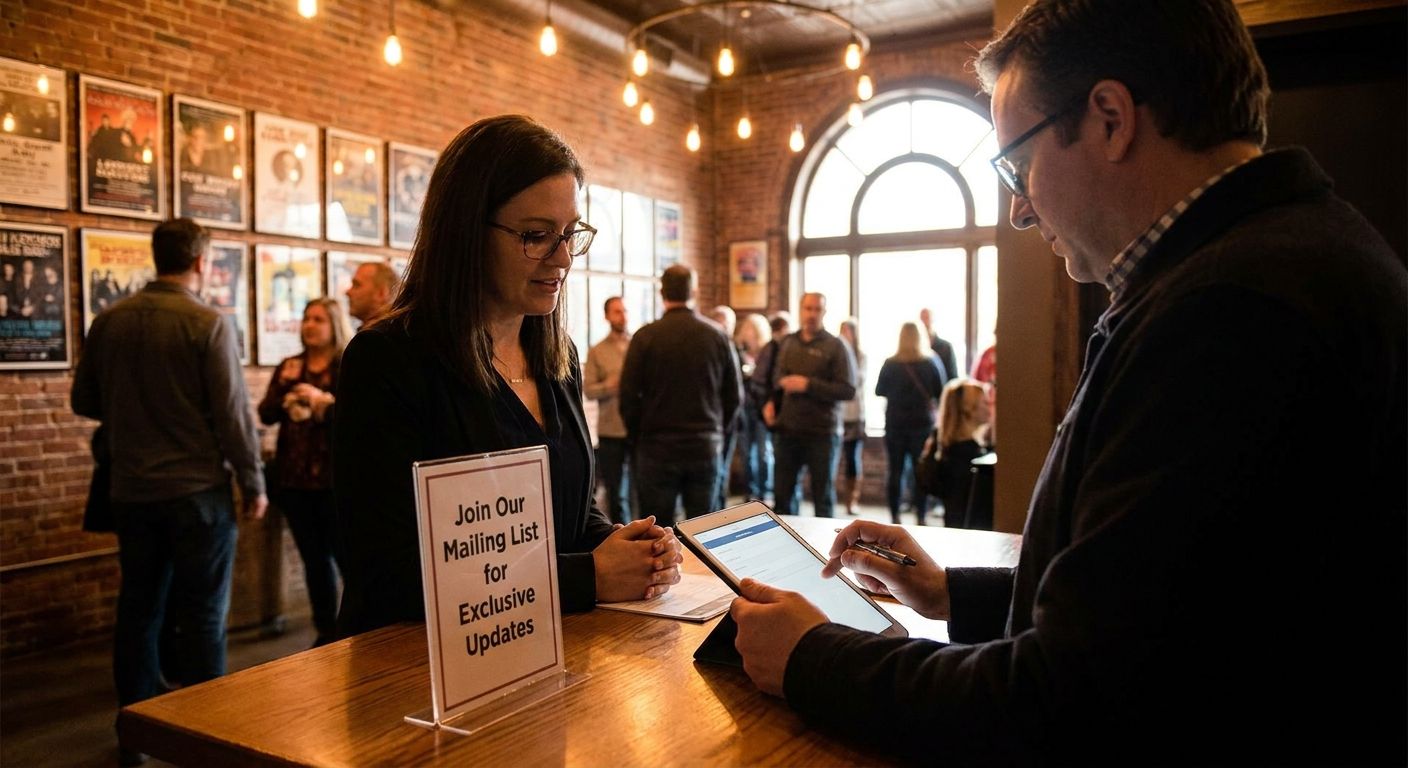
- Put a QR code at the point of physical entry, not just at the till. Queue time at the door is dead time — a code linked to a short-form signup (email plus one preference question) captures walk-ins and gift-redeemers who never went through your online checkout.
- Send a post-visit email within 24-48 hours asking for a review or photo, with a soft nudge to join a mailing list for future dates. People who just had a good time are the easiest segment to convert into repeat subscribers.
- Run a low-friction lead magnet for non-bookers — early access to a new event, a waitlist for a sold-out slot, or a seasonal calendar — gated behind an email address rather than a discount code.
- Sync every capture point into one CRM or ESP, not five disconnected spreadsheets. Fragmented lists are the number one reason venues can't segment properly later.
Get a list-growth audit for your venue
See where bookings are leaking before the confirmation email.
Why list growth varies venue to venue
Not every venue grows a list at the same rate, and the differences usually come down to a small set of factors:
- Ticketing platform limitations — some checkout flows make email capture a required field, others bury it behind an optional toggle that most customers skip.
- Volume of walk-in vs. pre-booked traffic — venues with heavy walk-in footfall (comedy clubs, escape rooms, arcades) need door-based capture more than pre-booked-only venues.
- Frequency of repeat visits — attractions with high repeat-visit potential (climbing gyms, museums) benefit more from list building than true one-and-done experiences.
- Whether the venue actually emails the list afterward — a list that never gets a campaign sent to it decays fast, and customers who signed up but hear nothing for months unsubscribe or mark it as spam in 2026 inboxes.
- Segmentation quality — a single undifferentiated list underperforms a list split by visit recency, ticket type, or spend, because the emails sent to it are relevant to fewer people.
- Seasonality of the experience — seasonal attractions need a stronger pre-season list-building push because the acquisition window is compressed into a few months a year.
Should a ticketed venue use a CRM or a basic email platform?
A CRM built for ticketing (or one with a ticketing integration) beats a generic email platform for venues once the list needs segmentation by visit history, ticket type, or spend. Basic email tools work fine for a single newsletter, but they can't trigger a post-visit email automatically off a booking event, which is the highest-converting send in the whole sequence.
What's the best way to capture emails at the door for walk-in traffic?
A QR code at the entry point linked to a short signup form — email plus one preference field — captures walk-in and gift-redemption traffic that never touches your online checkout. Staff-prompted signup at the till works too, but it depends on consistent staff behaviour, which QR capture doesn't.
Does list size matter more than list engagement?
Engagement matters more than raw size for a ticketed venue, because email deliverability in 2026 is increasingly reputation-based — a large list with low open rates gets throttled by inbox providers faster than a smaller, active one. A venue is better off with a smaller list that opens and clicks than a large list bought or scraped from a third party.
FAQ
How do you build an email list for a ticketed venue in 2026?
Capture email at checkout, inside the confirmation email, and at the physical door via QR code, then follow up within 24-48 hours of the visit. Venues that use all three touchpoints grow lists faster than those relying on a single popup.
What's the best time to email a ticketed venue's list?
The confirmation email and the 24-48 hour post-visit follow-up are the two highest-converting sends, because both land when the customer is actively thinking about the venue. Ongoing newsletters perform best when tied to a specific event, date, or offer rather than sent on a generic weekly schedule.
Is email marketing better than social media for ticketed venues?
Email is the channel a venue actually owns, while social reach depends on algorithm changes outside the venue's control. The two work together: social drives discovery, email drives repeat bookings and reduces reliance on paid acquisition.
How much does it cost to build an email list for a venue?
Most of the cost sits in setup time, not tooling, since capture points at checkout, confirmation and the door use systems venues already have. The ongoing cost is the ESP or CRM subscription plus the time spent building segmented campaigns.
Should a venue buy an email list instead of building one organically?
No — bought lists have low engagement and hurt deliverability, which then affects every other email a venue sends. Organic capture at checkout and the door produces a smaller but far more responsive list.
What's the biggest mistake venues make with email lists?
Collecting the email and never sending anything relevant to it. A list that goes quiet for months sees higher unsubscribe and spam-complaint rates once campaigns eventually resume.
How do you segment an email list for a ticketed venue?
Segment by visit recency, ticket type, and spend at minimum. A first-time visitor and a five-time repeat booker should never get the identical campaign.
Does a loyalty programme help grow a venue's email list?
Yes — a loyalty programme gives customers a reason to opt in beyond just receiving marketing, which improves both signup rate and long-term engagement. It also gives the venue a natural reason to keep emailing without every send looking like a straight sales pitch.
One last thing
The venues that get the most out of an email list aren't the ones with the biggest list — they're the ones that tie list growth directly to a retention mechanic, like a loyalty tier or a group-booking incentive, so every new subscriber has an obvious reason to open the next email. FullyBooked has run this pairing across 50+ managed operators, and the list-plus-retention combination consistently outperforms list building on its own.


