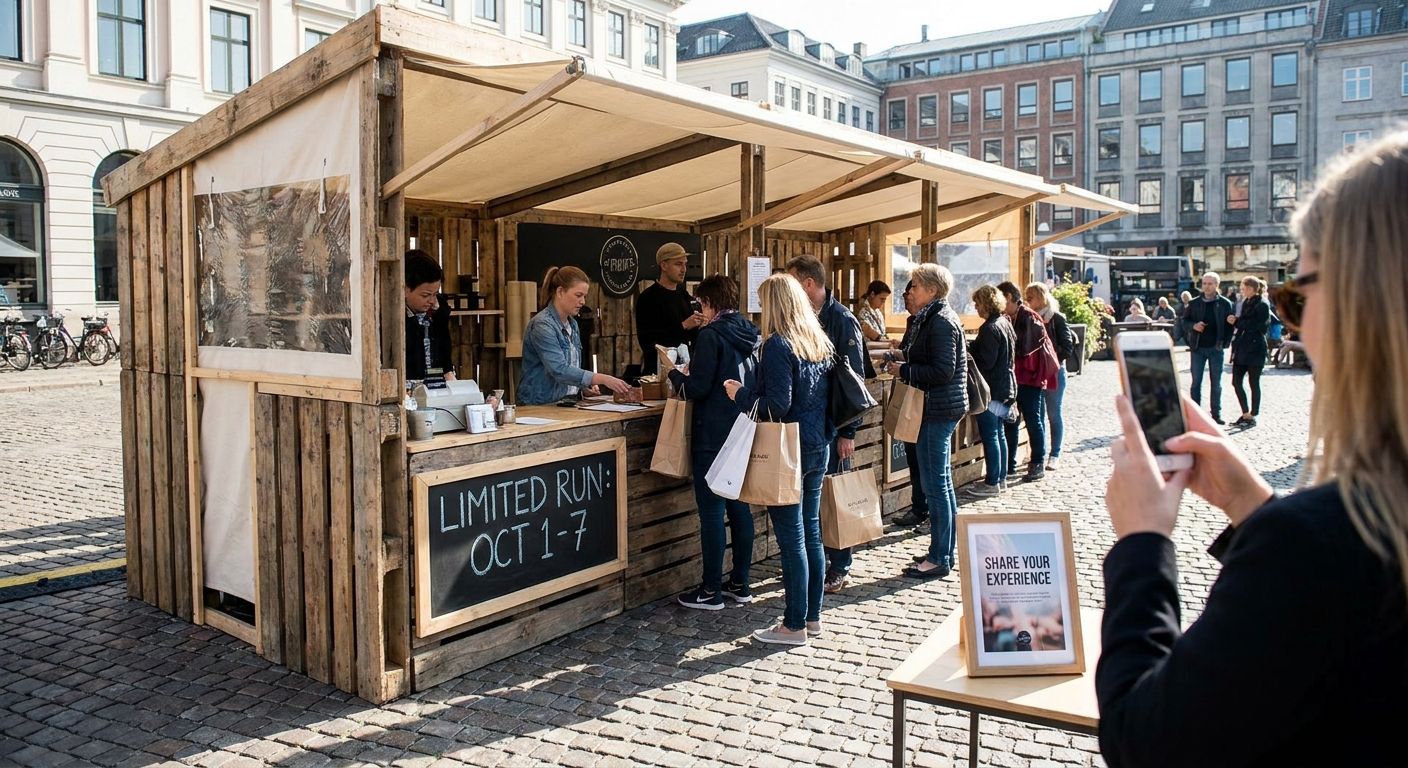
Marketing a pop-up experience with a limited run means treating the closing date as the headline of every campaign, not an afterthought. Urgency drives the sale, not brand story, and the channels that work for permanent venues don't translate directly to a run that ends for good in a matter of weeks.
- How to market a pop-up experience with a limited run starts with making the close date the hook, not the setting.
- FullyBooked has generated £85M+ in bookings value across 50+ managed experience operators using compressed-window campaigns.
- Front-load paid media spend into the first half of the run, then shift to scarcity messaging before close.
- Influencer sprints for pop-ups need creators in week one, not week three, when there's no week three left.
- No-show reduction matters more for a limited run because a missed slot can't be rebooked next week.
Why this matters
A standing venue can recover from a slow week. A pop-up can't — every unsold slot in the run is gone the day the doors close. That's why event marketing for pop-up experiences has to be built around a hard deadline from day one, not bolted on as a closing-week push.
The 2026 events calendar is crowded with limited-run activations, immersive dining experiences and seasonal installations competing for the same booker attention span. A pop-up that launches quiet and hopes word-of-mouth carries it through week two usually closes with half-empty slots and a marketing budget that never got the chance to compound.
How do you market a pop-up experience with a limited run?
Market a pop-up with a limited run by making the countdown itself the offer: build a waitlist before launch, front-load paid spend and influencer activity into the opening days, then shift every message to scarcity as the close date approaches. The sequence matters more than any single channel.
“If a pop-up has to sell every seat before the doors shut for good, treat the countdown itself as the offer.”
The six moves that make up the plan:
- Put the close date in every headline — ad copy, email subject lines, social captions. "Ends 14 March" outperforms "Now open" for a fixed-run experience.
- Build a pre-launch waitlist so opening week isn't the first time anyone hears about it — a cold launch wastes the highest-intent days of the run.
- Front-load paid media spend into the first half of the run while there's still time for word-of-mouth and retargeting to compound.
- Run a compressed influencer sprint in week one, not the final days — content needs time to be seen, shared and acted on before the run ends.
- Cut no-show risk with tighter reminder timing than a standing venue would use — see reduce no-shows for ticketed events for the sequencing.
- Escalate to scarcity language in the final stretch — "last week", "final slots", "closes for good" — once the halfway point has passed.
Channel priority: pop-up vs standing venue
| Channel | Standing venue priority | Limited-run pop-up priority |
|---|---|---|
| Paid social | Steady, always-on | Front-loaded, heavy week one |
| Influencer/UGC | Ongoing drip | Compressed sprint, week one |
| Email/SMS | Nurture over months | Waitlist-to-booking in days |
| PR/press | Evergreen coverage | One push at launch announcement |
| Organic social | Long-tail content library | Countdown-driven, urgency-led |
A standing venue can afford to build an audience slowly. A pop-up spends its entire marketing budget inside one run, which is why marketing budget split for attraction operators advice for permanent venues rarely applies without adjustment for a fixed close date.
Pre-launch: build the waitlist before doors open
The pre-launch phase decides whether opening week is full or empty. A waitlist captured through paid social and a landing page gives you a warm list to convert the moment booking opens, instead of starting cold on day one.
This is also when the influencer sprint gets locked in. Creators need the run dates, the hook and access confirmed early — sending an invite the week the pop-up opens leaves no runway for content to land before slots disappear.
Mid-run: convert momentum into bookings
Once the pop-up is open, paid media shifts from awareness to conversion. Retargeting anyone who visited the booking page but didn't convert becomes the highest-value spend of the run, because there's no next quarter to bring them back.
Social proof does heavy lifting here — user-generated content from opening week, reposted fast, tells later bookers the experience is real and worth the trip before the run ends. This is the window where a TikTok marketing approach for experience brands tends to outperform static paid ads, because short-form content travels faster than a run's remaining days allow a poster campaign to build recognition.
Final week: scarcity closes the gap
The final week is where messaging flips entirely to urgency. "Last chance", "final slots", "closes Sunday" — copy that would feel pushy for a standing venue is exactly right for a pop-up with days left on the clock.
This is also when no-show prevention matters most. A missed booking in the final 48 hours of a limited run can't be rebooked next week the way a standing venue's Tuesday slot can — tighter reminder sequences and clearer cancellation windows protect revenue that has no second chance.
Why bookings for a pop-up marketing campaign vary
- Existing audience size — a brand with an email list or social following converts a waitlist faster than a first-time pop-up starting from zero.
- Location and footfall — a pop-up in a high-traffic retail or events district needs less paid spend to generate walk-up interest.
- Price point — higher ticket prices need longer consideration windows, which compresses badly into a short run.
- Competing events — a pop-up launching the same week as a major local festival or holiday split attention and budget goes further outside that window.
- Whether it's a returning brand or a new concept — repeat pop-up brands convert waitlists faster because trust is already built.
- Weekday vs weekend launch — a weekend opening captures higher walk-up volume but a weekday launch gives paid media more runway before the weekend rush.
Do pop-up experiences need influencer marketing?
Yes — influencer marketing compresses the awareness timeline that a pop-up doesn't have, turning a handful of creator visits in week one into shareable proof the rest of the run can point to. Skipping it usually means the run relies entirely on paid ads to do work that content and social proof do faster.
How early should you start marketing a pop-up experience?
Start marketing before the run opens, not on launch day — a waitlist built ahead of time converts faster than a cold audience discovering the pop-up once it's already live. The exact lead time depends on ticket price and audience size, but starting during the run rather than before it is the most common reason opening week underperforms.
What's the biggest mistake in pop-up event marketing?
The biggest mistake is spreading the marketing budget evenly across the run instead of front-loading it — a pop-up that saves spend for the final week has already lost the opening days when word-of-mouth and retargeting had the most time to compound.
Get a pop-up marketing plan built for your close date
FullyBooked builds compressed-window campaigns for limited-run experiences.
FAQ
How do you market a pop-up experience with a limited run?
You market a pop-up with a limited run by making the close date the headline of every campaign, building a waitlist before launch, front-loading paid spend into the opening days, then shifting to scarcity messaging as the run ends. The sequence — pre-launch, mid-run, final week — matters more than any single channel choice.
How much marketing budget does a pop-up experience need?
Budget needs vary by venue size and ticket price, so there's no single figure that applies to every run. What matters more than the total is the split — pop-ups need budget front-loaded into the opening days rather than spread evenly across the whole run.
Is influencer marketing worth it for a short pop-up run?
Yes, influencer marketing compresses the time it takes to build proof and awareness, which a limited-run pop-up doesn't have the luxury of building slowly. Creators need to be booked in week one so content has time to circulate before the run ends.
Should a pop-up run paid ads the whole time it's open?
Paid ads should front-load into the first half of the run, then shift from awareness to retargeting and urgency copy as the close date nears. Spending evenly across the whole run wastes the highest-intent days at the start.
How do you reduce no-shows for a limited-run pop-up?
Reduce no-shows with tighter reminder sequences than a standing venue would use, since a missed slot in a short run can't be rebooked the following week. Clear cancellation windows and a final-day reminder close most of the gap.
What's the best social platform for pop-up marketing?
Short-form video, particularly TikTok, tends to outperform static paid ads for pop-ups because content travels faster than a fixed-run poster campaign can build recognition. Retargeting ads on the same platforms convert the audience that content builds.
When should a pop-up start marketing before opening?
A pop-up should start building a waitlist before the run opens rather than launching marketing on day one, since a cold audience wastes the highest-conversion early days. Exact lead time depends on ticket price and existing audience size.
One last thing
The most common failure in pop-up event marketing isn't a weak channel choice — it's spending the budget like the run is permanent. A limited run rewards front-loaded spend, a fast influencer sprint and scarcity copy that gets more urgent every week, not a steady drip that only peaks once the doors are already closing in 2026.


