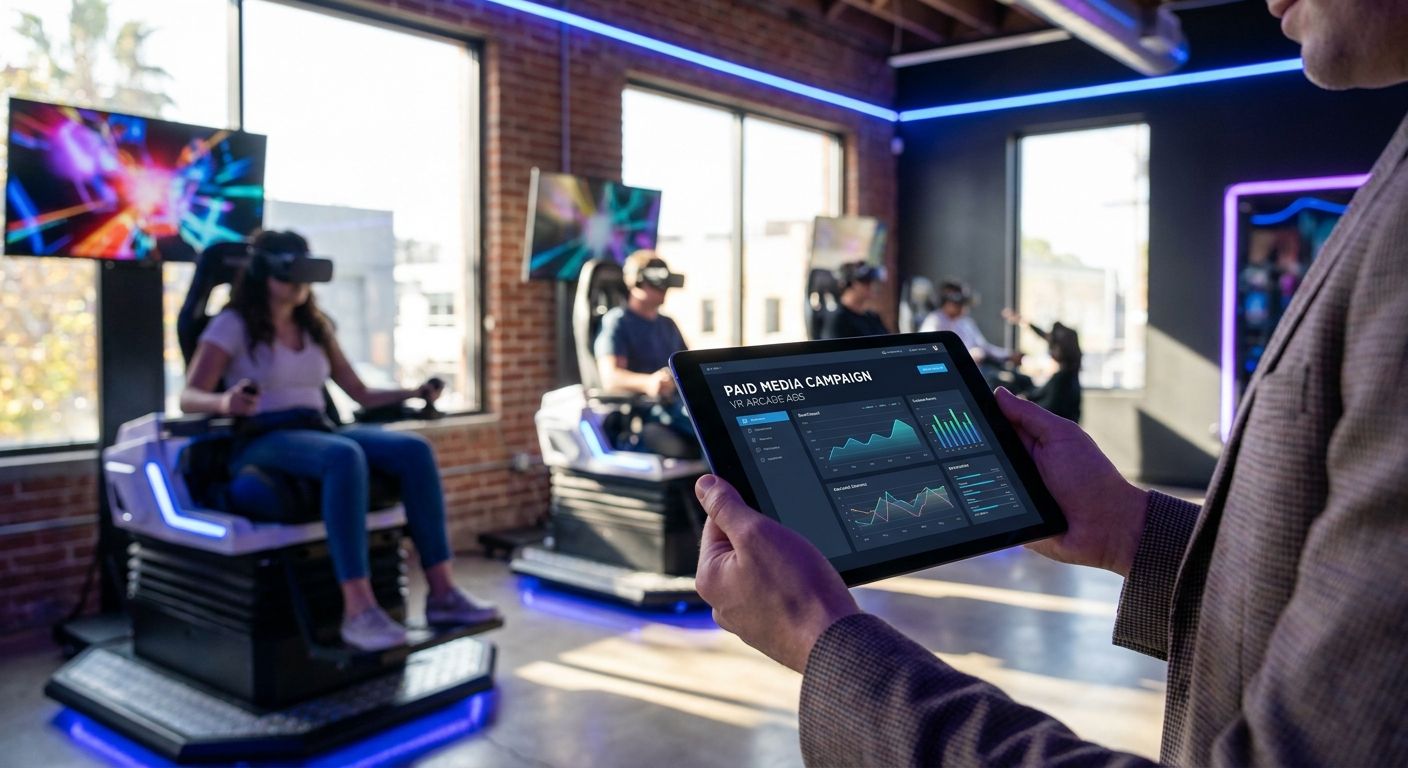
VR arcades sell a novelty experience with a tight local catchment, and that combination breaks most paid media playbooks built for retail or ecommerce. Get the channel mix wrong and you burn spend on reach nobody local ever sees; get it right and you fill weekday afternoon slots that would otherwise sit empty.
- Paid media for VR arcades works best on Meta and TikTok video, not broad brand awareness campaigns.
- Google Performance Max captures 'VR arcade near me' search intent — consider it, don't lead with it.
- Group and party bookings drive the highest average order value, so audience targeting matters more than reach.
- Skip flash-discount-only ads; layer retention marketing on top or repeat visit rate stays flat in 2026.
Why this matters
A VR arcade doesn't compete on national brand recall — it competes for a finite number of local bookers within a 20-30 minute drive, most of whom are searching or scrolling for something to do this weekend or booking a party. FullyBooked has managed paid media for 50+ experience operators and generated £85M+ in tracked booking revenue across venues, events and attractions, and the pattern for VR arcades is consistent: campaigns built like paid media for immersive experiences outperform generic local-business templates because they account for group size, session length, and the novelty decay that hits any location-based entertainment format within its first 12-18 months of operation.
Get this wrong in 2026 and you'll see the same symptom every operator reports: strong opening month, then a steep drop in repeat visits once the initial local buzz fades.
Who this is for
This guide is for the operator running one to five VR arcade locations, spending a real marketing budget without a dedicated in-house growth team, and trying to fill both weekend peak slots and dead weekday afternoons. If you're already running national brand campaigns with a media agency that doesn't specialise in experience-based ticketing, most of what follows will contradict what you're currently doing — that's the point.
What to look for in paid media for VR arcades
Local radius precision
A VR arcade rarely pulls bookers from more than a 20-30 minute drive radius, so any channel or campaign structure that defaults to city-wide or national targeting wastes a meaningful share of budget on people who will never walk through the door. Tight geo-fencing around the venue, refreshed as new locations open, should be non-negotiable in any media plan built for 2026.
Video-first creative support
VR is a visual, physical, high-novelty product — a static image ad undersells it badly compared to five seconds of someone reacting inside a headset. Channels and formats need to support short-form vertical video natively, not treat it as an afterthought bolted onto a photo carousel.
Group and party targeting
A large share of VR arcade bookings come from birthday parties, corporate team days and stag or hen groups, not solo walk-ins. Campaigns optimised purely for individual ticket clicks miss the audience segment most likely to book the highest-value slot — a group booking of six to ten people in one transaction.
Day-parting control
VR arcades run a hard split between weekend peak demand and dead weekday afternoons. A channel that can't day-part spend toward filling Tuesday 2pm slots is only ever going to help you sell out Saturday, which was already selling itself.
Booking-level attribution
Clicks and landing page views tell you nothing about whether a headset session was actually booked and paid for. The platform needs to tie ad spend to completed bookings, not surface-level engagement metrics that look good in a dashboard and mean nothing at the till.
Retention mechanics baked in
Novelty experiences see repeat visit rates fall off fast once the initial hype cycle passes, which is exactly what escape room operators run into — see paid media for escape rooms for the comparable pattern. Any paid media plan for a VR arcade needs a retention layer, not just acquisition spend, or you're refilling the same leaky bucket every month.
Top picks: where to put the budget
Meta video ads — the workhorse pick
Meta (Facebook and Instagram) remains the default channel for local, group-driven bookings because Advantage+ targeting handles radius precision and dynamic creative testing without a large manual setup. The format supports short vertical video natively, which matters for showing the headset experience rather than describing it. Verdict: Buy — this should be the largest single line item in a VR arcade paid media budget in 2026.
TikTok Spark Ads — the wildcard
Boosting organic TikTok content through Spark Ads reaches the 18-34 audience that skews heavily toward group bookings, stag/hen parties and birthday groups — the exact segment worth more per transaction. It works best where the arcade already has some organic video traction to boost rather than starting from zero. Verdict: Buy for arcades with a younger, social-first customer base; Consider for family-daytime-heavy locations where the audience skews older.
Google Performance Max / Local campaigns — the safe pick
Someone searching "VR arcade near me" or "things to do this weekend near [town]" has higher intent than someone scrolling past a video ad, and Performance Max with local inventory feeds captures that demand without heavy manual bid management. It won't build new demand the way video does, but it catches demand that already exists. Verdict: Consider — run it alongside video, never instead of it.
Snapchat local awareness — the niche pick
Snapchat's local ad formats can reach a younger teen and student audience in a tight geo-radius, which suits arcades near colleges or town centres with strong footfall from that age group. Outside those specific locations, reach and cost efficiency both drop off compared to Meta and TikTok. Verdict: Consider for student-town locations, Skip for suburban or retail-park venues.
Lifecycle retention layered on paid — the compounding pick
Paid media fills the top of the funnel, but repeat visits are what determine whether a location is profitable past month three. Layering SMS and email retention on top of paid acquisition — the same approach behind retention marketing for escape rooms — turns a one-off booker into a repeat customer instead of a single transaction. Verdict: Buy — this isn't optional if the goal is a sustainable operator, not a launch-month spike.
Fill more VR arcade slots
Talk to FullyBooked about paid media built for group bookings and repeat visits.
What to avoid
- National brand-awareness campaigns. They look impressive in reach metrics and do almost nothing for a business that pulls bookers from a 20-30 minute radius.
- Discount-only flash promos with no retention follow-up. A half-price code fills a slot once; it doesn't build the repeat visit rate a VR arcade needs to stay profitable past its opening quarter.
- Individual-ticket-only targeting. Optimising campaigns purely around single-ticket clicks ignores the group and party bookings that typically carry the highest transaction value.
Verdict comparison
| Channel / tactic | Best for | Verdict |
|---|---|---|
| Meta video ads | Local radius, group targeting, video creative | Buy |
| TikTok Spark Ads | Younger, group-heavy audiences | Buy / Consider |
| Google Performance Max | Capturing existing search intent | Consider |
| Snapchat local awareness | Student-town, teen-heavy locations | Consider / Skip |
| Retention lifecycle (SMS/email) | Repeat visit rate, compounding revenue | Buy |
FAQ
What's the best paid media channel for VR arcades in 2026?
Meta video ads are the strongest default for VR arcades in 2026 because they support local radius targeting and short-form video creative natively. Layer TikTok Spark Ads and Google Performance Max around Meta rather than replacing it.
How much should a VR arcade spend on paid media?
Budget should scale with the venue's local catchment size and the number of weekday slots that need filling, not a fixed national benchmark. Most operators FullyBooked works with put the largest share of spend behind Meta and layer smaller test budgets into TikTok and Google.
Is TikTok better than Meta for VR arcade marketing?
TikTok works best alongside Meta, not instead of it, especially for arcades with a younger, group-booking-heavy customer base. Meta still handles local radius precision and booking attribution more reliably in 2026.
Can Google Ads work for a VR arcade?
Yes, Google Performance Max with local inventory feeds captures people already searching for a VR arcade nearby. It captures existing demand rather than creating new demand, so it works best paired with video-first social campaigns.
Does influencer marketing work for VR arcades?
Influencer marketing works well for VR arcades because the experience is inherently visual and shareable, similar to how it performs for [influencer marketing for trampoline parks](https://fullybooked.byryze.com/influencer-marketing-for-trampoline-parks). It builds the organic content that paid boosting through TikTok Spark Ads and Meta can then amplify.
How do you measure ROI on VR arcade ads?
ROI should be measured against completed bookings and revenue, not clicks or landing page visits. Booking-level attribution is the single biggest gap operators miss when setting up paid media in 2026.
Should VR arcades run paid social or paid search first?
Paid social should come first because it builds awareness of a novelty experience most local people don't know exists yet. Paid search then captures the demand paid social creates once people start looking for the venue by name.
How does retention marketing fit with paid media for VR arcades?
Retention marketing keeps the customers paid media acquires coming back after the initial novelty wears off. Without it, most VR arcades see a steep drop in repeat visits within 12-18 months of opening.
One last thing
The operators who struggle most in 2026 aren't the ones with small budgets — they're the ones running one campaign type on repeat until it stops working, then switching entirely instead of layering. A VR arcade doing £85M+ scale marketing thinking with a five-figure local budget just runs Meta video for acquisition, Google for intent capture, and retention messaging for repeat visits, all at once, all year.


