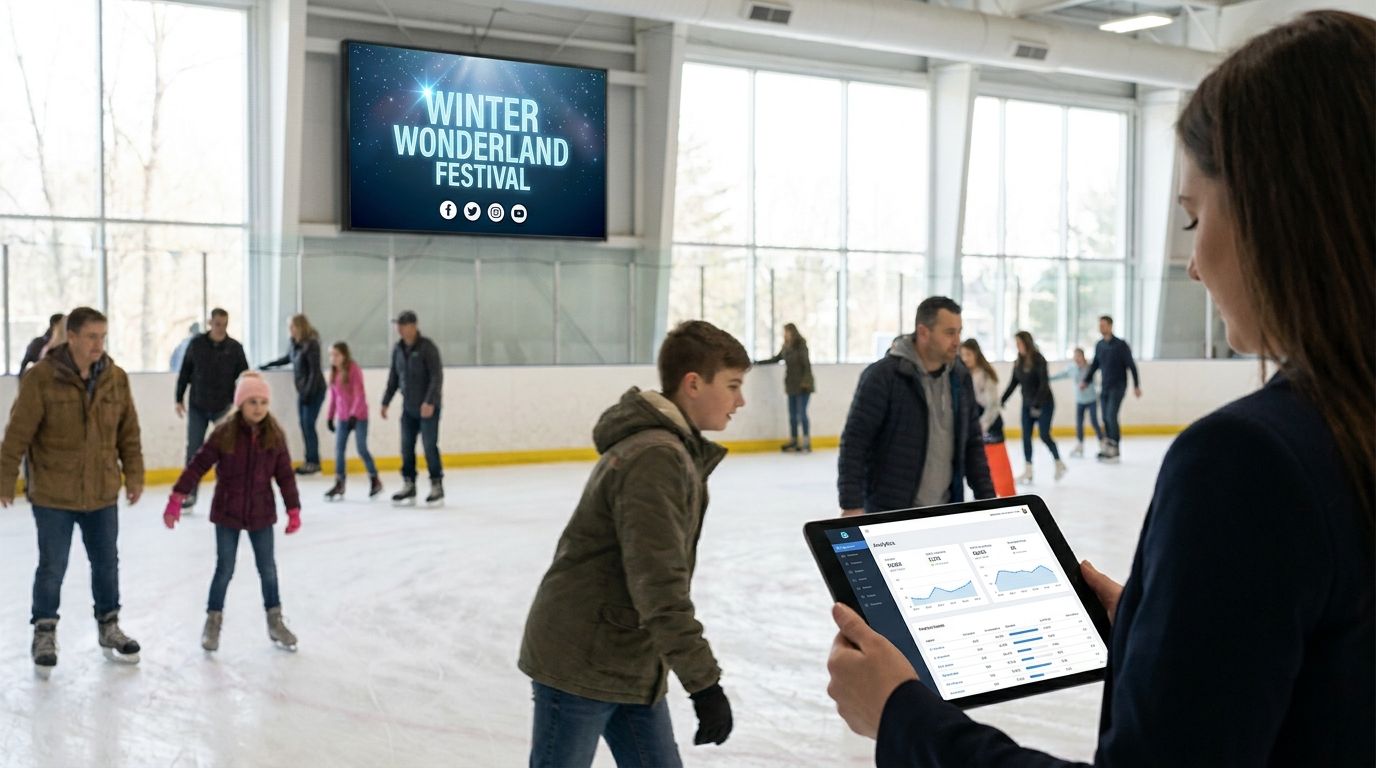
Paid media for ice skating rinks means running Meta, Google Search and TikTok campaigns built around session times, school holidays and local family radius — not a single generic "book now" ad set. Ice rinks sell perishable inventory: an empty 2pm Tuesday public skate slot earns nothing back once the clock hits closing, so the media plan has to chase the gaps a generic attraction campaign ignores.
- Paid media for ice skating rinks works best split by session type — public skate, lessons, parties — never one blanket campaign.
- Meta and Instagram carry public session and birthday-party demand; Google Search catches high-intent "ice skating near me" searches.
- Off-peak weekday slots need their own retargeting push and creative, separate from weekend and school-holiday campaigns.
- Blended CPA hides the real problem at rinks — cost per booking has to be tracked by session type, not as one number.
Why paid media matters for ice skating rinks
An ice rink's biggest cost — refrigeration, ice maintenance, staffing — runs whether the session is full or empty. That fixed-cost structure makes empty capacity the single most expensive thing a rink operator can leave on the table, and it's why paid media for ice skating rinks has to be built around filling specific slots, not just "driving traffic" to a homepage.
Demand at most UK rinks concentrates around three windows: winter and Christmas, school half-terms, and weekends. Everything outside those windows — weekday afternoons, Tuesday evenings — is where margin gets lost, and where a targeted campaign does the most work. FullyBooked builds rink campaigns around this exact pattern: heavy public-session and party ads through peak windows, dedicated off-peak pushes the rest of the time.
The rink operators who treat every week the same in their ad account are the ones subsidising empty ice.
Audit your booking funnel and session calendar before spending a pound
Before any ad goes live, map which sessions actually need demand and which sell themselves. A Saturday 2pm public skate in December rarely needs paid support. A Tuesday 11am slot in February does.
- Pull your session calendar for the next 8-12 weeks and flag low-fill slots
- Check whether public skate, lessons and parties are booked through separate checkout flows or one generic form
- Confirm your booking page loads fast on mobile — most rink traffic from ads arrives on a phone
- Note which sessions have age or skill restrictions that change who you should target
- Identify your highest-margin product (parties, group bookings, season passes) and protect its budget separately
Build audience segments around session type and life stage
A parent booking a Saturday birthday party and a teenager booking a Friday night public skate are different buyers with different triggers. One audience for both wastes spend on the wrong creative.
- Parents within a 5-10 mile radius for public sessions and lessons
- Party planners and parents of 6-12 year-olds for birthday party packages
- Teens and young adults for evening public skate and themed sessions
- School and youth group contacts for weekday group bookings
- Past bookers from your CRM or POS export, layered as a lookalike seed audience
Launch Meta and Instagram ads for public sessions and parties
Meta carries the bulk of rink demand because booking an ice skating session is an impulse-adjacent, visual decision — people book after seeing skaters on ice, not after reading copy. Video of the rink in motion consistently outperforms static graphics for this reason.
- Run separate ad sets for public skate, parties and lessons — never combine them
- Use short vertical video showing the rink full and lively, not an empty stock shot
- Push birthday party ads 4-6 weeks ahead of peak booking windows (Christmas, summer holidays)
- Retarget site visitors who viewed the booking page but didn't complete checkout
- Test radius targeting at 5, 10 and 15 miles to find where cost per booking holds up
Use Google Search ads to catch high-intent local searches
Searches like "ice skating near me" or "[town] ice rink tickets" carry buyers who've already decided to skate — they're comparing rinks, not weighing whether to skate at all. Search ads win these decisions at the point of highest intent.
- Bid on branded terms to protect against competitor conquesting
- Bid on "[town] ice skating" and "ice rink near me" variants
- Use call extensions for parties and group bookings — many parents still prefer to ring and confirm
- Add location extensions so the closest rink shows first in local search
- Exclude irrelevant queries ("ice skates for sale", "how to ice skate") to protect budget
Retarget lapsed skaters and abandoned checkouts
Most rinks lose bookings at the payment step, not the browse step. A retargeting sequence recovers a meaningful share of that drop-off without new acquisition spend.
- Retarget cart abandoners within 24-48 hours with a direct "complete your booking" message
- Retarget past visitors 60-90 days after their last session with a return-visit push
- Segment retargeting by session type so a lapsed lesson customer doesn't see a party ad
- Use dynamic creative showing the exact session or date they browsed
- Cap frequency so retargeting doesn't fatigue into ad blindness
Layer TikTok in for teen and family reach during school holidays
TikTok reach spikes when school holidays hit and teens are actively looking for something to do. It's a discovery channel, not a direct-response one — treat the click as the first touch, not the booking.
- Post rink footage that shows atmosphere: music, lighting, crowd energy
- Run TikTok ads specifically in the two weeks before half-term and Christmas breaks
- Partner with local micro-creators for authentic session clips rather than polished ads
- Route clicks to a landing page, not the homepage, to protect the conversion path
Track cost per booking by session type, not one blended number
A blended CPA across public skate, parties and lessons hides which product is actually profitable. Parties typically carry a much higher average order value than a single public skate ticket, so a "good" blended number can mask a loss-making public session line.
- Set up conversion tracking per session type, not just one "purchase" event
- Compare cost per booking against average order value for each product line separately
- Review off-peak campaign performance weekly — this is where budget waste hides longest
- Cut or pause session-type campaigns that miss target CPA for two consecutive weeks
Fill more off-peak sessions
Get a paid media plan built around your rink's actual session calendar.
Comparison: paid media channels for ice skating rinks
| Channel | Best for | Key limitation |
|---|---|---|
| Meta / Instagram | Public sessions, parties, retargeting | Creative fatigues fast without fresh video |
| Google Search | High-intent local searches, branded defence | Limited reach beyond people already searching |
| TikTok | Teen reach during school holidays | Weak direct-response, needs a strong landing page |
| Google Display / YouTube | Awareness during launch or rebrand | Harder to isolate cost per booking |
Verdict: Meta and Instagram carry the volume, Google Search protects intent, TikTok extends reach in school holiday windows — running all three against separate session-type budgets beats any single-channel plan.
Common mistakes ice skating rinks make with paid media
- One blanket campaign for every session type. A single "book now" ad set blends public skate, lessons and parties into one number and hides which product is actually working.
- Ignoring off-peak slots until they're already empty. Weekday afternoon capacity needs its own retargeting push weeks ahead, not a last-minute discount blast.
- Panic-cutting spend the moment a peak window ends. Christmas and half-term budgets need to taper into shoulder periods, not switch off entirely.
- Reusing the same static rink photo all season. Video showing the rink in motion, lit and full of people, consistently earns more clicks than a stock image of empty ice.
- Not tracking party and group bookings separately from single admissions. Parties carry a different average order value and deserve their own budget line and CPA target.
FAQ
What's the best paid media channel for ice skating rinks?
Meta and Instagram carry the most volume for public sessions and parties because booking is a visual, impulse-adjacent decision. Google Search adds high-intent local demand from people already searching "ice skating near me".
Is TikTok worth it for ice rinks?
TikTok works best as a reach channel during school holidays when teens are actively looking for things to do. It's weaker at direct booking conversion than Meta or Search, so route clicks to a dedicated landing page.
How do ice rinks fill off-peak weekday sessions?
Off-peak slots need a separate campaign and audience from weekend demand, launched weeks ahead rather than as a last-minute push. Retargeting past visitors 60-90 days out also recovers lapsed weekday bookers.
Should ice rinks run one campaign for all session types?
No — public skate, lessons and parties should run as separate ad sets with their own creative and budget. Blending them into one campaign hides which product is actually converting.
How much should an ice rink spend on paid media in 2026?
Budget should scale with the number of low-fill sessions on the calendar rather than a flat monthly figure, with more weight on off-peak weeks than peak weeks that already sell through organic demand.
What creative works best for ice rink ads?
Short vertical video showing the rink full and in motion outperforms static photography, particularly on Meta and TikTok. Fresh footage matters more than polished production value.
Do ice rinks need retargeting ads?
Yes — most bookings are lost at the payment step, not the browse step, so a retargeting sequence for cart abandoners recovers spend that would otherwise be wasted on cold acquisition alone.
How does FullyBooked approach paid media for ice skating rinks?
FullyBooked segments campaigns by session type and season, weighting spend toward off-peak weekday slots where fixed ice costs go unrecovered, rather than running one blanket campaign across the whole calendar.
One last thing
The single biggest lever most ice rinks skip in 2026 isn't a new channel — it's separating party and group booking budgets from public admission budgets. Parties carry a materially higher order value per booking, and folding them into a blended public-skate campaign means the algorithm optimises toward the cheaper, lower-value conversion by default. Split the budget and the higher-value line gets the spend it deserves.


