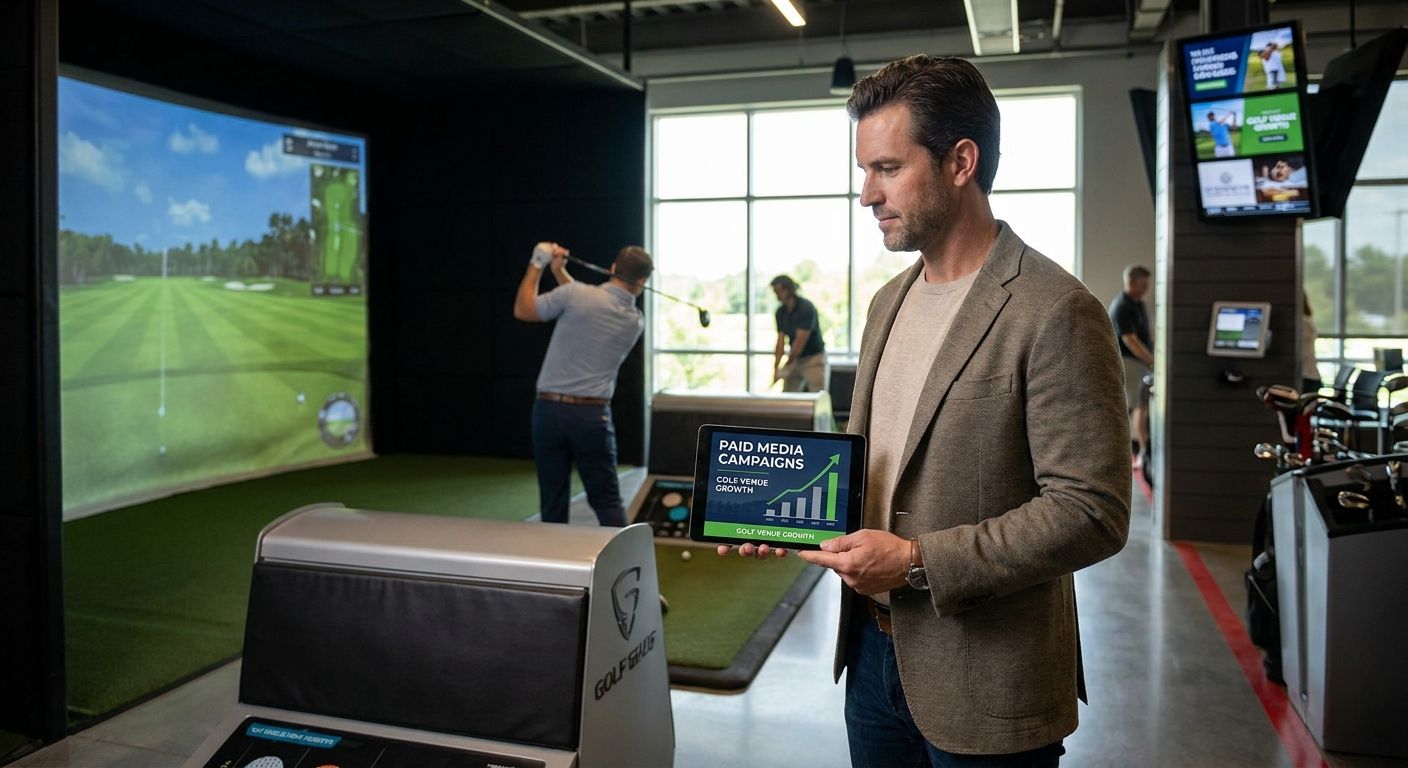
Paid media for golf simulator venues is the use of Meta, Google and TikTok advertising to fill bay slots, capture corporate and group bookings, and convert first-time swingers into repeat members, with the aim of keeping every bay booked across weekday afternoons as well as Friday and Saturday prime time. A golf simulator venue's biggest constraint is fixed capacity — a handful of bays, a finite number of hourly slots — so the paid media job is different from a generic leisure venue: it's about filling a known, countable inventory, not chasing broad footfall.
- Golf simulator venues need booking-funnel campaigns, not brand-awareness ads — Meta and Google should push straight to a bay booking page.
- Corporate and group bookers convert on a completely different funnel to casual walk-ins and need separate targeting and creative.
- Retargeting site visitors who didn't book recovers revenue that broad prospecting campaigns never touch.
- Weekday afternoon slots are the hardest to sell and the most profitable to fix with the right paid media for golf simulator venues.
Why paid media matters for golf simulator venues
A golf simulator venue with six or eight bays doesn't have a demand problem in the abstract — it has a distribution problem. Prime evening and weekend slots sell themselves through word of mouth and repeat visits. Weekday afternoons, off-season months and last-minute cancellations don't, and that's exactly where paid media for golf simulator venues earns its budget in 2026: filling the hours nobody books organically.
The venues struggling most in 2026 are the ones running the same generic "come play golf" ad to everyone. A corporate events manager booking a team afternoon and a 24-year-old booking a Saturday night with mates are not the same buyer, and they don't respond to the same ad, offer or landing page. FullyBooked builds these as separate campaigns because they convert at different rates, on different budgets, with different sales cycles.
How to build a paid media programme for a golf simulator venue
Audit your booking calendar for dead zones
Before any ad spends a pound, pull your booking data and map which hours, days and months are underfilled. This is the single most important step — it tells you exactly what paid media has to fix.
- List every bay-hour for the last 8-12 weeks and mark utilisation as full, partial or empty
- Flag recurring dead patches (Tuesday 2-5pm, first two weeks of January, etc.)
- Separate weekday corporate potential from weekend social demand
- Note cancellation and no-show patterns by day of week
- Check whether off-peak dead zones correlate with local weather, school terms or events nearby
Build campaigns around bay availability, not brand awareness
Meta and Google campaigns for a fixed-capacity venue should push a booking action, not a feel-good video. Every ad needs a clear next step: book this slot, this bay, this week.
- Run Meta conversion campaigns optimised for "complete booking", not "engagement" or "reach"
- Use Google Search campaigns on booking-intent terms like "golf simulator near me" and "book a golf bay"
- Push traffic directly to the booking page, never the homepage
- Test dayparting so weekday-dead-zone ads run Monday to Thursday, not Saturday morning
- Layer in local geo-targeting within a 15-20 minute drive radius rather than a whole city
Target corporate and group organizers separately from casual bookers
Corporate and group bookings carry higher average order value than a single walk-in bay, and they're won on a completely different funnel — enquiry form, quote, follow-up call, not a self-serve checkout.
- Build a dedicated LinkedIn and Meta campaign aimed at office managers and event planners
- Use ad copy that speaks to team socials and client entertaining, not casual play
- Send corporate traffic to an enquiry form, not the standard booking flow
- Follow up every enquiry with a phone call within 24 hours — paid media only gets you the lead
- Test seasonal corporate pushes around Christmas parties and summer team days
A specialist agency like FullyBooked builds this split funnel from day one, running the casual booking campaigns and the corporate enquiry campaigns as two entirely separate budgets with two separate creative sets — because blending them into one campaign quietly drags down performance on both sides.
Retarget site visitors who didn't book
Most people who land on a booking page and leave were interested enough to click — they just didn't finish. That group converts at a materially lower cost than cold prospecting.
- Set up a Meta retargeting audience of everyone who visited the booking page in the last 14 days but didn't book
- Run a Google Display or Search retargeting layer for the same window
- Use urgency-driven creative: "3 bays left this weekend", not generic branding
- Exclude anyone who already booked to avoid wasting spend on converted customers
- Read more on retargeting ads for event ticket sales if your venue also runs ticketed tournament nights
Layer in seasonal and weather-triggered campaigns
Golf simulator demand spikes when outdoor courses close or the weather turns — that's the entire pitch of an indoor bay. Paid media should flex around it.
- Build a standing "rain day" campaign that activates when local forecasts turn wet
- Push winter-months messaging around indoor practice while outdoor courses are shut
- Run short seasonal pushes around January fitness resolutions and post-Christmas boredom
- Time budget increases to match known seasonal demand troughs, not just holidays
Turn first-time visitors into repeat bookers
Acquisition paid media is expensive if every customer only visits once. The venues with the best return in 2026 treat the first visit as the start of a retention funnel, not the end of a sale.
- Capture email and phone at booking, not just at checkout
- Send a post-visit offer within 48 hours to book the next session
- Build a Meta custom audience of past visitors and exclude them from prospecting budgets
- Test a simple loyalty mechanic — punch-card style discounts after a set number of visits — to lift return rate
Track cost per booking, not just cost per click
Click metrics look good on a dashboard and mean nothing if they don't turn into filled bays. The only number that matters is cost per completed booking, split by casual and corporate.
- Set up conversion tracking on the actual "booking confirmed" event, not the enquiry form load
- Report cost per booking weekly, split by campaign type and day-part
- Compare cost per booking against average booking value to confirm profitability, not just volume
- Kill any campaign where cost per booking exceeds average booking value within two weeks of data
Choosing the right approach for golf simulator paid media
| Option | Best for | Key limitation |
|---|---|---|
| In-house DIY ads | Single-site venues testing their first campaigns | Time-intensive; little bandwidth to split casual vs corporate funnels |
| Generalist local marketing agency | Venues wanting basic local visibility | Rarely understands booking-funnel mechanics or bay-capacity economics |
| Specialist experience marketing agency | Multi-bay venues chasing corporate and group volume | Needs access to real booking data to optimise properly |
| Franchise national campaigns | Franchise-backed locations with shared brand budget | Little local flexibility for weekday dead-zone targeting |
Verdict: a specialist experience marketing agency wins on paid media for golf simulator venues with corporate ambitions in 2026; DIY works only as a short-term test before spend scales past a few thousand a month.
Get a paid media plan for your bays
See how FullyBooked fills weekday dead zones and corporate slots.
Common mistakes golf simulator venues make with paid media
- Running one ad set for everyone. Casual bookers and corporate organizers need separate campaigns, creative and landing pages — blending them dilutes both.
- Optimising for clicks instead of completed bookings. A cheap click that never books a bay is worse than an expensive one that does.
- Ignoring weekday afternoons in targeting. Prime-time slots sell themselves; the paid budget belongs on the hours that don't.
- No retargeting layer. Letting interested site visitors leave without a follow-up ad wastes the acquisition spend already paid to get them there.
- Treating every visitor as one-time. Skipping post-visit email or retention offers means paying full acquisition cost for every single booking, forever.
See how the same funnel logic applies at mini golf and adventure golf venues if your simulator site also runs an outdoor course.
FAQ
What's the best paid media channel for golf simulator venues?
Meta conversion campaigns paired with Google Search on booking-intent terms perform best for golf simulator venues in 2026, because both push traffic directly toward a bay booking action rather than passive brand awareness.
How much should a golf simulator venue spend on paid media?
Spend should scale to the number of dead-zone bay-hours a venue needs to fill, not a fixed percentage of revenue. Track cost per booking against average booking value before increasing budget.
Is TikTok worth using for a golf simulator venue?
TikTok works well for casual and social bookings, especially group nights out, but converts poorly for corporate enquiries — keep corporate targeting on LinkedIn and Meta instead.
Should golf simulator venues run separate campaigns for corporate bookings?
Yes. Corporate and group organizers convert through an enquiry-and-quote process, not a self-serve checkout, and mixing them into casual booking campaigns lowers performance on both.
How do you fill weekday afternoon slots at a golf simulator venue?
Run dedicated dayparted campaigns Monday to Thursday with urgency-driven offers, and target local corporate audiences who can book daytime team sessions.
Does retargeting work for golf simulator bookings?
Retargeting site visitors who didn't complete a booking converts at a lower cost than cold prospecting because that audience already showed intent.
What's the biggest paid media mistake golf simulator venues make?
Running one generic ad campaign for both casual and corporate audiences, which dilutes messaging and conversion rate for both groups.
Can a specialist agency improve paid media results for golf simulator venues?
A specialist experience marketing agency builds separate casual and corporate funnels, tracks cost per completed booking rather than clicks, and layers in retention campaigns most in-house teams skip.
One last thing
The venues getting the most out of paid media for golf simulator venues in 2026 aren't spending more — they're spending on the right hours. A campaign built purely to fill Tuesday and Wednesday afternoons will often show a lower cost per booking than a weekend campaign, simply because there's less competition for that ad inventory. Check your dead-zone data before you check your ad spend.