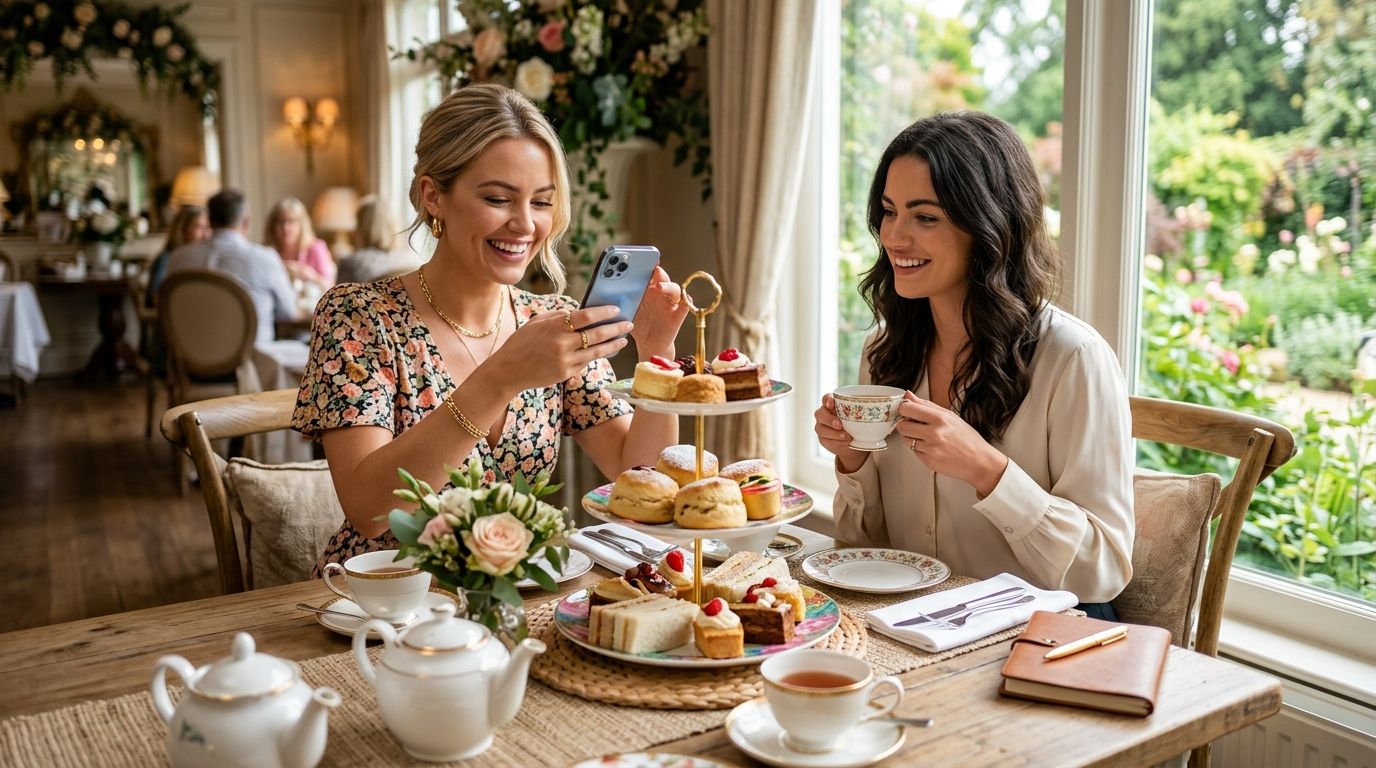
Influencer marketing for afternoon tea experiences means paying or gifting creators to post about a specific tea sitting, tiered stand, or seasonal menu with the aim of filling weekday covers that would otherwise sit empty. Afternoon tea sells on visuals and scarcity — a three-tier stand photographs better than almost any other food category, but bookings cluster around weekends unless a campaign actively pushes Tuesday-to-Thursday slots. That's the gap this guide fixes.
- Influencer marketing for afternoon tea works best when it targets off-peak weekday sittings, not Saturday covers that already sell themselves.
- Micro-influencers in the 1,000-15,000 follower range convert better than celebrity-tier creators because their audience actually books local venues.
- FullyBooked runs influencer programmes for experience operators and has generated 85M+ in tracked revenue across 50+ managed venues.
- Track influencer-driven bookings with a unique promo code or booking link — without it you are guessing at ROI.
- Content built around the guest journey (arrival, stand reveal, pour) outperforms single food shots.
Why influencer marketing matters for afternoon tea venues
Afternoon tea is a visually-led, occasion-led purchase. Guests book it for birthdays, hen dos, mother-daughter days out and bridal showers — occasions people research on Instagram and TikTok before they open a booking site. A creator's post showing the stand, the setting and the pour does more to move a fence-sitting booker than a paid ad showing the same thing, because it reads as a recommendation rather than a sales message.
The segment also has a structural problem paid search doesn't solve well: weekday capacity. Most afternoon tea venues run near-full on Saturdays and quiet on Tuesdays and Wednesdays. Influencer content pointed specifically at midweek treat occasions shifts demand into the slots that need it, which is a different job than a generic brand awareness push.
FullyBooked builds influencer programmes for experience operators around this kind of demand-shaping in 2026, not just follower reach.
Define the guest you're trying to reach
Afternoon tea has at least three distinct booking occasions, and each needs a different creator profile.
- Celebration bookers (birthdays, anniversaries) respond to lifestyle and food creators with a warm, aspirational aesthetic
- Group bookers (hen dos, girls' days) respond to creators who post with friends, not solo content
- Family bookers (grandparent visits, Mother's Day) respond to parenting and family-lifestyle accounts
- Corporate and gifting bookers respond less to influencers and more to PR — don't force this segment into an influencer brief
Map your quiet slots against these occasions before you approach a single creator. A venue struggling with Tuesday lunch covers needs family and retiree-adjacent creators, not 20-something lifestyle accounts posting at 8pm.
Audit your afternoon tea offer for content potential
Before any outreach, look at your own product through a creator's lens. Not every stand is Instagrammable, and that's fixable cheaply.
- Check whether the stand reveal moment (lid off, tiers visible) happens at the table or in the kitchen — it should happen at the table
- Confirm lighting at your best tables during the 12pm-3pm sitting window creators actually book
- List any seasonal or limited-run menus (Christmas, Mother's Day, Wimbledon) — these give creators a timely hook rather than a generic post
- Note anything visually distinctive: a signature pastry, a themed teapot, a view. Creators need one strong image, not ten average ones
Build a micro-influencer seeding programme
Start with the free, manual version before paying for reach: identify 15-20 local micro-influencers (1,000-15,000 followers, in your specific city) and invite them to a complimentary sitting in exchange for a post and story.
- Filter for engagement rate over follow count — a 4,000-follower account with 8% engagement outperforms a 40,000-follower account with 1%
- Prioritise creators who've already posted about tea, brunch or dessert venues in your city
- Set a clear ask upfront: one feed post, one story sequence, tagged and geotagged, within 14 days of the visit
- Avoid gifting to accounts under 1,000 followers with no engagement history — the content rarely gets seen and rarely converts
Once the manual programme is running, the faster path is a managed seeding pipeline that sources, vets and briefs creators at volume instead of one-by-one outreach. This is where a specialist influencer marketing agency for UK attraction operators earns its fee — sourcing 15-20 creators every month is a part-time job most venues don't have spare hours for in 2026.
Brief influencers on the guest journey, not just the food
The single biggest mistake in afternoon tea influencer content is briefing for a food photo when the booking decision is about the whole experience.
- Ask for arrival and setting shots, not just the stand
- Request one clip of the stand reveal moment specifically — the highest-performing content type in the category
- Give creators the actual booking link or a trackable code, not just a tag
- Specify the sitting time to shoot: natural-light sittings between 12pm and 2pm photograph better than evening slots
- Ask for a caption line naming the specific day or slot you want to fill, not a generic sign-off
Turn user-generated content into paid social assets
Organic reach from a single influencer post is temporary. The content itself has a longer life as paid social creative, which is where most operators leave value on the table.
- Get usage rights written into every brief, even for gifted (unpaid) collaborations
- Repurpose the best-performing organic post as a Meta or TikTok ad targeting your catchment area
- Test UGC-style ads against studio photography on cost per booking, not on engagement
- Rotate creative every 3-4 weeks; afternoon tea ad fatigue sets in fast because the visual format is narrow
Track bookings back to influencer activity
Without attribution, influencer marketing for afternoon tea is a vanity exercise. Set this up before the first post goes live, not after.
- Issue a unique discount or bonus code per creator, even a small one, purely for tracking
- Use a dedicated landing page or booking link parameter per campaign wave
- Log bookings against the code in your reservation system weekly, not monthly
- Compare cost per booking (gifted meal value plus any fee) against your average spend per cover
“If a creator's post can't be tied to a booking within two weeks, you're paying for reach you can't measure.”
Build a retention loop after the visit
An influencer campaign fills a seat once. What happens after the visit decides whether that guest rebooks for the next seasonal menu.
- Capture email addresses at the table or on the booking confirmation, not as an afterthought
- Follow up within 48 hours with a request for a review or a repost of their own photo
- Add first-time guests to a seasonal reminder sequence — Christmas, Mother's Day and birthday-month prompts convert well here
- For the mechanics, see how to build an email list for a ticketed venue
Comparison: influencer approaches for afternoon tea venues
| Approach | Best for | Key limitation |
|---|---|---|
| Manual micro-influencer gifting | Single-site venues testing the channel | Time-intensive sourcing and vetting per creator |
| Paid macro-influencer posts | One-off launches or seasonal menu pushes | High cost per post, weaker conversion than micro-tier |
| TikTok-first creator briefs | Reaching younger celebration bookers | Content ages fast, needs constant refresh |
| Managed influencer seeding programme | Multi-site or growth-stage operators | Requires a monthly retainer commitment |
| In-house UGC from staff and regulars | Budget-constrained single venues | Inconsistent output, no reach guarantee |
Fill your quiet afternoon tea slots
Talk to FullyBooked about an influencer programme built around your booking calendar.
Common mistakes afternoon tea venues make with influencer marketing
- Chasing follower count over engagement — a celebrity-tier creator's audience rarely books a specific local venue; a local micro-influencer's audience often does
- Gifting without a booking window ask — posts that don't name a specific day or slot fill whatever's already popular, not what's quiet
- No usage rights in the brief — losing the ability to reuse strong UGC as paid creative wastes the most valuable output of the collaboration
- Treating every sitting the same — weekend sittings don't need the push in 2026; weekday sittings do, and briefs should say so explicitly
- No attribution code or tracked link — without this, you can't tell whether the campaign paid for itself
FAQ
Is influencer marketing worth it for a single-site afternoon tea venue?
Yes, when it targets specific quiet sittings rather than general brand awareness. A single-site venue running a focused micro-influencer seeding programme can shift weekday covers without the ad spend a paid campaign needs.
How many influencers should an afternoon tea venue work with per month?
15-20 micro-influencers per month is a workable starting volume for a single venue testing the channel. Multi-site operators typically need a managed pipeline to sustain that volume.
Do afternoon tea venues need to pay influencers or can they gift the experience?
Gifted experiences work well at the micro tier of 1,000-15,000 followers in exchange for a post and story. Larger creators typically expect a fee on top of the gifted sitting.
What content performs best for afternoon tea on Instagram and TikTok?
The stand reveal moment, lid off and tiers visible at the table, consistently outperforms single food close-ups. Content shot in the natural-light 12pm-2pm window also photographs better than evening slots.
How do you measure ROI on afternoon tea influencer marketing?
Issue a unique discount code or tracked booking link per creator and log redemptions weekly against the gifted meal value or fee paid. Without this step ROI can only be guessed at.
Should afternoon tea venues target macro-influencers for a launch?
Macro-influencers suit one-off launches or a new seasonal menu where reach matters more than conversion. For ongoing weekday bookings, micro-influencers with local engaged audiences convert at a better cost per booking.
Can influencer content be reused as paid social ads?
Yes, provided usage rights are agreed in the brief before the collaboration, even for gifted posts. UGC-style creative from real visits typically outperforms studio photography as paid ad creative in this category.
One last thing
The stand reveal — lid off, tiers visible, shot at the table rather than the kitchen pass — is the single highest-converting content moment in this category, and most venues brief creators straight past it to the food close-up. Fix the brief before you fix the follower count. That one change costs nothing and is the fastest win available to an afternoon tea operator in 2026.


