Theme park marketing lives or dies on one thing: getting a stranger to picture themselves on the ride before they've bought the ticket. Influencer marketing for theme parks is the fastest way to do that in 2026, but only when the creator mix, content format and tracking are built for a venue business, not a product launch.
- Nano and micro creators outperform celebrity talent for theme park ticket sales in 2026 because local trust converts faster than reach.
- POV thrill content is the highest-engagement format for theme parks — pair it with paid amplification, don't rely on organic alone.
- One-off influencer posts without a retention loop waste 60-80% of the visit's lifetime value. Buy the follow-up, not just the launch post.
- Fully Booked has generated £85M+ in ticket revenue across 50+ experience operators using this exact playbook.
Why this matters
A theme park doesn't sell a product once — it sells the same day out to thousands of different households every season, and each one needs a different reason to book. Influencer content does the job a static ad can't: it shows the ride, the queue, the food, the meltdown-free family day, from someone the viewer already half-trusts.
Agencies running paid media and influencer campaigns for experience operators — Fully Booked included — have moved £85M+ in ticket revenue across 50+ venues by treating creator content as a sales channel, not a brand awareness exercise. That distinction changes every decision below.
Who this is for
This is for marketing leads and operators at theme parks, water parks and family attraction venues who already run paid social but haven't systemized creator content — parks with seasonal peaks (half-term, summer, Halloween events, Christmas lights) that need a content pipeline that refreshes every few weeks, not a one-off campaign that goes stale by June.
What to look for in influencer marketing for theme parks
Local and regional reach over raw follower count
A creator with 8,000 followers in a 40-mile drive radius of your park will move more tickets than a national creator with 400,000 followers scattered across the country. Theme parks are a drive-to purchase, so geography beats vanity metrics every time.
Format built for the ride, not the feed
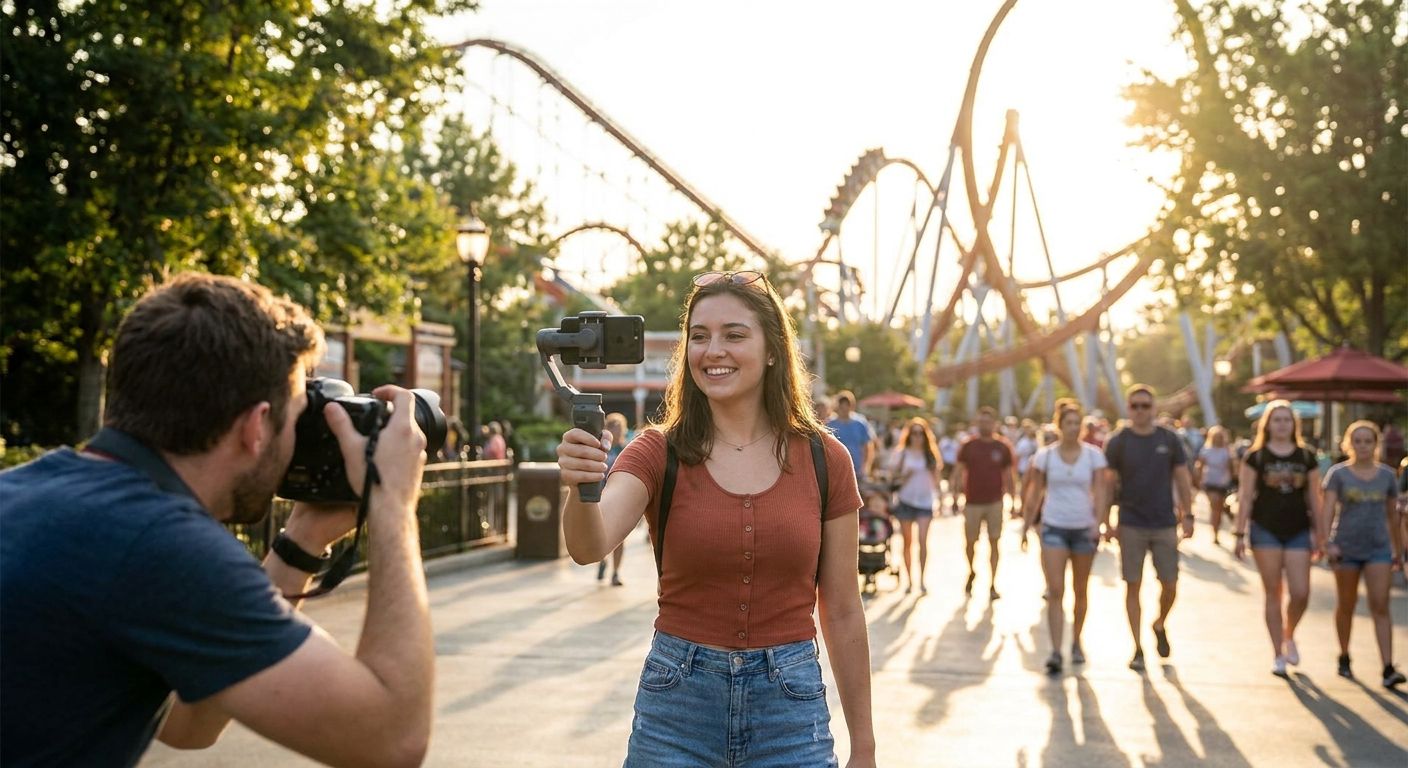
POV coaster footage, first-drop reaction clips and queue-time content consistently pull higher watch-through than staged lifestyle shots. If a creator's portfolio is all posed photos and no motion content, they're the wrong fit for a ride-led attraction.
Seasonal cadence, not a single campaign burst
Theme parks have 3-5 distinct commercial windows a year — half-term, summer, Halloween, Christmas, and often a spring reopening. Creator content needs a brief and a booking rhythm for each window, not one shoot in May that has to carry the whole year.
Ticket-linked tracking baked in from brief one
If you can't attribute bookings to a specific creator or post, you're running awareness spend and calling it performance. Unique promo codes, UTM-tagged links and platform-level attribution should be non-negotiable in the brief, not an afterthought added after the content goes live.
Paid amplification layered on top of organic
Organic reach on TikTok and Instagram fluctuates campaign to campaign. Parks pairing creator content with paid boosting — the same approach used in paid media for immersive experiences — see content outlast the algorithm's mood swings.
Compliance and safety sign-off
Ride footage, queue footage and any content involving other guests needs a sign-off process before it's briefed, not after a creator posts something that trips a safety or privacy issue. ASA disclosure rules for paid or gifted content apply in the UK regardless of creator size — #ad or #gifted has to be visible, not buried in a caption.
Top picks: creator types for theme park campaigns
The safe pick: local family micro-creators (10K-50K followers)
These creators post real family days out — queue waits included — and their audience is already local, already has kids the right age, and already trusts recommendations from someone who isn't a paid celebrity. Expect a content turnaround of days, not weeks, since they're used to posting the same day they visit. Verdict: Buy.
The volume play: nano-creators (1K-10K followers) in bulk
One nano-creator moves a handful of tickets. Twenty of them, briefed the same week for a half-term push, move a lot more collectively — and they're cheaper per post than a single mid-tier creator. The trade-off is briefing overhead: twenty relationships take more management time than one. Verdict: Consider, if you have the internal bandwidth or an agency running the briefing.
The wildcard: POV thrill creators
Coaster-POV and first-drop reaction content is the highest-engagement format theme parks have access to, and it travels well beyond the local radius because thrill content is inherently shareable. It's not a ticket-driver on its own — it's a top-of-funnel play that needs retargeting behind it. Verdict: Consider as a supporting layer, not the whole campaign. Parks running similar high-adrenaline formats, like the ones behind influencer marketing for trampoline parks, lean on this exact combination of thrill content plus paid retargeting.
The skip: celebrity or mega-influencer one-off posts
A single post from a creator with a million-plus followers looks impressive in a screenshot but rarely ties to a measurable ticket lift, and the cost per booking is almost always worse than five well-briefed local creators. Verdict: Skip, unless the post is part of a wider paid partnership with tracked links and a real content series, not a single sponsored story.
The steady earner: seasonal event specialists
Creators who build a following specifically around Halloween scare events, Christmas lights or Easter trails bring an audience that's already primed to book seasonal experiences, and they tend to post multiple times across the run-up rather than a single launch clip. Verdict: Buy for any park running a distinct seasonal event on top of standard admission.
Get an influencer plan for your park
Fully Booked has run creator and paid media campaigns across 50+ experience operators.
What to avoid
- Follower-count-first briefs. A creator brief that leads with "minimum 50K followers" filters out exactly the local micro-creators who convert best for a drive-to attraction.
- One-and-done content deals. A single post with no retention follow-up — no email capture, no retargeting audience built from video viewers — throws away most of the campaign's value. This is the same mistake covered in retention marketing for escape rooms: the first booking is cheap to get and expensive to waste.
- Unbriefed ride footage. Letting a creator film whatever they want on-site without a safety and content checklist is how parks end up with off-brand footage or a compliance headache after the fact.
Verdict comparison
| Creator type | Best for | Content format | 2026 verdict |
|---|---|---|---|
| Local family micro (10K-50K) | Everyday visits, half-term | Family day vlogs, queue content | Buy |
| Nano-creators (1K-10K), bulk | Seasonal ticket volume | Short-form clips, Stories | Consider |
| POV thrill creators | Top-of-funnel reach | Coaster POV, reaction clips | Consider |
| Celebrity / mega-influencer one-off | Rarely worth it | Single sponsored post | Skip |
| Seasonal event specialists | Halloween, Christmas events | Multi-post series | Buy |
FAQ
What's the best influencer type for theme park marketing in 2026?
Local family micro-creators with 10,000-50,000 followers within driving distance of the park convert best in 2026 because their audience already matches the visitor profile. POV thrill creators add reach but need paid retargeting behind them to convert.
How much does influencer marketing cost for a theme park?
Costs vary widely by creator tier, from gifted tickets for nano-creators up to negotiated fees for established local names. An agency running campaigns across multiple operators can benchmark rates against current market activity rather than guessing.
Is influencer marketing better than paid ads for theme parks?
Neither replaces the other — influencer content builds trust and supplies creative for paid amplification, while paid media controls reach and timing. The strongest theme park campaigns in 2026 run both together rather than choosing one.
How do you track ticket sales from influencer content?
Unique promo codes and UTM-tagged booking links tied to each creator are the standard method, checked against platform-level view and click data. Without this in the brief, attribution is guesswork.
Should theme parks use nano or macro influencers?
Nano and micro creators generally outperform macro and celebrity talent on cost-per-booking for theme parks because their audience is more local and more trusted. Macro creators can still help for pure reach campaigns tied to a big seasonal launch.
How many influencers should a theme park work with per season?
There's no fixed number, but a mix of a handful of local micro-creators plus one or two specialist thrill or seasonal-event creators covers most half-term and summer pushes. Scale up around Halloween and Christmas events specifically.
Do theme park influencers need to disclose paid or gifted content?
Yes — UK ASA rules require clear disclosure such as #ad or #gifted on any content involving payment, free tickets or products. This applies regardless of the creator's follower count.
Can influencer marketing work alongside a retention strategy?
Yes, and it should — influencer content is most valuable as the top of a funnel that feeds into email capture, retargeting and repeat-visit offers. Treating it as a one-off post wastes most of the visitor's lifetime value.
One last thing
The park that wins isn't the one with the biggest creator name attached — it's the one that turns every creator post into a retargeting audience. A ten-second POV clip with 40,000 organic views is worth far more once it's fuelling a paid lookalike campaign than it ever was sitting on a feed.