
Six platforms handle experience-venue bookings well in 2026, and none of them do everything. Best overall for timed-capacity venues: FareHarbor, built for tour and activity operators juggling multiple daily sessions. Best for hospitality-led experiences: DesignMyNight, built for bars, immersive dining and late-night ticketed nights. Best for one-off ticketed events: Eventbrite, built for marketplace reach rather than repeat-visit retention. Best budget-conscious pick: Ticket Tailor, a flat-fee, self-serve setup with no sales call required.
- FareHarbor wins for timed-capacity tours and activities managing multiple sessions a day.
- DesignMyNight is the strongest fit for hospitality-led experience venues in the UK market.
- Eventbrite still leads on marketplace discovery for one-off ticketed events, not repeat bookings.
- Ticket Tailor suits independent operators who want a flat-fee setup without an integration project.
- None of these platforms replace a retention layer — the best ticketing platforms for experience venues still need a CRM sitting behind them.
Why this matters
The ticketing platform you pick in 2026 decides what data reaches your marketing stack, not just how tickets get sold. Pick wrong and you're stuck exporting spreadsheets to run a retargeting campaign; pick right and every booking feeds straight into attribution, CRM tools for ticketed venue operators, and lifecycle email.
FullyBooked works across 50+ experience operators — escape rooms, immersive dining, adventure golf, comedy clubs — and the platform underneath rarely determines whether a venue sells out. What it does determine is whether that sell-out turns into a repeat booking six weeks later.
That's the lens for this ranking: not which platform has the slickest checkout, but which one gives an operator the data and integrations to run paid media, retention campaigns and dynamic pricing without fighting the export button.
What makes the best ticketing platform for experience venues
- Time-slotted capacity management — sessions, not seat maps, with real-time inventory across a day
- Checkout add-ons and upsells — merchandise, photos, group extras added at point of purchase
- Native CRM and email/SMS integration — booking data flows out without a manual export
- Transparent, predictable fee structure — margin protection on lower-priced tickets (£15-£40 is typical for attractions)
- Waitlist and sold-out slot handling — automatic release when a booking cancels
- UTM and ad-platform attribution — booking events pass back to Google Ads and Meta cleanly
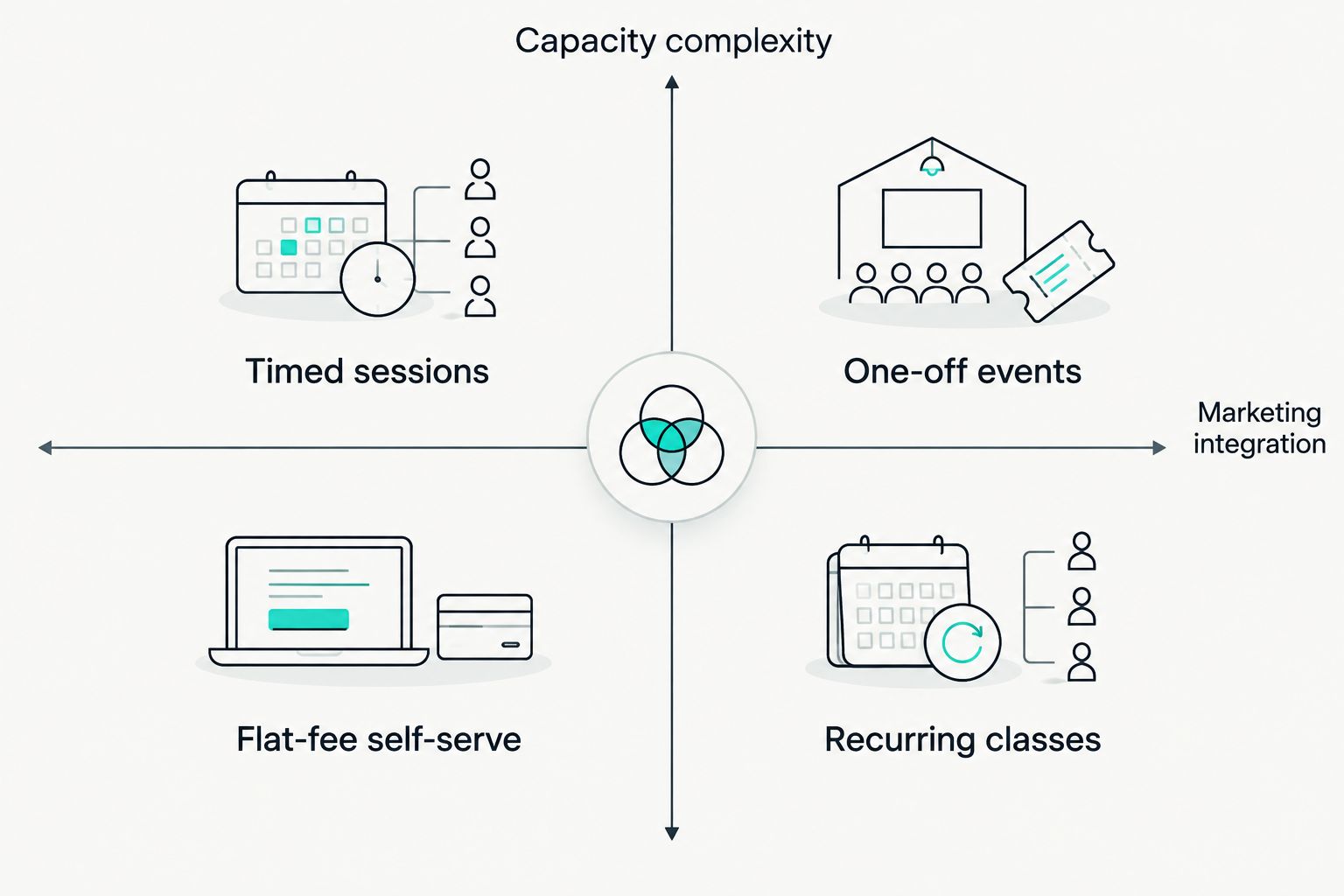
At a glance: ticketing platforms for experience venues in 2026
| Platform | Best for | Standout feature | Key limitation |
|---|---|---|---|
| FareHarbor | Timed tours and activities | Multi-session capacity and waiver capture at checkout | Setup leans heavily on FareHarbor's team, less self-serve |
| DesignMyNight | Hospitality-led experience venues | Table and event booking built for bars and late-night spaces | Less suited to single-day pop-up ticketing |
| Eventbrite | One-off ticketed events | Marketplace discovery and broad public reach | Data capture skews toward event discovery, not repeat visitors |
| Ticket Tailor | Independent, budget-conscious operators | Flat-fee, no-integration-project setup | Fewer native CRM and retention integrations out of the box |
| Rezdy | Multi-channel activity distribution | Reseller and OTA network built in | Own-brand checkout feels secondary to the distribution layer |
| Bookwhen | Classes and recurring sessions | Recurring schedule and roster management | Weak fit for single large-capacity events |
1. FareHarbor: best ticketing platform for timed-capacity tours and activities
FareHarbor handles multi-session days — karting tracks, escape rooms, guided tours — where capacity resets every 30 or 60 minutes. It's built around waiver capture and add-on sales at the point of checkout, which matters for anything with a safety briefing attached.
FareHarbor pros:
- Strong handling of repeating time slots across a single day
- Waiver and liability capture built into the booking flow
- Established distribution links into OTA networks like Viator and TripAdvisor
FareHarbor cons:
- Onboarding runs through FareHarbor's own team rather than pure self-serve
- Branding customisation is more limited than a fully white-labelled checkout
Best for: activity and tour operators running multiple sessions a day. Verdict: Buy.
2. DesignMyNight: best ticketing platform for hospitality-led experience venues
DesignMyNight is built for the UK hospitality market — bars, immersive dining nights, late-night ticketed events — where the booking sits alongside a table reservation, not instead of one. It captures guest data at booking stage, which feeds directly into venue marketing.
DesignMyNight pros:
- Purpose-built for hospitality and late-night venue formats
- Table and event booking sit in one system rather than two
- Guest data capture designed with UK venue marketing in mind
DesignMyNight cons:
- Less relevant for pure activity or attraction operators with no F&B element
- Reporting depth varies depending on which module a venue runs
Best for: bars, immersive dining and late-night ticketed venues. Verdict: Buy.
3. Eventbrite: best ticketing platform for one-off ticketed events
Eventbrite still owns marketplace discovery for single events — a comedy night, a pop-up, a one-time festival date. Its strength is reach: people browsing Eventbrite find events they weren't already searching for.
Eventbrite pros:
- Broad public marketplace with organic discovery built in
- Fast setup for a single event with no ongoing venue calendar
- Familiar checkout that most ticket buyers already trust
Eventbrite cons:
- Fee structure erodes margin faster on lower-priced tickets
- Data capture leans toward event discovery, not long-term retention
- Weaker fit for venues running the same experience every week
Best for: one-off ticketed events and pop-ups. Verdict: Hold — fine for a single date, weaker for a recurring calendar.
4. Ticket Tailor: best ticketing platform for budget-conscious independent operators
Ticket Tailor markets itself on a flat-fee model rather than a percentage cut, and the self-serve setup means an operator can be live within a day with no sales conversation. It suits smaller venues running their own marketing rather than leaning on the platform's built-in tools.
Ticket Tailor pros:
- Self-serve setup with no onboarding call required
- Flat-fee structure appeals to operators selling higher volumes of lower-priced tickets
- Reasonably flexible checkout branding
Ticket Tailor cons:
- Fewer native integrations into CRM and retention tools than the bigger platforms
- Less useful when a venue needs OTA distribution built in
Best for: independent operators who want control without a build project. Verdict: Buy for lean setups.
5. Rezdy: best ticketing platform for multi-channel activity distribution
Rezdy is built around distribution — pushing activity inventory out through resellers and OTAs rather than relying only on direct bookings. That makes it useful for operators who sell through partner channels as well as their own site.
Rezdy pros:
- Reseller and OTA distribution network is a native feature, not an add-on
- Handles complex activity inventory across multiple channels
Rezdy cons:
- Own-brand checkout can feel like a secondary priority to the distribution tooling
- Steeper setup than a pure direct-booking platform
Best for: activity operators selling through resellers as well as direct. Verdict: Hold — strong for distribution, less essential for direct-only venues.
6. Bookwhen: best ticketing platform for classes and recurring sessions
Bookwhen is built for recurring schedules — workshops, classes, weekly sessions — rather than one large-capacity event. Its roster and repeat-attendee handling suits studios and workshop operators more than attraction-style venues.
Bookwhen pros:
- Recurring schedule management is genuinely purpose-built
- Simple roster view for instructors and hosts
Bookwhen cons:
- Weak fit for a single large-capacity event or festival date
- Marketing integrations are lighter than the bigger platforms
Best for: workshop studios and class-based operators. Verdict: Buy for recurring-session formats.
How we ranked these
Each platform is scored against the six criteria above — capacity handling, checkout upsells, CRM integration, fee transparency, waitlist logic and ad-platform attribution — based on the feature sets and integrations each provider publishes. None of this ranking is about which platform looks best in a demo; it's about which one keeps feeding a marketing engine after the sale closes.
“The ticketing platform decides how a booking is captured. It never decides whether that customer comes back.”
Turn platform data into repeat bookings
See how FullyBooked connects ticketing data to paid media and retention campaigns.
Which ticketing platform should you choose in 2026?
If you're running timed sessions across a day, FareHarbor is the safest default. If your venue is hospitality-led — a bar, an immersive dining night, a late-night ticketed format — DesignMyNight fits the UK market better than a generic events platform. Running one-off dates only, or a workshop calendar rather than a single big event? Eventbrite and Bookwhen sit at opposite ends of that spectrum.
Whichever platform wins the shortlist, the bigger lever in 2026 is what happens after the booking confirms. A venue with the wrong platform but a sharp retention and paid media strategy will outsell a venue with the perfect platform and no follow-up. That's the gap most operators leave on the table — worth reading how to sell more tickets for your venue or event once the platform decision is made.
FAQ
What is the best ticketing platform for experience venues in 2026?
FareHarbor is the strongest overall pick for experience venues running timed-capacity sessions in 2026, with DesignMyNight leading for hospitality-led formats like bars and immersive dining.
Is Eventbrite good for experience venues?
Eventbrite works well for one-off ticketed events and pop-ups thanks to its marketplace discovery, but it's a weaker fit for venues running the same experience every week.
Which ticketing platform has the lowest fees for small venues?
Ticket Tailor markets a flat-fee model rather than a percentage cut, which tends to suit operators selling higher volumes of lower-priced tickets. Check current fee terms directly with each provider before switching.
Do ticketing platforms integrate with CRM and email marketing tools?
Integration depth varies by platform. FareHarbor and DesignMyNight offer stronger native data capture than Ticket Tailor or Bookwhen, which matters if retention marketing runs off booking data.
What ticketing platform is best for recurring classes and workshops?
Bookwhen is built specifically for recurring schedules and roster management, making it a better fit for workshop studios than for single large-capacity events.
Can a ticketing platform alone increase bookings for a venue?
No. The platform captures and processes bookings; it doesn't drive demand. Paid media, retention campaigns and dynamic pricing sit outside the platform and determine whether slots actually fill.
Should a multi-site operator use one ticketing platform across all venues?
Standardising on one platform in 2026 usually simplifies reporting and marketing attribution across sites, but the platform still needs to match each site's booking structure — timed sessions versus recurring classes versus one-off events.
One last thing
The platform comparison matters less than most operators think — the venues seeing the biggest year-on-year growth in 2026 aren't the ones with the fanciest checkout, they're the ones treating every booking as the start of a retention sequence, not the end of a sale.


